Showing posts with label beasties. Show all posts

Tuesday, March 13, 2018

Monday Musical Offering, Spring edition

OK, a day late...

Kidding and lambing has started here at the farm, both scheduled and otherwise.  We have a kidding parlor, which took months of work (almost all by Duva's brother & his family), and which was actually ready within hours of the first kids being born.  The other five does scheduled for this weekend waited to pop until their appointed times.  It went fairly well--relatively little assistance was needed by the does, and of the 13 kids, only one didn't make it (which sucks, but it happens--their on-board systems just don't fire up, they lose body heat, which shuts down appetite, and so on.  We have saved some like this, with warm baths, tube feeding, vitamin shots, and so on, and we did all that and more for this little kid, but nobody bats 100% on these cases).  The score so far:

Boadicea--buck and doe
Opera--three bucks
Mocha--two does, one died
Zephyr--single buck
Karuna--single doe
Cavatina--two bucks, two does

The weather for the entire show was grand and glorious and springy.  The fact that the kidding parlor worked so well and that the deliveries were mostly textbook made me feel better.  This was the music running through my head--the first movement of Rachmaninov's symphony/cantata The Bells, based on a translation of Poe's poem.

(Performance by Kiril Kondrashin, Moscow Symphony Orchestra, RSFR chorus, soloists.  Meh sound quality but the performance is like burning magnesium.)
         Hear the sledges with the bells--
             Silver bells!
What a world of merriment their melody foretells!
       How they tinkle, tinkle, tinkle,
           In the icy air of night!
       While the stars that oversprinkle
       All the heavens, seem to twinkle
           With a crystalline delight;
         Keeping time, time, time,
         In a sort of Runic rhyme,
To the tintinnabulation that so musically wells
    From the bells, bells, bells, bells,
               Bells, bells, bells--
  From the jingling and the tinkling of the bells.

Tuesday, March 6, 2018

Minimum day, the calm before the storm

The day before yesterday was one of the hinges of the year, where we turn from one segment of the farm calendar to another.  In the morning, I went up to the barn.  I gave the elderly sheep a scoop of senior equine feed.  To the does, I gave a feeder-full of orchard grass hay.  For the ewes, I only had to fluff up the orchard grass that was in their feeder, for they hadn't cleaned it up, and as soon as I opened the door they bolted out into the pasture.  I walked over to the bucks, filled up their feeder with orchard grass, and fluffed up the rams' feeder.  I then walked over to the junior bucks, topped off their feeder with orchard grass, walked over to the junior does and did the same for them, and I was done.

That was the morning feed.  The junior does and bucks had been getting supplementary grain and a little alfalfa, but they had outgrown their need for it.  The senior bucks are coming out of rut, and no longer need extra calories from grain.  The sheep are working the pastures down to nubbins before I spread seed, and are less interested in hay than they are in fresh grass.  Those animals had just finished tapering off their feed requirements.  Today, some of the animals are starting their increase--the first does are expected to kid in a week or less, so now they are getting a generous serving of alfalfa.  Things will get more complicated as we have kids to bottle feed, milking does to nourish,  and possibly a ewe or two with lambs--and that's not to mention the routine of milking.  But, for a couple of days there, feeding everybody, including the chooks, the cats, and the dog, took only twenty minutes.

Thursday, December 14, 2017

Monday, January 16, 2017

Monday Musical Offering Alla Breve

Not so much about music as the uses thereof; when I started milking the goats, a couple of years ago now, I thought it would be nice to have some music playing.  I started an album, and by the time I had dealt with an inefficient barn set up, a bunch of naive and recalcitrant first-fresheners (and my own inexperience with milking), a not-very-ergonomic milking set-up, and a kludgy cleaning system, I had played two full CD's worth of music and started on a third.  Today, I started a CD, fed all the animals in the barn, milked a dozen goats, cleaned the milking equipment and swept the barn, hanging up the last thing to dry as the last track ended.

So, progress is possible.  I will have to remember this in a couple of months, when I have over 24 goats to milk, and about half of them will be first fresheners.

CD was Bach, transcriptions for piano by Russian composers, played by Hamish Milne.

Tuesday, November 1, 2016

Tuesday Tool Bioassay Edition

This Tuesday's tool is the voltage tester.  It's a little doohickey with a probe that you stick in the ground, connected by a wire to a little box with a metal hook that you hang onto an electric fence.  If the fence is "hot", then the box lights up.  The stronger the voltage, the more lights.  You use this to see if your electric fence is working like it's supposed to.

You can also use a ram for the same purpose.  If he's scratching his head, flossing the gap between his horns with what is supposed to be the hot wire, then you can be pretty sure that your fence isn't working properly.

Thursday, January 14, 2016

The Ballad of Butch the Chook

The life of the farm chicken is mostly good: a steady supply of food, acceptable housing, room to roam and scratch, nice spots for laying eggs, the occasional juicy snail...and then a rather sudden end.  But not for Butch.

We got our first batch of chooks almost three years ago.  At that time, there wasn't much to the farm at all--very few animals and almost no infrastructure.  However, chickens don't need much, especially when they first arrive.  (We get ours from Murray McMurray, and they arrive by mail as one-day-old peeps; you get a call from the P.O. at 5:30 in the morning, asking you to come by and pick up your package, which is about the size of a large shoe box and is chirping like a box full of chicks.)  For a few weeks, they were fine in a big wooden box with a heat lamp.

The theme of our farm, for far too much of our term here, has been a race between animal acquisition and the construction of animal facilities, and animal facilities have consistently lagged.  So our first batch of chooks was getting far too big for their temporary quarters before I got their coop built...a situation I'm really ashamed of.

I am also ashamed of the coop that eventually got built.  There are a lot of paintings out there that have violins in them, and in many cases, you can tell that the artist has seen a violin before but when pressed, couldn't quite remember some features right.  Well, I had seen some nice larger coops, and had some ideas about what I wanted, but I was constrained by cheapness and didn't get some details right.  I was also hampered by my own inexperience:  I had seen some construction work, but I clearly didn't get the construction right.  The result was just bad.  The floor gave out, the doors didn't stay together, the roof was horrible, there were severe design flaws...just bad.

Once we got them into the coop, we had a mixed relationship with our chooks.  I never did get the coop painted, so it stayed ugly.  As always, facilities for animals lagged behind need, so I didn't get the perches installed for a while.  I never got a satisfactory waterer, so the birds got all their water from the animals' water buckets.  I was so busy with the other animals that I didn't really get to domesticate the birds, and only two of them ever got named.

Things even managed to get worse. I didn't get egg boxes made until after the birds had started laying, so I taught them some inexcusably bad habits.  Of the dozen or so birds, a couple laid eggs where they were supposed to; the rest would find secluded nooks and hidden niches to make nests.  I'd periodically find a clutch of a dozen or two dozen eggs of unknown age behind the fencing wire or in the burn pile or with the plumbing supplies or behind the paint cans or in some other private place. If I found a nest, I could sometimes clean the eggs out and the culprits would continue to lay there; more often than not, as soon as they realized they'd been found, the culprits would stop laying there and find a new hiding place.

There were a few birds who did lay in the boxes we provided.  However, there were also a couple of birds who developed a taste for eggs.  Worse, the oviphages knew that the egg boxes were an easy mark.  I never did see a smoking gun--or yolky beak--to know who did it, but I had some suspicions.

By last spring, we were feeding over a dozen birds, and getting eggs from maybe two.  The remainder had some utility, eating snails and such, but still, we were paying to feed them.  We decided to get a new batch of chooks.  The chirping box arrived in the mail in July, and they've been settling in nicely since.  I took longer than I'd like to admit, but I did finally get their coop built, and it's pretty good:  better design, and vastly better construction.  I took unreasonable delight in dismantling the old coop, obliterating that stain from our yard.

A neighbor of ours offered to take our old birds and give them a home in some canning jars, which was fine by us.  So one night, S. came by, reached into the coop and grabbed the snoozing chooks by their feet and stuffed them, complaining and groggy, into a box.  "Big day tomorrow," said S., "been hunting, so we're doing chickens and grouse and a turkey!"

Such was the end for our first batch of chooks--except Butch.  Butch was always a special bird.  We were very suspicious about Butch from an early age; though the bird never developed spurs, it did develop a bit more comb and wattles than a hen of the breed was supposed to.  Butch would try--and still tries--to crow sometimes in the morning, though it comes out like a teenage boy trying to do James Earl Jones.  But, Butch was one of the few birds that, at least for a while, went into nest boxes, and with my own eyes I saw Butch enter an empty nest box and leave an egg behind.  Thus the name (and the lack of a gendered pronoun), and Butch avoided an early trip to the cook pot.

Butch differed from the other birds in one essential way: instead of heading back to the crummy, shoddy coop to sleep, Butch would perch high in the rafters of the woodshed.  So when S. came by that fateful night, Butch escaped.

But Butch had to develop a new modus vivendi.  The new chickens have grown up in their new coop, and I have them fenced in with an eight-foot-high wall of chicken wire under a tree.  (They can fly around, but remain naive about the possibility of flying out of their enclosure, and they will learn that they should always lay eggs in the nest boxes.)  Butch was wandering around forlornly (and hungrily) so I put captured the bird and threw it in with the young 'uns.  They collectively decided that this newcomer should be at the bottom of the pecking order and went on the attack.  From nesting in rafters, Butch knew that vertical flight meant safety, and so escaped--back to hunger and solitude.

However, Butch has it figured out now.  Every morning I find Butch in the enclosure, under the coop, breakfasting on scratch that has fallen through the floor.  When I release the new birds from the coop, Butch quickly runs in as they fly out, and grabs a bit more chow before flying up to the roof and over the fencing.  Periodically, during the day, Butch will fly in for a nibble and fly out.  Every night finds Butch safely and smugly roosting, high up in the woodshed, resting up for another day.  And so Butch lives and will, unlike the rest of the first cohort, continue to live, happily ever after.

Provided I never find yolk on Butch's beak.

Butch, getting ready to fly the coop.

Wednesday, January 13, 2016

The year in review...

Well, that was a busy year.  It's good to look back on it--partly because it allows me to actually se that we have accomplished something in this our third year on the farm, and partly because it's nice to have such a year in the rear view mirror.
There it is: most of what I worry, work, fuss, and tire myself out on, a place that I don't leave most days.  I can walk less than a mile, and most of my world gets small enough that you can't really tell much about it.

Here's a few lines that clarify things--the green line is our property line, and the purple line is what we actually payed attention to in the last year--just over half of our acreage.

Here's the same bit of land, viewed from space; my world is again in purple.

As with the previous years, the big effort was to get our infrastructure built to meet the needs of the animals, those already here, those born on site, and those acquired--an effort comparable to building an airplane as it's flying and full of passengers.  We started the year with facilities that could accurately be described as "not immediately fatal."  We are beginning the new year with facilities that are, for some animals, adequate, and for others, promising to be much better than adequate.

Our barn has become quite functional.  Of course, it was designed to be functional, but between design and implementation there are always contingencies.  That said, it is now safely and effectively housing more than 35 Shetland ewes of all ages and more than 20 Nigerian Dwarf does and kids.   Banks of LED lights make the barn bright as day, using the power of a single 120 Watt bulb.  Building enclosed spaces under the eaves has doubled our housing area and allowed different age groups to be segregated.

Sheep expansion--November 2015 (Goats earlier in the year)
The construction of new feeders has made feeding quite easy.  I'll need to tweak their design in the coming year to further reduce waste and improve fleece quality, but the improvement over the last year is huge.
New center-aisle feeders: Feb 2015
The male animals are still in "not immediately fatal" housing, but that is changing; after two years of delay (getting engineering done on the works, negotiating with a federal granting agency, waiting for weather, waiting for the end of hunting season, etc) we are finally building housing for our bucks and rams.
Ram housing--started Dec 2015
It won't be done until early 2016, but at least it's under way--which means that our rams will have shelter that protects them from the elements and that they can't destroy.

As growers of sheep and goats, we are primarily growers of pasture, which we use animals to harvest.  This year saw big improvements in our pastures, improvements visible from space.  Thanks to the federal government (and you, the taxpayer!), we received financial assistance in building fencing in our pastures to facilitate rotational grazing and good grazing techniques. You can actually see this part of our labors in the satellite picture:
New pasture fencing: January 2015
The south (left) pasture is divided in two by permanent fence, then subdivided by electric mesh for rotational grazing.  The rams and bucks are in smaller pastures (top and lower right).  Internal fencing, combined with improved housing, has made management of the farm immeasurably easier.  2015 was a very difficult year for grazing--a severe drought made the fields dry up two months earlier than usual.  We could have done worse:  we've done some seeding, to try to improve our pasture, and some targeted grazing and manual weed control to eradicate some of the more troublesome weeds.  Also, we did a soil analysis, and started lime applications to help bring our soil's pH back to a more hospitable range.  We could do better:  this year will see additional seeding, lime, and perhaps fertilizing. So far, we are having a nice wet winter.

We still need to buy hay, and this year we did a better job.  In previous years, I'd become something of a fixture at the co-op, coming in every week to buy six bales of hay, because that was all that fit in the truck and all that we had space for; an expensive and inefficient way to do things.  This last year, we've started buying hay by the three-ton, then by the eight-ton load, and we've connected with an organic supplier--although not soon enough to get the really good stuff.  This coming year, we'll hopefully be able to buy (and store) a year's worth of the good, second-cut hay.

A lot of that food eventually becomes poop, and this year saw no improvement in our ability to deal with it.  We are still using deep bedding, a system of straw bedding that is changed quarterly.  It's effective, but creates problems with fleece quality and can damage the barn structure.  We don't have good compost management, either.  The coming year we will hopefully see the construction of a proper compost facility and installation of a raised flooring system in the barn.  I also hope to purchase a manure spreader, to recapture valuable nutrients that are otherwise lost.

Of course, it is necessary for the farm to not only manage resources, but also be financially sound.  Our products this year have been primarily quality breeding stock (both goat and sheep), dairy products, and meat (and a few eggs).

A breeding program is a decades-long endeavor, and we are at the very beginning.  This year, we bought a few more animals that will make good breeding stock: we took advantage of a herd dispersal, and got a couple of good sires by being persistent and in the right place at the right time.  We are just seeing the very first results of our first round of breedings, some of which are good.  A goat of our own breeding placed tenth in a huge class at the ADGA national show, and other animals of our breeding got good reviews from judges at other shows.
Boadicea, daughter of Lady and Cernunnos, at ADGA Nationals

While show ribbons are nice, stock is supposed to be sold.  We sold all of the goat kids that we didn't want for ourselves (we keep the ones that are better than their parents).  We didn't do as well with the sheep, having twice as many rams as ewes in our lamb crop.  Most of the boys went to the butcher, though one found a home as a sire in Colorado.  We are not able to command as high a price for our animals as more established farms, but we hope that will change over the coming years.

Dairy production was limited this last year, with only eight does in milk and most of them low-producing first-fresheners.  However, this allowed me to work on cheesemaking techniques.  Happily, I have learned to make a variety of fresh cheeses that people are willing to pay for.  We also improved our aging facilities, making hard cheese possible.  I am now sampling some of the cheeses that I made this summer, and they are genuinely pleasing.  This coming year, with more does in milk, I'll be making and hopefully selling much more cheese; indeed, the challenges will lie not in the reliability, but in time management (both in milking and cheesemaking) and marketing.
Mmmmmmmmmmmmmmm....

Wool production is still rather below what we'd like.  Our game is not yet up to producing a good, clean fleece.  The improvements in pasture management and housing over the last year are a start, but more work is required.   We have yet to find a shearer we are completely happy with, and our experience with a wool processor this year was nearly farcical.  We have got some wool that is being made into combed top and yarn, so hopefully we will have some product to sell, but we probably won't break even on wool this year or next.
Oak Apple Bing--currently siring lambs in Co.  

We had some turnover in our chickens this year. The original gang got forcibly retired, as most of them had stopped laying with any regularity, and all of them refused to use their egg boxes, choosing instead to lay in obscure hiding places.  We also retired the original chicken coop, which caused me shame whenever I looked at its construction.  The new chicks arrived in July, and have been kept separate from the original gang so they won't learn bad habits.  I built their egg boxes in late December, and the first egg showed up January 2nd.
New chooks: Jul 2015; New coop: Nov 2015

Wedge and Spot, the cats, are both now permanently outdoor cats, having had too many incidents indoors.  They do fine with it, and follow us around whenever we go for walks in the area, complaining the whole way.  Eleanor likes her goats, and will let you know when she thinks you're getting to close to them.  Sophie, having been subjected to a rigorous program of forced marches, is losing weight and resembles more a bullet and less a cannonball.

We didn't get to have a vegetable garden this year; the garden plot has been continuously used for animal housing (see "not immediately fatal" conditions), but we hope to plant something this spring after the rams are moved into their new manse.  However, this summer saw the Real Doctor's brother and his family totally reconstruct the gardens along our front path, so we now have a lovely herb garden that has been making life much tastier.  Now we just need to grow some tomatoes!

So there's the year on the farm.  When I look at what I do, day to day, I feel both exhausted and like I haven't accomplished anything.  However, taking the long view, I suppose a lot of progress has been made, and much of that progress will allow us to be both more relaxed and more productive next year.  But for right now, I am very tired.

Tuesday, December 8, 2015

Tuesday Tool: The Needle and the damage done, and the damage repaired.

Today's tool is the needle.

Every so often, we need to draw blood from our animals.  There's a couple of reasons for this.  One is biosecurity.  There are a number of infectious diseases that can be devastating to an operation that is trying to sell breeding stock, as we are.  The pathogens responsible for these diseases have in their bag of tricks ways of bamboozling the immune system; they can infect an animal for years, and yet the animal's immune system will not register their presence.  (One of the pathogens is a lentivirus, like AIDS; another is a relative of the tuberculosis bacillus--both of which are similarly hard for human immune systems to process.)  So, a critter could be infected at birth, and give rise to a couple of years' worth of offspring, and infect them, before you could be sure that they were infected.  So, it behooves us to periodically do blood tests on everybody.

Another reason for blood draws is to test for pregnancy.  We want to know whether our animals have been successfully bred, or whether they need to go and visit the boys again.  A blood test can tell you this within a month of breeding, well before the mom-to-be's start bulging.

At any rate, a blood draw is no big deal, mostly.  The tool of the day is a 20ga, 1" needle on a 12cc syringe.  My job in the process is to straddle the goat to immobilize her, and firmly but gently hold her head pointing slightly up and to the side.  The Real Doctor is getting quite good at feeling for the jugular vein, slipping the needle in, finding the lumen of the vein, and pulling out five or six cc's of blood.  The vein seals itself up nicely when she pulls out, and, just as I always got a lollipop for getting a shot, the goat goes away with a couple of peanuts.

All is mostly routine, and for a dozen of our goats all was routine.  However, there was one doe, Mizuki, who went all drama queen on us.  First she was totally squirmy, and would not agree to be held.  As soon as I could hold her somewhat still, and the Real Doctor started palpating her throat, she would scream, and scream loudly.  If we ignored the screaming and the Real Doctor could actually locate the vein, she would give a tremendous wrenching twist, or rear up on her hind legs, or somersault, or lash out with a hoof, or otherwise upset things--and we'd have to start all over again.

Three times, Mizuki reared up just as the Real Doctor was about to poke her.  Even though she's a Nigerian Dwarf doe, she's on the large end of the spectrum for her breed, and way overweight.  So, when she reared, it was with some power; it was enough to throw me over (and because of a wrist injury, I was choosing to roll onto my back rather than catch myself).  Three times she did this, interspersed with bouts of kicking and flailing.  I was getting kind of sore, the Real Doctor was getting kind of frustrated, and eventually, Mizuki was getting kind of tired.

After almost half an hour of this, Mizuki gave one mighty effort and reared up, and I was able to hold on to her as I was launched onto my backside.  There I was, on my back in the mucky straw, clamping a wheezing, upside-down seventy-pound goat to my chest.  The Real Doctor was able to slip in, find the right blood vessel, and slip out before Mizuki recovered herself enough to struggle.  I let her get up, gave her a peanut, and picked myself up.

Surveying the damage, I had a lot of scratches and stiffness.  There was evidence of one close call: a sharp hoof had punched a four-inch-long gash into my jeans, from the crotch seam to the inseam.  I had a nasty welt, but given the location of the tear, I was glad that was all that it was.

Which means that the tool of the day makes another appearance: the needle, but this time it's one used with thread.  I just got the jeans back from the seamstress, nicely patched and (I guess) more fashionable than new.  A few dollars of repairs have saved me $40 of jeans, so I'm happy.

And Mizuki?  Not reactive for any diseases, and pregnant.


Friday, July 31, 2015

Use and misuse

National conventions are terrific ways to spread diseases.  People jetting in from all over, immune systems weakened by the stress of travel, confined in small rooms, mixing and mingling in shared facilities, then jetting back to wherever.  It would be hard to design a better system to distribute pathogens.

Goats have their own conventions, and the same rules obtain.  Mostly, goat shows are small affairs, a couple of hundred goats from a dozen counties, and the risks are slight.  However, the Real Doctor recently took five of our animals to the national show of the American Dairy Goat Association.  The goats spent four hours in a truck, then five days in six-by-four pens in a barn with hundreds of other goats, then another four hours to get back home.  While at the show, they were in the competition, which meant walking around in an arena used by zillions of other goats from all over the U.S.A. 

Our beasties did better than we had expected--nobody won their classes, but they all made the first cut and finished between 15th and 10th in their classes, and got some nice notices.  So nobody got ribbons, but they did (despite a lot of effort and sanitizing) get some ickies. 

By the last day, Opera had developed a fever and was looking pretty listless.  Some banamine (works in goats like acetomeniphen in us) perked her up, and a course of ceftiofur (a cephalosporin antibiotic) has left her right as rain.  Helen had a slightly elevated temperature too, which was also treated.  But, in the two weeks since the show, a cough has spread through our kids, one at a time, and it may be correlated with a couple of the young kids getting the poops.  Right now, Helen is back on ceftiofur after developing another fever, and Cavatina is finally coming off of a fever that spiked at 107.4 and has had her miserable for four days.  So, hurrah! for ceftiofur and banamine and their judicious use.

So far, ceftiofur works.  It works against Gram-positives and -negatives, and penecillin-resistant bugs.  But for how much longer?  Every dose of antibiotic, especially if I am not careful with it, is an additional bit of selection pressure that will favor the spread of antibiotic resistance genes in the environment.   (Genes, not bacteria.  First, genes are much easier to detect, since they don't need to be cultured.  Second, the bacterial predisposition to promiscuous lateral gene transfer means that once a gene is out there, it will get around.)

So I read in Science a charming article about the hog farming and spread of antibiotic resistance genes in waterways in China.  Antibiotics are a wonderful tool for rescuing sick animals, but it wasn't long after they were introduced that somebody noticed that you can just give your young animals lots of antibiotics all the time and they will grow faster.  Never mind that they will excrete most of the antibiotic in their urine, and it will go out into the environment and give that selective nudge to the genes that will make antibiotics useless, profit is to be had!

Needless to say, hog farming in China is epic in its scale.  So is the abuse of antibiotics.  About half of the antibiotics produced in China are used to fatten up the little piggies.  How much is that?  About 100,000 tons. 

Since I am human, I have a hard time visualizing numbers over 100 or 1000.  So, a ton of water is a cubic meter.  We'll assume that the density of dry antibiotic is the same as water, which is true to an order of magnitude.  So, I am picturing a mound of antibiotic, as long and as wide as a football field, and as tall as the tips of the field goal posts.  Or maybe a cube, half a football field on each side.  Now that is some selection pressure.

(Question for those interested--how big a mound of antibiotics is used in American meat production?  Answer here, if you highlight it:  Ten thousand tons.   Picture a cube about twenty meters on a side.  Still some selection pressure.) 

Sometimes, I feel like scientists giving humanity antibiotics was like giving a hormone-raddled teenager the keys to a Ferrari.  Are we really mature enough to not wreck ourselves?


Monday, November 24, 2014

Happiness

I forget which philosopher tells us that true happiness is found at the concordance between what one  wants to do, what one ought to do, and what one is able to do.  If that is the case--and if the intensity of desire is a significant coefficient--then Cernunnos and Go Daddy, the bucks who are the sires in most of this year’s breedings, are the happiest creatures on the planet. 

*****

There are a lot of incidents that launch themselves on a trajectory that can lead either to farce or to tragedy, and until they play out, there's no knowing whether to laugh or cry.  One such incident happened last Friday. 

We "leash breed" our goats, so we can be absolutely sure that breeding has taken place and we know exactly who is the daddy.   It means leashing up a specific doe and a specific buck individually and leading each to some place where we can watch them mate.  What ensues has nothing that a human would recognize as romance; the deed takes a few seconds, and then the animals get led back home.  Being able to provide certainty about our pedigrees enhances the value of our stock, and is reflected in the breeding page of our farm website.  

 Practically, leash breeding is a bit of work.  Our happy, happy bucks live at one corner of the big pasture, where they pass their days grazing, peeing on their beards, making grotesque noises, and trying to relieve their sexual tensions with each other.  Our does live in a pasture on the other side of the big pasture, over a hundred yards away, and pass their time with grazing and meditating--except for when they are in heat.  Then, they stand up on the junked workbench that I put in their pasture for their amusement, orient themselves towards the distant bucks, and sing a loud song of lust and desire.  

Two of our does, Opera and Mizuki, were in heat last Friday.  It was far from a beautiful day for romance--it was pouring, and Nigerian Dwarf goats hate rain.  But, omnia vincit amor, so Opera didn't complain when I tied her up under the barn's awning.  Cernunnos was not too enthusiastic about being rousted out of his dry shelter, but once he figured out what was up, he picked up his pace.  The deed done, each went back through the downpour and into their shelters.  Then it was Mizuki's turn; she knew what was up, and was willing to be tied up under the barn's eaves to await her mate, Go Daddy.  

What happened next was all a wet, furry, stinky blur.  I went to fetch Go Daddy, who had figured out what was going on, and was defying the downpour to wait at the gate of his pasture.  Cernunnos had the same thought, and the other bucks--Guy, Cherubino, Mustafa, and Caliban, who are less experienced--were curious as to what was going on, so they were at the gate too.  I slipped through the gate, attached the lead to Go Daddy's collar, and shooed all the other bucks away from the gate.  Go Daddy, I should mention, is the strongest and most eager of our bucks, and it is a genuine struggle to hold onto him.  So, perhaps it’s understandable that my attention was focused on restraining him as I fumbled in the pouring rain to close the balky latch on the gate.  I failed to notice Cernunnos charging the gate.  I did notice him when he barged past me and Go Daddy and was moving at an urgent, waddling trot towards the barn.  

And here is where we were suspended between farce and frustration.  Rain pouring down, Mizuki tied up at the barn singing of her desire, Cernunnos eagerly galloping across the field towards a doe he should definitely not mate, me getting forcibly dragged away from an open gate by Go Daddy, who is trying to beat Cernunnos, and four naive but intrigued bucks looking intently at the open gate and their buddies who seemed quite keen on...something.  I didn't hesitate: the most important thing was to intercept Cernunos--if it were necessary, I could simply pick Mizuki up and throw her over the electric fence, provided I got to her before Cernunos.  So, I charged across the field in the pouring rain, accompanied by the lusty Go Daddy, and trailing a train of confused bucklings who didn't know anything about what was going on but that it looked like fun. 

Fortunately for the resolution of the affair, Go Daddy and I are faster than Cernunnos.  Despite my attempt at sprinting, Go Daddy still towed me most of the way (from the strain he puts on his collar, I have come to the conclusion that his kink is erotic asphyxiation).  We got to Mizuki, who was urging her suitors onward, just before Cernunnos.  I let go of Go Daddy’s leash, figuring that he would know what to do, and grabbed a hold of Cernunnos’ collar.  The other bucks were strung out in a line, halfway between their pasture and the barn, reconsidering the wisdom of going out in the heavy rain for an uncertain reward.  Once he was finished, I grabbed Go Daddy's lead, and held onto it with the same hand that was restraining Cernunnos; with the other hand, I hustled Mizuki back through her gate.  Temporarily sated, Go Daddy was not too difficult to lead back to his pasture, and Cernunnos also seemed to realize that his date had left him standing in the rain.  We shuffled back across the field, and were joined by the other bucks, who seemed confused by the whole business, but content to fall in line and follow the big boys back into the pen.  I closed the gate behind everybody, and let out a deep sigh of relief, and some laughter.

So, if you look at our farm’s web page, you will see our breeding list.  I can assure you that it is accurate. 


Tuesday, November 18, 2014

Tuesday Tool Early Winter Edition

The tool of the day was going to be the 20-foot trailer used to schlep the two tons of hay which I unloaded this afternoon.  But no, the honor of being the tool of the day goes to...
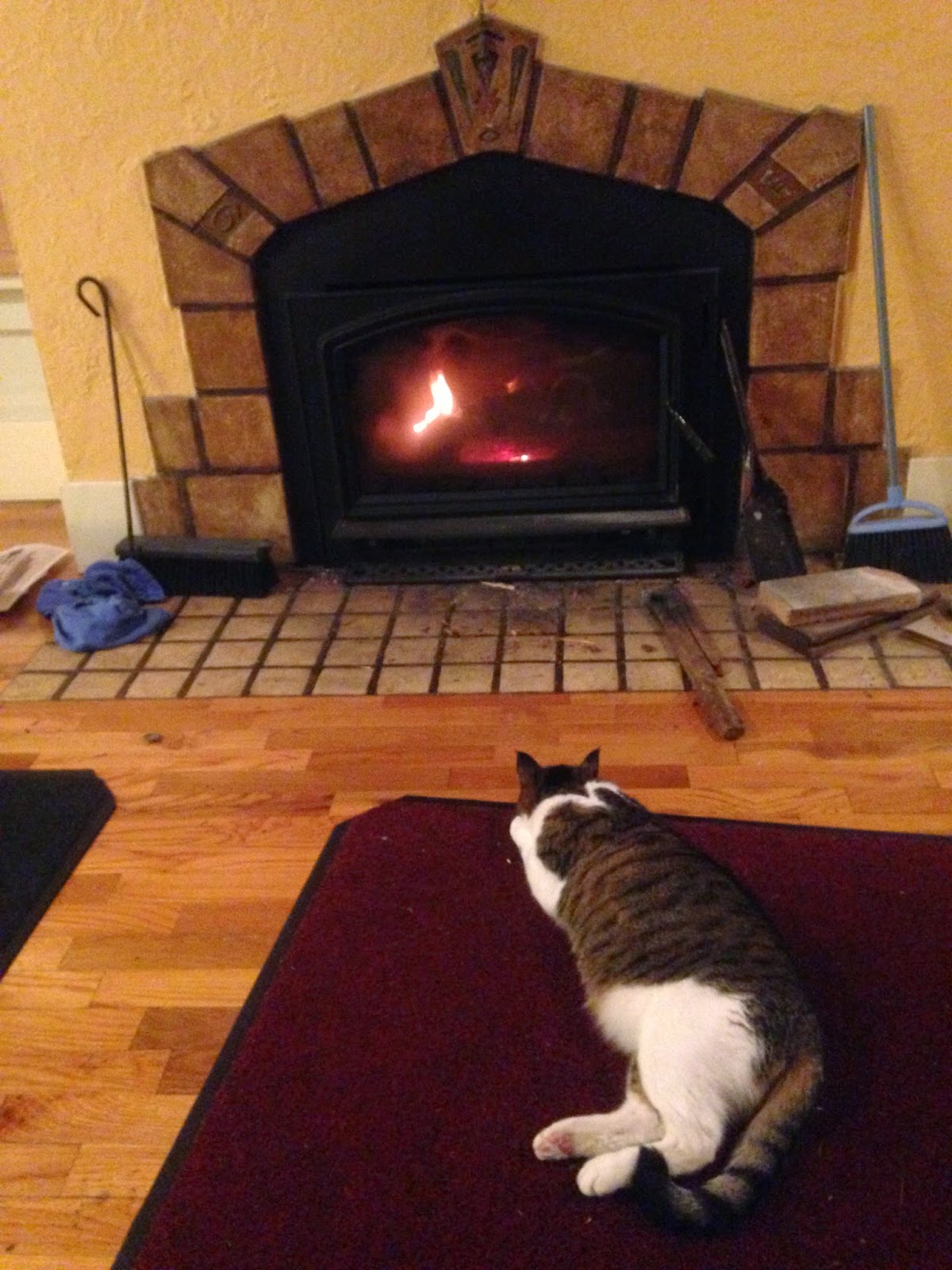
...the cat warmer.

Seriously, he hasn't moved for the last four hours.

Monday, November 3, 2014

Monday Musical Opinion: Opera and the Bechdel Test

Here's the names of this year's lambs:  Uberto, Tristan, Marthe, La Castafiore, Gerhilde, Heliane, Ortlinde, Vixen Sharp-ears, Elvira, Ernani, Carmen, and Linda di Chamounix.  (There were a bunch of other ram lambs, who are unnamed and are destined to become either other peoples' pets, or meat).  Like a lot of breeders, we have a theme for naming our sheep; we use opera characters. 

I was looking at who we bred this year, and thinking about what names would be appropriate.  I strive to have some sort of continuity in naming.  So, for example, Truffles is a bit nutso, so her daughters are Lucia di Lamb-ermoor and Linda di Chamounix--both of whom have "mad scenes."  Tristan is out of Isolde.  Some are a bit more of a stretch.  La Castafiore, for example, will be recognized by fans of Tintin...

as the diva who always bursts forth with the "Jewel Song" from Faust; the song is sung by a character who sometimes is called Gretchen--and Gretchen is the name of the ewe who gave us La Castafiore.  Kinda torturous, but it helps me to remember who is who. 

It's not as though there are a shortage of opera characters.  Naming the rams is easy, because there is definitely no shortage of randy, testosterone-driven, brutish male characters.  Female characters?  They are there, but they are often a lot less interesting.  As often as not, the Soprano is a fairly passive object of dispute between two tenors or a tenor and a baritone, and the Alto is either the Soprano's mother or maid.  Sure, there are lots of exceptions, but they are exceptions nonetheless.

Mulling on this (I was driving from San Francisco to Roseburg, listening to the opera station on the satellite radio, so plenty of time for mulling), I got to wondering if there were any operas which pass the Bechdel Test.  The Bechdel Test (named after the woman who committed it to ink) asks if a movie has a) at least two named female characters who b) talk to each other about c) something other than a man.  Given that operas generally have few named characters, are often composed in (and about) times when men were the only acknowledged movers and shakers, and are almost always about complicated heterosexual interpersonal relationships, it's hard to think of many that pass the test. 

"Dialogues of the Carmelites" is an easy one.  "Suor Angelica" also passes easily.  It gets harder to find operas that pass the Bechdel Test outside the walls of the convent:  "Lakme" has the famous flower song, which is a nice duet about flowers (completely free of innuendo).  The barcarolle from "Tales of Hoffman" is about night and love, generally--but the mezzo is a trouser role, Nicklausse.  Really, I'm drawing a blank on this--if you can think of any, please let me know. 

Tuesday, December 31, 2013

Happy Goat (ii)


(He's a wether, for sale, if you want him)

Monday, December 30, 2013

Thursday, November 28, 2013

in which I feel like Prometheus (stealing fire, not the bit with getting my liver eaten by eagles eternally)


That is a bowl of cheese curds.  While they are not exactly dime-a-dozen in Wisconsin (more like $5.00/lb), they are very common there.  I grew to love cheese curds during my time in America's Dairyland, and  I have been in withdrawal ever since.  You simply can't find decent cheese curds in California--I tried some at the Davis farmers' market, but they were not so good.  Likewise, they're unavailable in Roseburg.  I remember samples of them as part of the Tillamook factory tour, but Tillamook is about four or five hours from here.  One sees them in groceries, but they are generally vacuum-packed and tagged with a sell-by date that is months in the future, suggesting a basic ignorance of the fact that they should be eaten less than a day after they were milk. 

So now I have made my own.  From the milk of my own goats, which is made from the grasses and brambles and grain and hay that I've fed them, from milk that was inside a goat earlier this morning, I've made cheddar cheese curds.  I've stolen the secret of cheese curds from Wisconsin, and I feel like Prometheus stealing fire from the gods.  And I've gotta say, those were some damn fine curds.  

Wednesday, August 21, 2013

Wednesday Wordage Parasitic edition

I think my goal for the next couple of years will be to master the skills of robotics, electronics, programming, and engineering.  I will then use those skills to make small aerial drones, equipped with compact chromatographs and spectrometers that will be able to analyze the air they fly through.  They will be able to detect trace amounts of a staggeringly wide variety of airborne chemicals, ranging from gases to aerosols to particulates, identify them all and trace them to their point of origin.  These autonomous robots would act like a swarm of noses, and would be tremendously useful in a number of applications.  I would call them "nose bots."

And, all the effort would be worth it if I could obliterate from my mind what "nose bots" really are--we may have them in our flock of sheep, so I had to do some reading about them.  Eeeeew.

Wednesday, July 3, 2013

Wednesday Wordage context is everything edition

I often find myself marveling at where I am and how different it is from my previous life.  Two years ago, had you told me "You will spend an afternoon assembling a creep panel, and then you'll spend a chunk of the next day rueing," I would be a bit confused.  I'd probably come to the conclusion that, for some reason, I'd decided to form a committee of the weirdest people I knew for some reason, and that I'd later experience some regret.

Now, I know better.  A creep panel does not invite perverts; rather, it's a panel in a fence that excludes adult animals, but allows lambs or kids to creep through to some high-calorie food.  My former self would refer to it as a 0.2 m filter, cellulose.  And "rueing" or "rooing" (spellings vary) is not at all unpleasant; rather, it's kind of relaxing and leaves both parties involved feeling better.  Under certain conditions--a hot spell combined with the nutritional demands of nursing, or simply the change of season, can cause a sheep's hair follicles to just let go of the hair, with the result that great chunks of wool can simply be pulled off, or rued.  Rooing is as therapeutic as peeling sunburn, and it leaves the sheep feeling much less itchy. 

Tuesday, May 28, 2013

Tuesday Tool Body Modification edition

The Real Doctor and I spent a chunk of yesterday giving some of our newer animals unique identifiers.  The lambs got their ears pierced for a fashionable plastic earring; it carries info about our farm and a name and number specific to the sheep.  The marks of these beasts are duly noted by the feds, who have an interest in keeping track of scrapie and such diseases.

The tool of the day, though, is the Ketchum Revolving Head Ear Tattoo Pliers.  (Pictures from the Nasco catalog, for all your farm and ranch needs.) 

The holes in the jaws of the pliers hold individual letters.  For example, this is the letter "A", upside down.

The revolving head is nice, because you can load up the tattoo for the left and right ears at the same time.  While the poor, innocent little goat is restrained, you can smear the ears with green ink (which gets all over the place; annoyingly, the little tube is packaged under pressure so that when you open it, five mls of gooey green blorts out over everything), and wham! wham! before the poor, innocent little goat knows what hit her, she's got the baddest tattoos this side of Mike Tyson:


Wednesday, May 22, 2013

Wednesday Words Tactful Edition...

...or, "Things you can say about a very pregnant sheep, whose udder is rapidly expanding prior to giving birth, that you can't say about an aspiring supermodel who is undergoing a similar expansion due to plastic surgery:"
"Ah-yup.  She's really bagging up nicely."

Sunday, March 10, 2013

Pasturized

The Real Doctor and I jumped into this business of sheep and goats in a way that is both deliberate and precipitous.  The deliberation comes in how we’ve chosen most of our animals:  the Real Doctor spends hours and hours studying bloodlines and breeders, sifting and winnowing to find the best available that we can afford.  The net she has cast for quality Shetland sheep covers Oregon; bundles of desirable genes, carried both by cute little Nigerian Dwarf goats and by mysterious containers in liquid nitrogen, have arrived from all over the United States.

The pell-mell aspect of this process has been the timing.  Goat time (as previously noted) and sheep time do not pay attention to the conveniences of human time.  So, for all of the animals that we’ve gotten, there has been an absolute panic to find adequate housing in time for their arrival.  The hurly-burly has been complicated by delays in building our barn.  It is built, but not yet ready for animals, and given my work docket, it won’t be ready until the end of April.  It was supposed to be finished in March—of last year!   

There is a sort of cascade of jury-rigging, where incoming animals get shunted from one temporary accommodation to another.  Our first animals were four goat kids.  These were to be housed in what the previous owner of our property had built as a dog run, but that had decayed considerably and had no gates.  I was still assembling the gates as the Real Doctor was returning from the airport with the kids. 
The next animals were eight sheep.  The sheep were to displace the goats, who were to go out to a childrens’ play area that had just been fenced in.  But the play area had no secure pen to shut the animals in (and the predators out) over night—so we were up until 11:30 at night, working with headlights, hanging up fencing and plywood and a makeshift door to fortify what we now call “the castle” for the goats. 

The eight sheep, who we had picked up from farms in the Eugene area, spent their first night here in the horse trailer in which they’d arrived. 

We got a couple more goat kids, and we wanted to quarantine them before introducing them to the rest of the herd.  There were already sheep in the dog run, so we had to figure out where to put them.  Again, we jury-rigged a structure built by the property’s previous owner—in this case, a garden area surrounded by an eight-foot-tall corral made of steel pipes from a closed-down lumber mill.  The structure was goat-permeable, so I spent a fatiguing day stringing four-foot tall no-climb fencing over the steel-pipe framework, and erecting a sort of field shelter that would only later acquire a roof—but, amazingly, the accommodations were sort of ready the same night the animals arrived!  This was cause for heady celebration.

We’d seen examples of field shelters that were on trailers so that sheep could easily be moved from pasture to pasture.  This is facilitates “rotational grazing” (which has nothing to do with tethering the sheep to a stake so that they’d mow a spiral pattern, but rather alternating a field’s grazing between goats and sheep).  So, last summer, with the capable captaincy of the Real Doctor’s brother H., we built the Sheep Housing/Mobility Unit, or SHMU—a twenty foot trailer with a shed, barn flooring, a feeder and waterer.  As soon as it was ready, the sheep that had been festering in the narrow confines of the dog runs were moved in.  They were very happy—they were still confined, but it was like moving from a monastic cell to a decent apartment. 
It was good that these sub-optimal accommodations were vacated, because as soon as they were emptied, they were filled again with more sheep that we acquired from a woman who was shutting down her sheep operation so she could concentrate on horseback riding.  Oh well.  Those are still there, because they have been bred and we’d like to keep them separate from the youngsters. 

The garden also got vacated, and again it was a good thing; soon after the young does left to join their comrades in the castle, a pair of bucks arrived and moved in to the field shelter. 

Not to go too much into the details of animal husbandry, but the Real Doctor’s plan for the bucks involved using them for Artificial Insemination (AI), which (among other things) meant keeping them together (so they wouldn’t go insane—they’re herd animals) but separate (so they wouldn’t get—how to put this politely for a family blog—too intimate with each other).  So, hastily, I built a fence subdividing the garden.  The AI scheme also involved taking the bucks to a clinic in Washington—still separated—so, hastily, we purchased a truck topper and hastily, modified it to make the “Goatabago.”
After the AI clinic, the bucks could be together, which was a good thing, because that’s when the rams arrived.  So, we kept the subdividing fence in the garden, hastily erected another field shelter, and put the rams there.  We’ve discovered that this is not an optimal solution—fencing that is proof against 30-pound dwarf bucks is not resistant to a 110 pound ram, and a field shelter that easily contains those bucks is not resistant to two rams sorting out their dominance issues.  I posted about this earlier; this is what their shelter is like now.  I watched one of them spend a half hour on a sunny afternoon, patiently and methodically using his forehead to destroy one wall:  If it weren’t my work that I was watching being destroyed, I’d be amused. 
So, we have this recurring theme—animals, good animals and carefully selected, arriving before we are good and ready.  Hasty accommodation is thrown up, and only in the case of the castle goats, has their been any access to pasture. We have a big field, about 11 acres, with really nice fence around it, but no internal fencing.  It’s a drag to try to bring in animals for the night if they are skittish and have 11 wide-open acres over which to elude you. 

Now, thankfully, there is a fix to this problem.  We’ve gotten some easily set up, lightweight, powerful electric fencing.  I moved the SHMU, and spent a day setting things up, and now the eleven residents of the SHMU are happily—and I do mean happily—grazing and kicking their feet up in one corner of the field.  I then spent another tiring day mowing, stringing fence, making a gate, and breaking down and rebuilding a field shelter.  Now, next to the sheep, contentedly munching on some brambles, are the bucks.  I am, honestly, so happy to see these animals out in the pasture, contentedly doing what animals are supposed to do, that I find myself just standing there with them, smiling.  This is real progress. 
And none too soon.  We have two more doelings arriving in a little over a week, and they have no place to stay.