
The news this week has given me a faint glimmer of hope. There has been a certain repudiation of Trumpism in the Virginia gubernatorial election. Karma started collecting some overdue bills: the state rep who was proud of his homophobia and wouldn't address his trans opponent as a human...lost to his trans opponent; a selectman who wondered if the women who marched against Trump would be home in time to cook dinner...lost his seat to a woman who was pissed off by his comment and so decided to run against him. There was a gratifying scattering of immigrants, minorities, and other voices that won in local elections.
There has also been a growing number of women (and men) calling out those men who committed sexual offenses as a way to assert power. The list of powerful people being undone by their own appetites keeps growing, adding show biz moguls and politicians daily.
I find myself wanting that number to grow. It is impossible to credit that there aren't many more people who have such a distorted view of how society works. I don't think that society will advance until more of their number are taken out of positions where they can do harm. The process is, hopefully, reaching a stage where it is autocatalytic, where revelation emboldens revelation.
It feels like we, as a society, may finally be lancing an abscess, one that has disfigured us for so long that we may account it as a normal part of our physiognomy. Lancing it will be disgusting, things will come to view that will make us gag and vomit. But, if we don't, we will grow ever sicker and the toxins will poison us.
Showing posts with label deep thoughts. Show all posts
Showing posts with label deep thoughts. Show all posts
Thursday, November 9, 2017

Friday, July 15, 2016
Imagine there's no countries/it's...quite difficult, actually.
I experienced an odd juxtaposition of thoughts today, as I was driving home from town. The radio was giving me the news of an attempted coup-de-etat in Turkey. A commentator noted that one of the problems facing the current PM was a persistent secessionist group, the PKK, that wants to establish a Kurdish homeland, a state whose geography corresponds to the ethnicity of its citizens. Fine, I thought. Borders, when you get right down to it, are kind of stupid. Why should a Turk in Istambul even want to exercise political control over a bunch of people who want nothing to do with him, away over in Silopi? What good does such a line on a map do anybody? Why do we make such a fuss over borders anyway? If Jorge wants to live and work over there, and Miryam wants to live and work yonder, who even cares?
As I was imagining these pleasingly Lennon-esque thoughts, I passed the airport. The flags, as happens all too often these days, were at half-staff, whether for slain policemen in Dallas or the dozens of murdered in Nice, I don't know. But, despite what I was thinking about the stupidness of national borders, my first reaction on seeing the flag display was "hey...the flag of the United States is lower than the state flag and the other flag. That's just wrong!"
As I was imagining these pleasingly Lennon-esque thoughts, I passed the airport. The flags, as happens all too often these days, were at half-staff, whether for slain policemen in Dallas or the dozens of murdered in Nice, I don't know. But, despite what I was thinking about the stupidness of national borders, my first reaction on seeing the flag display was "hey...the flag of the United States is lower than the state flag and the other flag. That's just wrong!"
Thursday, February 11, 2016
More late night thoughts after too much news and too much wine
I heard an interesting program on the radio (http://hereandnow.wbur.org/2016/02/10/prisons-around-the-world) about how prison is viewed in different countries. The U.S. was an early reformer of prisons, but (especially with the invention of privately-run prisons in the U.S.) we seem to have lost sight of what prison is about. Rehabilitation and reintegration into society have faded as goals, displaced by a stridently punitive attitude and an inhuman quest for profit. In some countries, however, there has been an increasing emphasis on making offenders, especially younger offenders, into useful members of society.
There's a lot going on there, and a lot of it has to do with wether or not we regard ourselves as a society. If you view society as a single entity, then healing society means healing the atoms that make it up. If you view the state as the representative of the will of society as a whole, then of course the state should use tax money to do this work.
If you follow the inspiration of Margaret Thatcher and the modern development of conservatism, then there is no such thing as society--we are all individuals, all for ourselves and against each other. A war on crime too easily becomes a war on "other"--other races, other classes. It becomes too easy to find support for locking people up and throwing away the key. It becomes too easy to yield to an animal demand for blood. Prisoners are not to be rehabilitated or given anything, only punished. The state is not us or our agent; it is also "other", so it has no more business looking after prisoners than, say, a private company. If state or company abuses prisoners on the way to making a profit, so what? It is always "other" getting hurt. And, as the researcher on the radio pointed out, as long as society doesn't exist and there is only "us" and "other," all "other"s are assumed to be bad. Indeed, that is precisely the dominant attitude in this well-armed neck of the woods.
I am too much of a collectivist to see the merit of this view, which has gained such traction in our country. I am too rooted in a tradition that encourages me to see all "others" as equally human. So I was pleased to hear about programs that could take people--mostly young adults--who had been failed by family or education, who had gone wrong and done wrong, being helped back onto a good path.
Then I heard other stories on the radio, about executives at a coal company deliberately endangering miners for profit, about executives of an energy company poisoning a river, about a leading presidential candidate enthusing about torture, about a government choosing to poison its constituents with lead, about a county sheriff who engaged in torture and abuse of prisoners, and so on. There are miscreants out there, and these folks have done a lot more to destroy the fabric of society than a punk with a revolver holding up a convenience store, or even a murderer or rapist. They have generally been doing what they do for twenty, thirty, fifty years. The longer they have done it, the more profit they've derived, the more firmly they believe in their actions' absolute righteousness. In most cases, they admit no wrongdoing, and such contrition as is seen is mouthed by their defense attorneys during their sentencing--and never again.
I don't know--can such people, who I must acknowledge as my fellow humans, be reformed? Can they be redeemed? Their energy and skills directed towards mending the society they've assaulted? Or is a punitive model appropriate for such people? How does society heal itself of such cancers? I do not know.
There's a lot going on there, and a lot of it has to do with wether or not we regard ourselves as a society. If you view society as a single entity, then healing society means healing the atoms that make it up. If you view the state as the representative of the will of society as a whole, then of course the state should use tax money to do this work.
If you follow the inspiration of Margaret Thatcher and the modern development of conservatism, then there is no such thing as society--we are all individuals, all for ourselves and against each other. A war on crime too easily becomes a war on "other"--other races, other classes. It becomes too easy to find support for locking people up and throwing away the key. It becomes too easy to yield to an animal demand for blood. Prisoners are not to be rehabilitated or given anything, only punished. The state is not us or our agent; it is also "other", so it has no more business looking after prisoners than, say, a private company. If state or company abuses prisoners on the way to making a profit, so what? It is always "other" getting hurt. And, as the researcher on the radio pointed out, as long as society doesn't exist and there is only "us" and "other," all "other"s are assumed to be bad. Indeed, that is precisely the dominant attitude in this well-armed neck of the woods.
I am too much of a collectivist to see the merit of this view, which has gained such traction in our country. I am too rooted in a tradition that encourages me to see all "others" as equally human. So I was pleased to hear about programs that could take people--mostly young adults--who had been failed by family or education, who had gone wrong and done wrong, being helped back onto a good path.
Then I heard other stories on the radio, about executives at a coal company deliberately endangering miners for profit, about executives of an energy company poisoning a river, about a leading presidential candidate enthusing about torture, about a government choosing to poison its constituents with lead, about a county sheriff who engaged in torture and abuse of prisoners, and so on. There are miscreants out there, and these folks have done a lot more to destroy the fabric of society than a punk with a revolver holding up a convenience store, or even a murderer or rapist. They have generally been doing what they do for twenty, thirty, fifty years. The longer they have done it, the more profit they've derived, the more firmly they believe in their actions' absolute righteousness. In most cases, they admit no wrongdoing, and such contrition as is seen is mouthed by their defense attorneys during their sentencing--and never again.
I don't know--can such people, who I must acknowledge as my fellow humans, be reformed? Can they be redeemed? Their energy and skills directed towards mending the society they've assaulted? Or is a punitive model appropriate for such people? How does society heal itself of such cancers? I do not know.
Saturday, January 30, 2016
Late night thoughts after too much news and too much wine
One of the greatest things about humans--perhaps one of the only things that sets apart from other animals--is that we take abstract ideas very seriously. It's also one of the worst things.
Something like tribal warfare is known in chimpanzees, and there was a recent discovery of the remains of a possible tribal war between non-agrarian humans 10,000 years ago. So we're not unique on that score: murder likely ran in the blood of our last common ancestor.
But at some point one of our ancestors believed that it was necessary to kill another human--not because of a threat to self or family, or for control of a desirable resource, but because of heterodox belief about a thing that did not exist in the real world. Probably, sometime around then, some human reckoned that it was worthwhile to risk its life for an abstraction. Before this time, these thoughts had never ever occurred. There was a first time.
Possibly, about the same time as those humans were killing and being killed, some residents of Anatolia were carving and erecting monumental stones at what is now Gobekli Tepe--making a considerable sacrifice of time, energy, and wealth, to an abstraction long forgotten. That's the only material evidence we have of this development, and it is highly enigmatic.
We'll never know the first belief that inspired murder, the first abstraction that instilled a willingness to die. We can't ever know how many millions of humans have lost life to ideas, how much suffering stems from notions without substance--nation, sect, dogma, politics, racial purity--since then. It's been about 10,000 years since this idea appeared. Sometimes I let myself hope that we will grow out of it; that at some point, maybe less than 10,000 years from now, the last murder will be committed for an idea, the last sacrifice made for a belief. It will, in all likelihood, be well after I die.
Something like tribal warfare is known in chimpanzees, and there was a recent discovery of the remains of a possible tribal war between non-agrarian humans 10,000 years ago. So we're not unique on that score: murder likely ran in the blood of our last common ancestor.
But at some point one of our ancestors believed that it was necessary to kill another human--not because of a threat to self or family, or for control of a desirable resource, but because of heterodox belief about a thing that did not exist in the real world. Probably, sometime around then, some human reckoned that it was worthwhile to risk its life for an abstraction. Before this time, these thoughts had never ever occurred. There was a first time.
Possibly, about the same time as those humans were killing and being killed, some residents of Anatolia were carving and erecting monumental stones at what is now Gobekli Tepe--making a considerable sacrifice of time, energy, and wealth, to an abstraction long forgotten. That's the only material evidence we have of this development, and it is highly enigmatic.
We'll never know the first belief that inspired murder, the first abstraction that instilled a willingness to die. We can't ever know how many millions of humans have lost life to ideas, how much suffering stems from notions without substance--nation, sect, dogma, politics, racial purity--since then. It's been about 10,000 years since this idea appeared. Sometimes I let myself hope that we will grow out of it; that at some point, maybe less than 10,000 years from now, the last murder will be committed for an idea, the last sacrifice made for a belief. It will, in all likelihood, be well after I die.
Wednesday, November 19, 2014
Wednesday Wordage: Chiron, son of Chronos, god-like beast...
One of the many things that vexes me about the state of civil discourse these days has to do with qualifications, or more precisely, disqualifications. We have too many news and opinion shows on too many channels and blogs and twitters, all going 24/7. All of these outlets need people to voice opinions--otherwise, no show, and no ad revenue. But what does it take to be one of these opinion-spinners?
The qualifications are minimal. One can earn an advanced degree in seemingly any field, or you can be at a think-tank, or you can be an elected official, or you can have an obsessive blog about a particular subject, or be eloquent, or telegenic, or family of someone relevant, or any of a number of other things. All of these things, whatever their true worth at forming an educated opinion, apparently qualify you to share your opinion with lots of people, and try to sway their opinions.
What distresses me is not how easy it is to gain qualification as an opinion-maker. It is, rather, how it is nearly impossible to be disqualified as an opinioneer. There are too many people whose opinions are given far too much weight, based on how their previous opinions or policies have played out in the real world. They should, one thinks, be disqualified from having publicly broadcast opinions on these matters. We really should never have to listen to a news or opinion piece on human rights from Henry Kissinger, on middle-eastern policy from Dick Cheney, on defence policy from Don Rumsfeld, on presidential powers from John Yoo, on appropriate workplace behavior from Bill Clinton, and so on--except, perhaps to hear them say, "whatever you do, make it the opposite of what I did". But banning people is not the solution, or consistent with our constitution.
So, I argue for the return of the epithet. You may remember epithets from Homer and his ilk: swift-footed Achilles, Eos of the rosy fingers. In documented history, you have kings such as Ethelred the Unready or Ivan the Terrible. These adjectival phrases become part of the character's name. Epithets help us to grasp the essential nature of the person, and they're not always flattering.
There are certain positions or clearly stated opinions--not off-the-cuff remarks, but publicly declared views--that have been tested by time, and found stupid or odious. They become less like opinions and more like falsified hypotheses that are still, despite evidence, clung to. I propose that these should become epithets. However, it doesn't really advance public discourse when you reduce a talking head's world-view to a single adjective like "unready" or "terrible." A more useful and informative epithet, one that would help the audience to weigh an opinion, would be something such as "who thought Sarah Palin would be a good president" or "who reckons that bombing Iran would be constructive," to suggest a few that would apply to the Honorable Senator John McCain.
How does one deal with a bulky and cumbersome epithet such as this? A solution is provided by repurposing yet another scourge of public discourse, the Chyron. Chyrons (the name is apparently a trademark and has nothing to do with the centaur who taught Achilles; they are also called crawls or "the bottom third") are those lines of text that pollute the bottom of a TV screen whenever there is a talking head spouting opinions. They are generally full of garbage, or take the talking head's opinion an reduce it to one phrase of mush. Either way, they do nothing useful. I suggest taking the Chyron and using it to show the talking head's epithet.
Here's an example: nowadays, we see James Inhofe's head talking above lines of text saying "Sen (R) Okla / Jets 14 Ravens 3 (final) / Dow up 13 3/8 / Did Rhianna cheat on Ussher? / Volcanic eruption in Hawaii threatens golf course..." and so on. Instead, we should see James Inhofe talking above lines of text saying "despite a century of accumulated scientific evidence and the assurances of pretty much everybody who has studied them, he refuses to place any credence in biological evolution or anthropogenic climate change. Also gets lots of money from fossil fuel business." That way the viewer would know the talking head is venal and committed to ignorance on not just one, but two, and probably lots of issues.
It might be argued that this would stifle free discussion of important issues. But, if you consistently have opinions that the passage of time have shown to be clearly dumb and harmful, it seems that your views should be branded. If you're stupid on one topic, fine, opine on others--and if you trip on those, you will accumulate more tar and more feathers, for all to see. It's been noted that, in the internet age, that a PhD does not automatically confer wisdom, and that formal qualifications have become less important. Right now, civil discourse has an urgent need for disqualifications.
(signed) J. A. Appleman...for a while, thought corn-based ethanol was a reasonable alternative energy source...
I'll put a few possibilities in the comments...please add your own.
The qualifications are minimal. One can earn an advanced degree in seemingly any field, or you can be at a think-tank, or you can be an elected official, or you can have an obsessive blog about a particular subject, or be eloquent, or telegenic, or family of someone relevant, or any of a number of other things. All of these things, whatever their true worth at forming an educated opinion, apparently qualify you to share your opinion with lots of people, and try to sway their opinions.
What distresses me is not how easy it is to gain qualification as an opinion-maker. It is, rather, how it is nearly impossible to be disqualified as an opinioneer. There are too many people whose opinions are given far too much weight, based on how their previous opinions or policies have played out in the real world. They should, one thinks, be disqualified from having publicly broadcast opinions on these matters. We really should never have to listen to a news or opinion piece on human rights from Henry Kissinger, on middle-eastern policy from Dick Cheney, on defence policy from Don Rumsfeld, on presidential powers from John Yoo, on appropriate workplace behavior from Bill Clinton, and so on--except, perhaps to hear them say, "whatever you do, make it the opposite of what I did". But banning people is not the solution, or consistent with our constitution.
So, I argue for the return of the epithet. You may remember epithets from Homer and his ilk: swift-footed Achilles, Eos of the rosy fingers. In documented history, you have kings such as Ethelred the Unready or Ivan the Terrible. These adjectival phrases become part of the character's name. Epithets help us to grasp the essential nature of the person, and they're not always flattering.
There are certain positions or clearly stated opinions--not off-the-cuff remarks, but publicly declared views--that have been tested by time, and found stupid or odious. They become less like opinions and more like falsified hypotheses that are still, despite evidence, clung to. I propose that these should become epithets. However, it doesn't really advance public discourse when you reduce a talking head's world-view to a single adjective like "unready" or "terrible." A more useful and informative epithet, one that would help the audience to weigh an opinion, would be something such as "who thought Sarah Palin would be a good president" or "who reckons that bombing Iran would be constructive," to suggest a few that would apply to the Honorable Senator John McCain.
How does one deal with a bulky and cumbersome epithet such as this? A solution is provided by repurposing yet another scourge of public discourse, the Chyron. Chyrons (the name is apparently a trademark and has nothing to do with the centaur who taught Achilles; they are also called crawls or "the bottom third") are those lines of text that pollute the bottom of a TV screen whenever there is a talking head spouting opinions. They are generally full of garbage, or take the talking head's opinion an reduce it to one phrase of mush. Either way, they do nothing useful. I suggest taking the Chyron and using it to show the talking head's epithet.
Here's an example: nowadays, we see James Inhofe's head talking above lines of text saying "Sen (R) Okla / Jets 14 Ravens 3 (final) / Dow up 13 3/8 / Did Rhianna cheat on Ussher? / Volcanic eruption in Hawaii threatens golf course..." and so on. Instead, we should see James Inhofe talking above lines of text saying "despite a century of accumulated scientific evidence and the assurances of pretty much everybody who has studied them, he refuses to place any credence in biological evolution or anthropogenic climate change. Also gets lots of money from fossil fuel business." That way the viewer would know the talking head is venal and committed to ignorance on not just one, but two, and probably lots of issues.
It might be argued that this would stifle free discussion of important issues. But, if you consistently have opinions that the passage of time have shown to be clearly dumb and harmful, it seems that your views should be branded. If you're stupid on one topic, fine, opine on others--and if you trip on those, you will accumulate more tar and more feathers, for all to see. It's been noted that, in the internet age, that a PhD does not automatically confer wisdom, and that formal qualifications have become less important. Right now, civil discourse has an urgent need for disqualifications.
(signed) J. A. Appleman...for a while, thought corn-based ethanol was a reasonable alternative energy source...
I'll put a few possibilities in the comments...please add your own.
Wednesday, November 30, 2011
Home is where the...well, where is it exactly?
I’m back in La-La Land, both in the Los Angeles sense of the term, and in the sense of living with the craziness of Alzheimer’s disease.
My parents live in Pacific Palisades, a coastal suburb of LA name-checked by the Beach Boys in “Surfin USA” (though more for the scansion than the waves). They moved here before I was born and they still live in the same house. In 1967, the town was welcoming to the modest means of a new assistant professor. Now, in the language of the moment, the average resident of the Palisades is closer to being “the 1%” than part of “the 99%”. With my every visit, the town I knew is further buried under hyper-architectonic mansions crammed onto the lots formerly occupied by bungalows. Upscale boutiques occupy storefronts that used to sell useful stuff.
The population of the town has changed too, both with generational turnover and with the influx of new money. I’ll admit it makes for good people-watching. Some sightings from the last week:
--three very, very white teenagers filming themselves doing a rap video with some very, very expensive camera equipment
--a guy bringing his ‘cello and music stand down to the beach to play, perhaps for the amusement of the fishes
--a rather ample man and woman doing a wedding photo shoot down at the beach, right next to a woman taking photos of her daughter all bundled up for Christmas cards. After they left, a crew came in and filmed a TV commercial.
--a terribly elegant woman jogging with her two terribly elegant afghan hounds; everything was progressing elegantly until the dogs spotted a squirrel…
--a guy who walks his pug every morning, moving very slowly and never once looking up from his texting
--tides of students to and from the high school across the street (Alma mater!), illustrating the toxic combination of teenage peer pressure, teenage lack of judgment, and too much parental money
--a vegan activist who adopts two turkeys before every Thanksgiving, and gives them the run of her front yard until after Christmas, when they go to an animal rescue farm.
Also, since this is Los Angeles and who you are is what you drive, the car-watching is also great. It’s difficult to drive in West LA without encountering automotive ostentation. Two weeks ago, while I was walking to the grocery store, I was almost hit by a car that (seriously!) cost more than my house. The driver certainly had money, but was apparently void of driving skill. At the store, there was a perfectly-restored 1950's Messerschmitt "bubble car" in the lot:

The Palisades offers an endless variety of such cars, expressing a wide range of character traits: no brains and lots of money, an abundance of ego and money, masculine insecurity and money, a love of antiques and money, eccentricity and money, too much testosterone and money, and so on. [update 1 Dec; a desire for eco-chic and money--while on a walk last night, I saw a Chevy Volt, and this is where I saw my first Tesla.]
This town, Pacific Palisades is—in one sense of the word—home. I grew up with a positively un-American level of stability: we never moved, and my parents have avoided divorce for more than 50 years. This house with its termite-riddled roof and Edenic garden--the walk down the canyon to Will Rogers State Beach--the walk up the canyon into the Santa Monica Mountains: these have all been a rock to me and my family. I was walking on the beach during an hour off of my parent-sitting duties, when I was struck by the sobering thought that in a year’s time, if everything goes as I hope it will, this rock will be gone.
The day-to-day task of providing care for my father (and mother) has really made their health the focus of my thinking about them. From this narrow point of view, I really want them to move out of their house. I feel that my father needs more specialized care than can be provided at home, and that my mother would do well to be closer to me or one of my brothers. So, I’ve been hoping that I can persuade them to move to Roseburg. In focusing so hard on this issue, I’d practically ignored—until that walk on the beach—that this would mean erasing “home.”
Well, as has been noted, you can’t go home again, and has also been noted, attachment to the material world only leads to grief. I’m pretty sure the Santa Monica Mountains will outlast Los Angeles, and despite its charms, Will Rogers State Beach can’t hold a candle to the Oregon shore. I dislike Los Angeles proper. This house is not really good for an older couple—it’s got a severe termite problem, the balcony overlooking the canyon is listing, and it’s nearly impossible to keep warm. The only real tie I have to this place is a work of art that is literally rooted to the spot—my mother’s garden, which (as has also been noted) is better than yours. While it’s not as bad as the historic eviction from Eden, saying goodbye to this garden is the only thing that would sadden me about saying goodbye to this “home.” Without it, I find myself wondering if I’ll ever bother to visit Los Angeles.
Sunday, August 28, 2011
You can take a geneticist out of the lab...
...but it's harder to take the lab out of the genetecist.
The morning routine here involves me making a cappucino for the Real Doctor. The standard recipe for this drink is one third espresso, one third steamed milk, and one third milk foam, which is exactly how the Real Doctor likes it: 10 ml espresso, 10 ml milk, and 10 fluid ounces of foam.
This last week, we had a bottle of milk that just would not produce satisfactory foam. This morning I opened up a fresh bottle of milk, and whoosh! excellent foam. Groggy though I was, my first thought was "hmmm...is there a foam inhibitor present in the old bottle, or is it lacking a necessary reagent for foam, one that's present in the new bottle?"
So, more or less on genetics autopilot, I made a heterozygous diploid by combining the two milks, and tried to steam it up. It would not foam at all. So, it looks like there's a foam inhibitor in the old bottle.
My next thought as a geneticist was "My work here is done. Give it to a biochemist to identify the inhibitor." The thought after that was about my own cocoa.
Disclaimer--of course there are other options, but this is 6:30 AM genetics autopilot.
The morning routine here involves me making a cappucino for the Real Doctor. The standard recipe for this drink is one third espresso, one third steamed milk, and one third milk foam, which is exactly how the Real Doctor likes it: 10 ml espresso, 10 ml milk, and 10 fluid ounces of foam.
This last week, we had a bottle of milk that just would not produce satisfactory foam. This morning I opened up a fresh bottle of milk, and whoosh! excellent foam. Groggy though I was, my first thought was "hmmm...is there a foam inhibitor present in the old bottle, or is it lacking a necessary reagent for foam, one that's present in the new bottle?"
So, more or less on genetics autopilot, I made a heterozygous diploid by combining the two milks, and tried to steam it up. It would not foam at all. So, it looks like there's a foam inhibitor in the old bottle.
My next thought as a geneticist was "My work here is done. Give it to a biochemist to identify the inhibitor." The thought after that was about my own cocoa.
Disclaimer--of course there are other options, but this is 6:30 AM genetics autopilot.
Sunday, June 19, 2011
First class, last class
First Class/Last Class
I typically have a rough time with last lectures. First lectures are easy—your head is clear, there is no personal history between you and the students to complicate communication, and you haven’t made any mistakes yet. Last lectures are tough. The stress of the end of the quarter fills your mind, and standing at the front of the chalkboard is like standing at the focus of a parabolic reflector of undergraduate anxiety. A class of undifferentiated freshmen has become a class of individuals: the ones that are smarter than you, the ones who planktonically drift towards failure, the angry whiners and grade-grubbers, the earnest strugglers who through might and main are dragging themselves from a C to an A-. Addressing a class is just public speaking; addressing these individuals who you know personally demands personal communication.
The hardest thing on the last lecture is the mistakes. I should say "mistake," because it's always the same one: I’ve somehow forgotten to tell them just how much they should love the subject for its poetry and emotion. So, I read Darwin’s tangled bank, or emphasize how a single mutation can change the history of life on earth, or how every atom in their bodies was formed in a star and recycled through thousands of lives…and I get choked up. Usually, I make it through, but it’s rough.
I was really worried that this time would worse—after all, not only the last lecture for this class, but my last lecture at Davis. I decided to try a slightly different tack. This was the first biology class for most of my students, and rather than make the envoi about me and my love, I made it a challenge for them: ten big problems that I thought could be solved during their science careers. This list is by no means comprehensive—in fact, it was designed as much to prompt review as anything else. I could add lots of other things, but it was fun to think about:
1. In the laboratory, make a self-replicating molecule or assemblage of molecules.
2. Make a simple cell from scratch (not Ventner’s reboot), or completely model one on a computer.
3. Effectively use biological systems to clean up the messes of the 20th century—from superfund sites to Hanford nuclear reservation. This will require an understanding of metabolism and genetics
4. Make a solar cell that simply comes close to the efficiency of rhodopsin or a chlorophyll-based photosystem.
5. Understand photosynthesis—from the initial excitement of an electron by light, to how to split water at room temperature, to consuming CO2 to make fuel.
6. Fix nitrogen efficiently. The Haber process, which produces ammonia from atmospheric nitrogen, and which modern agriculture depends upon, consumes somewhere between 2 and 5 percent of all natural gas production worldwide.
7. Understand the central dogma in Archaea. We just don’t understand how these cells work.
8. Understand how proteins fold, so that we can not only predict the structure that comes from a given sequence of amino acids, but design a sequence of amino acids that will give a specific structure.
9. Use viruses for therapy. This includes “gene therapy,” which has been the medicine of tomorrow for about three decades, as well as phage-based antibiotics.
10. Understand the role of Viruses, Archaea and microbial Eukaryotes in the environment. These have been called the “Dark Matter” of the biosphere, and we just don’t know what they do. It’s as if 70% of the economy was the black market.
(Bonus number 11—understand development. This is another thing we just don’t fully understand in biology, and it’s a neat problem.)
Well, I managed to get through it without choking, and to my surprise, I got a round of applause at the end. Kind of gratifying, but I’ll be happier, more like ecstatic, if one of my students goes on to actually solve one of those problems. I think they can.
Feel free to suggest further problems to be solved in the next 20 years.
Saturday, May 7, 2011
That plus a buck-fifty will get you coffee at Starbuck’s
Both the Real Doctor and I will be leaving our current employment in June. I leave from an employment situation that other lecturers have described as akin to an abusive relationship. I have the anxiety and uncertainty of whether I’ll be employed every three months, the financial compensation that would be humorous were it not real, the lack of collegiality, and the outright hostility of the university administration. I don’t know yet what I am moving into, but I can say with certainty that it won’t be much worse. The Real Doctor, on the other hand, has a different departure. There was some testiness between her and her supervisor. This irritation--the sort of thing that leads to a movie’s producer and director citing “differences in artistic vision,” but actually meaning something far less appealing—has been sort of resolved, and sort of buried, so she is leaving on better terms.
I really doubt there’s going to be any official acknowledgement of my departure. I have rendered very useful (and hopefully competent) service to my department, but it’s not in the character of this department or any UC department to get overly worked up about teaching or the departures of staff. The situation is somewhat different for the Real Doctor. In general, the real doctors will at the very least go for a nice lunch or a dinner or cake or something. However, despite her imminent departure, no such plans have been made, which the Real Doctor finds a bit discomfiting.
It’s nice to receive recognition for one’s work. I have some evidence that I do an OK job teaching. The Real Doctor is a more-than-minimally-competent physician. Her patients seem to like her, and she takes the time to talk with them. Additionally, she does a lot of service work—organizing journal club, teaching family practice residents, and so forth. To our surprise, we both feel as if we should get some sort of official recognition for transcending mere competence.
We were talking about this during a bike ride the other day. Both of us, as soon as we had this feeling, wondered why we should have it, what exactly we wanted, and whether or not it this desire was morally objectionable. We both do our jobs, and we are both paid—exactly per contract. We are owed neither recognition nor cake. But money isn’t esteem. While money makes the world go ‘round, the esteem of peers lubricates the pivots. It’s not fungible, but it would mean a lot to me and the Real Doctor to get some sort of “good job!” from officialdom. It doesn’t make any sense at all, and it verges on greediness. I know the job I’ve done, and I need no certificate beyond my students being prepared for whatever is next in their lives.
Neither the Real Doctor nor I had a good solution to this puzzle about ourselves. So there it lies, destined in all likelihood to become a snarl of unresolved feelings when we leave in a few weeks.
Saturday, April 30, 2011
Bachelor Food
Tonight I dine on lentils, washed down with quaffs of white wine. For me, this is bachelor food, since tonight I am a temporary bachelor. The Real Doctor is away, and will not be offended. There's some dishes and wines that the Real Doctor does not care for, or loathes, but that I rather like. There's enough out there that we both like that I don't suffer from the absence of these dishes. However, if I am alone, I'll make them. So, bachelor food.
During a drive from Tahoe to Sacto, I asked Laurabee if she had such meals. She did--until Rad developed a liking for hers. Rad had some too, until Laurabee found out how to make them appealing.
I don't think the Real Doctor will learn to like lentils and Sauvignon Blanc anytime soon. Do you have a bachelor meal?
During a drive from Tahoe to Sacto, I asked Laurabee if she had such meals. She did--until Rad developed a liking for hers. Rad had some too, until Laurabee found out how to make them appealing.
I don't think the Real Doctor will learn to like lentils and Sauvignon Blanc anytime soon. Do you have a bachelor meal?
Wednesday, February 23, 2011
deep geopolitical metaphysical thought
I can't help but wonder if there's some parallel universe in which the supreme court acted with intellectual consistency in Bush v. Gore; and in this parallel universe, Saddam Hussein has watched what happened in Egypt and Libya and Tunisia and Bahrain, and is just now delivering a rambling, hour-long speech in which he vows to fight on; and meanwhile, his soldiers have decided that they are tired of shooting their fellow-countrymen.
Wednesday, December 1, 2010
The problem is that truth is boring
I had a phone conversation with a parent the other day. He was concerned about vaccination for his daughter, and had questions about safety and long-term effects of vaccines. The nature of his questions--which were the well-intentioned questions of a concerned parent--reflected the ways that different types of information get around. It's like Mark Twain is alleged to have said, a lie travels halfway around the world while the truth is still getting its shoes on.
The questions the parent had were familiar to anyone who has paid attention to the vaccine "controversy." Is there a link between vaccines and autism? Is the mercury in vaccines going to cause brain damage? Is the aluminum in vaccines going to cause problems? There are so many vaccines--won't the immune system get tired out? Isn't the flu vaccine ineffective? Was the whole response to H1N1 completely overblown?
The answer to all of these questions is no. The undying persistence of these questions is really frustrating, and shows the sort of asymmetrical warfare that goes on between reality and wishful thinking. All you have to do is mention some poorly-supported hypothesis once, and it is established. If it appeals to people's fears or prejudices, then it is solidly rooted. The problem, though, is that the truth is boring. It can take a long explanation with lots of evidence and patient demonstration to prove the obvious--and even then, there has been some research showing that people still assign greater trust to the thing that they heard first, even if they've been shown solid evidence to the contrary.
So I tried to be patient and tactful with the concerned parent. I pointed out the origin of each of the rumors, how they were generally based on very incomplete and biased information. How, if you directly tested the question, the problem just disappeared. How the immune system can generate a virtually infinite number of immunities. How, due to poor sampling and a knowledge of history, H1N1 was initially terrifying to epidemiologists. How there's a whooping cough epidemic going on in California, and how it is totally unnecessary. How, if you were concerned about risk, you'd avoid McDonalds and driving. But I don't know if the concerned parent will vaccinate. Too often, if reality doesn't conform to bias, bias wins.
This pattern goes on too often. Just about any popular "debate" about science follows this pattern--evolution, climate change, vaccination, you name it. Rumor blurts something out, and refuting it takes patient work with lots of footnotes.
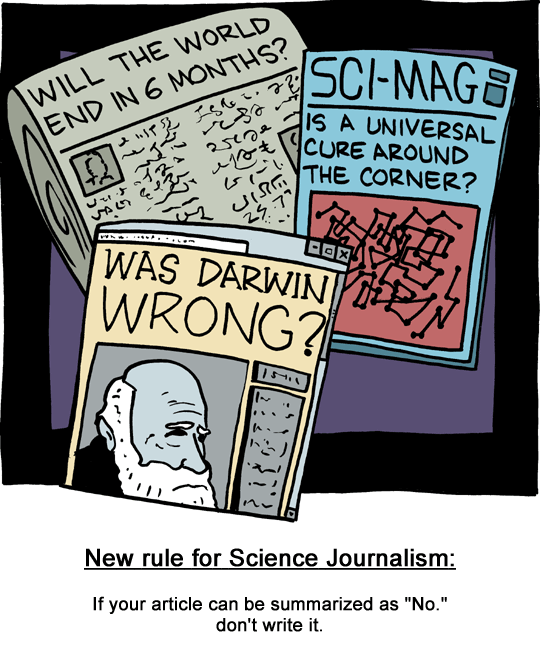
The day after my conversation, this cartoon appeared on the web, from the often amusing SMBC:

The questions the parent had were familiar to anyone who has paid attention to the vaccine "controversy." Is there a link between vaccines and autism? Is the mercury in vaccines going to cause brain damage? Is the aluminum in vaccines going to cause problems? There are so many vaccines--won't the immune system get tired out? Isn't the flu vaccine ineffective? Was the whole response to H1N1 completely overblown?
The answer to all of these questions is no. The undying persistence of these questions is really frustrating, and shows the sort of asymmetrical warfare that goes on between reality and wishful thinking. All you have to do is mention some poorly-supported hypothesis once, and it is established. If it appeals to people's fears or prejudices, then it is solidly rooted. The problem, though, is that the truth is boring. It can take a long explanation with lots of evidence and patient demonstration to prove the obvious--and even then, there has been some research showing that people still assign greater trust to the thing that they heard first, even if they've been shown solid evidence to the contrary.
So I tried to be patient and tactful with the concerned parent. I pointed out the origin of each of the rumors, how they were generally based on very incomplete and biased information. How, if you directly tested the question, the problem just disappeared. How the immune system can generate a virtually infinite number of immunities. How, due to poor sampling and a knowledge of history, H1N1 was initially terrifying to epidemiologists. How there's a whooping cough epidemic going on in California, and how it is totally unnecessary. How, if you were concerned about risk, you'd avoid McDonalds and driving. But I don't know if the concerned parent will vaccinate. Too often, if reality doesn't conform to bias, bias wins.
This pattern goes on too often. Just about any popular "debate" about science follows this pattern--evolution, climate change, vaccination, you name it. Rumor blurts something out, and refuting it takes patient work with lots of footnotes.
The day after my conversation, this cartoon appeared on the web, from the often amusing SMBC:
Friday, October 29, 2010
Philosophical Question
Our neighbors up the street and around the corner have built an enclosure in their yard for their pets to roam around. We have such an enclosure for our animals, and it is a "chicken run". Our neighbors across the way have one for their animal, and it is a "dog run". However, our neighbors up the street and around the corner have turtles...
Subscribe to:
Posts (Atom)