
Q: Which is the odd one out?
a) Bloop
b) Slow Down
c) Train
d) Mistpouffers
e) Julia
A: (Highlight for answer: They are all unexplained noises; Mistpouffers is the only one that is not an undersea phenomenon. I absolutely love that there are replicated observations of inexplicable things. I was reminded of this by the What If blog's mention of the Oh My God Particle.)
Showing posts with label not microbiology but still cool. Show all posts
Showing posts with label not microbiology but still cool. Show all posts
Wednesday, November 14, 2012

Tuesday, June 5, 2012
Transit of Venus!!!!!!!!
Venus transited across the sun today. Unlike Captain Cook, we didn't travel to Tahiti to see it; we slouched out to our front porch. Of course, we didn't see the entire transit, and for most of the day it looked as if we would see only the transit of raincloud. Fortunately, at just about the last minute, the weather broke...
 Here we see noted natural philosopher The Real Doctor with her sophisticated apparatus, observing the transit of Venus:
 Here's a close-up of the transit, as we saw it projected onto a Dixie plate (the most readily available stiff white surface):
 Here's a few minutes of the event. If you blow the first clip way up, you can see the shadow of Venus wiggling and jiggling like a droplet of water--that's atmospheric distortion. The remaining few minutes shows (upside down, as it is projected through a telescope) the sun and the transiting Venus as it is blocked by a telephone pole down the driveway from us, and then as it is approached by the trees on our local horizon.
I love microbiology because it makes me feel connected to the scope of life on earth; I love this kind of astronomy because it makes me feel connected to the universe. The solid earth I stand on suddenly becomes part of an orrery, and I feel my home and all I know tumbling through the cosmos in a dance with the sun and moon and planets and stars. It doesn't make me feel insignificant at all; it makes me feel connected.
(The audio for the clip is included as this is also a personal blog, and it illustrates the more microscopic details of our life right now--we were planning to be in LA right now for the violin-building workshop, but plans exist mainly to remind us that we're not in control of things. Between the excitement of work on the farm and house and some conniptions involving a faulty alternator, it seems we are missing the first week of the workshop. A bummer, definitely, but far from a tragedy.)
 Here we see noted natural philosopher The Real Doctor with her sophisticated apparatus, observing the transit of Venus:
 Here's a close-up of the transit, as we saw it projected onto a Dixie plate (the most readily available stiff white surface):
 Here's a few minutes of the event. If you blow the first clip way up, you can see the shadow of Venus wiggling and jiggling like a droplet of water--that's atmospheric distortion. The remaining few minutes shows (upside down, as it is projected through a telescope) the sun and the transiting Venus as it is blocked by a telephone pole down the driveway from us, and then as it is approached by the trees on our local horizon.
I love microbiology because it makes me feel connected to the scope of life on earth; I love this kind of astronomy because it makes me feel connected to the universe. The solid earth I stand on suddenly becomes part of an orrery, and I feel my home and all I know tumbling through the cosmos in a dance with the sun and moon and planets and stars. It doesn't make me feel insignificant at all; it makes me feel connected.
(The audio for the clip is included as this is also a personal blog, and it illustrates the more microscopic details of our life right now--we were planning to be in LA right now for the violin-building workshop, but plans exist mainly to remind us that we're not in control of things. Between the excitement of work on the farm and house and some conniptions involving a faulty alternator, it seems we are missing the first week of the workshop. A bummer, definitely, but far from a tragedy.)
Tuesday, April 17, 2012
My attempt to teach the controversy: adaptationist vs stochasticist
This month, Tennessee enacted a law that would require education officials at the state and local level to
assist teachers to find effective ways to present the science curriculum as it addresses scientific controversies…[and] help students understand, analyze, critique, and review in an objective manner the scientific strengths and scientific weaknesses of existing scientific theories [such as] biological evolution, the chemical origins of life, global warming, and human cloning.
These “teach the controversy” laws are a nod and a wink to creationists and global warming deniers, denizens of that parallel world I visited earlier. Meanwhile, in the reality-based community, we have some really fun studies that engage real questions about evolution.
One of the long-standing tussles in evolutionary theory is about what pushes evolutionary change. In one corner we have the adaptationists: folks such as Richard Dawkins (and many microbiologists) who see good old-fashioned Darwinian natural selection as being the main force behind change. In the other corner we have the stochasticists: folks who argue that chance fluctuations and genetic drift in small populations are the main way that changes get established within a population (the blog Sandwalk is an example; to some degree, Stephen Jay Gould was of this school).
Evolutionary biologists of both stripes have long known that islands are prolific incubators of unique species. The Galapagos Islands are the classic example, but pretty much any island chain will have its oddities. My favorites are California’s Channel Islands, with the world’s second cutest fox species and the oxymoronic pygmy mammoth. Adaptationists will say that the unique, isolated environment of any island will drive evolution of founder species in idiosyncratic directions, producing species perfectly and uniquely adapted to every specific island. Stochasticists will say that island species are typically “founded” by a very small number of individuals, and since no individual perfectly represents a species, the differences between island species are due to these “founder effects.”
If you were a god, the question of who is correct here would be easy to solve—simply find some islands with distinctive (but related) species, and reverse time’s arrow until you arrived at the common ancestor of all the different types. Being merely human, though, you could do what a group of researchers from Harvard, Duke, and UC Davis did, and act like a god to a bunch of lizards.
When I was a kid, I was a god to a lizard; it was a Carolina Anole that we bought at the Los Angeles County Fair, where it was sold as a “chameleon” because of the species’ ability to change color from muddy brown to green. Anoles are native to the islands of the Caribbean, where, over millions of years and hundreds of islands, they have diverged into many different species. Why so many different species? Are the individual islands all so different that they select for unique adaptations, or are we seeing the effects of chance events in small populations?
To play god for these lizards, the researchers took advantage of an "act of god". A hurricane had eliminated the lizard population of seven tiny islands in the Bahamas. The researchers repopulated each of these lizard-free islands with an anole Adam and Eve, chosen at random from a large and well-established population on a nearby island.
For the stochasticists, this is a promising start. Given that each island’s Adam and Eve were randomly chosen, some of the islands would start with larger-than-normal founders, and others would start with smaller-than-normal founders. Stochasticists would believe that subsequent generations would bear the signatures of their founders, and that you could tell many generations later whether an island’s population had been founded by a relatively large or small Adam and Eve.
What about the adaptationists? The godlike researchers had something to satisfy them as well. It’s pretty well established that small shrubs—like those found on the new islands—provide a selective advantage to anoles with shorter limbs. The Adams and Eves chosen to populate these islands came from a population that had evolved with big trees, and so tended to have long limbs. Thus, all the new populations were subject to selection pressure to make their limbs shorter with every generation. Adaptationists would believe that, after a few generations, all the anoles on all the islands would have the same short limbs, regardless of which Adam and Eve founded their island’s population.
Part of being godlike is being patient, so the researchers gathered data on these lizards for four years; the populations of the islands grew from their founding couples to thirty or forty lizards, all of whom were subject to annual measurements of limb length and other characteristics. All the lizards also gave DNA samples to be sequenced, giving the researchers a certain godlike omniscience about these beasties.
So, after four years, what did the researchers find? Were the stochasticists right, and the lizards descended from larger Adams and Eves remain larger? Or, were the adaptationists right, and all the lizards got smaller and smaller limbs?
Of course, as one of my teachers would say, absolutists are always wrong! After four years, all the lizard populations had clearly evolved by selection. On every island, the population’s limbs were all shorter than the limbs of that island’s Adam and Eve. However, after four years, the imprint of the founders was still visible—the larger the founding couple’s limbs, the larger their descendents’ limbs. In one potent, information-packed graph, we have this result about the last years of the study:

(The islands have poetic names like "N1" and "N15"; all populations evolved towards shorter limbs, and generally speaking, larger-limbed founders lead to larger-limbed descendants. Just to be sure, the researchers followed the large population that provided each island’s Adam and Eve, and it barely changed over this time.)
There’s two other things that the lizard gods noticed in their study. One thing fit in very nicely with the stochasticists’ world-view. The researchers measured the amount of variation in some of the lizards’ DNA sequences (they looked specifically at non-coding DNA, a sort of filler that is not essential or even useful to the lizard; all animals have lots of this, and by definition it is not affected by selection, only by stochastic events). In the generations of Adam and Eve and their first offspring, the lizards on each island had a lot of variation in their DNA sequences. However, in succeeding generations, this sequence variation collapsed. The populations experienced a genetic bottleneck, and all the subsequent generations showed the effect—essentially, they became highly inbred. This fits with the stochasticist view of how island populations evolve and become different from one another, as each population’s genetic variation collapses around a different focus.
Another observation bolsters the adaptationist viewpoint. Most of the lizard populations peaked after three or four generations, and were actually in a significant decline as the study ended. This is a phenomenon that would be unsurprising to the Rev. Thomas Malthus: a small population in a rich environment expands, and eventually exceeds carrying capacity, leading to a crash. Under such circumstances, the selection pressure gets turned up to eleven.
The authors of this paper are not godlike enough to see into the future. Really, they studied just the very beginning of the island evolution process, and nothing like speciation has happened yet. The authors suggest that the adaptationist trend will dominate in the short term (especially given the pressure of overcrowding), driving all the populations to a similar conformation. However, beyond that they are agnostic: there aren’t any significant environmental differences between the islands (at least, any that they can perceive), so selection will no longer work as a force to make the island’s populations divergent. Also, the islands’ populations are really small, so it’s relatively easy for a chance event to have a profound effect. Retreating from the role of omnipotent and omniscient gods, they assume the mantle of Solomon, and judge the case of stochasticist v adaptationist by cutting the baby in half.

Kolbe, Jason J., Manuel Leal, Thomas W. Schoener, David A. Spiller, and Jonathan B. Losos (2012). Founder Effects Persist Despite Adaptive Differentiation: A Field Experiment with Lizards. Science 355: 1086-1089.
Monday, February 27, 2012
Picture for yesterday
Brother M. sent me this picture of what I was describing yesterday:
 It kind of highlights the difficulties of lens choice; to capture the people, the birds become invisible. If you blow it way up, you can see groups of cranes and ducks flying near the horizon. Also the stubble is full of grey blobs; each is a sandhill crane. Brother M and I have our binoc's trained on an absolutely enormous flock of geese coming in near the levee, a couple of hundred meters away. The tall guy at the back was the naturalist who was leading the workshop. I forget his name, but he was able to name each kind of goose and duck, some even as tiny, distant silhouettes.
 It kind of highlights the difficulties of lens choice; to capture the people, the birds become invisible. If you blow it way up, you can see groups of cranes and ducks flying near the horizon. Also the stubble is full of grey blobs; each is a sandhill crane. Brother M and I have our binoc's trained on an absolutely enormous flock of geese coming in near the levee, a couple of hundred meters away. The tall guy at the back was the naturalist who was leading the workshop. I forget his name, but he was able to name each kind of goose and duck, some even as tiny, distant silhouettes.
Sunday, February 26, 2012
Harbingers of Spring
Spring is coming to us here in Oregon, in its messy way. Yesterday, the Real Doctor and I got out the tandem and rode out to the house at Oak Creek. In the course of that ten mile ride, we experienced bright sunshine, overcast, rain, sleet, snow, and (again) bright sunshine*. At the house, the daffodils are starting to bloom, and some of them have even avoided becoming garnishes for whatever salad the local turkeys eat. As we were talking with a neighbor, we were interrupted by the classic spring experience: over the noise of the wind and occasional logging truck, we heard the classic “rusty windmill” sound of cranes.
Looking around, we spied the largest flock of migrating sandhill cranes I’ve seen in my entire life—more than a hundred of them, arranged in a huge, north-pointing V. By the time they were overhead, the racket they made (and the jaw-dropping sight of these birds) made conversation impossible. These wonderfully elegant birds and their creaky song of spring are what I tried to remember later, during our ride home, to counter the miserable winter weather and my miserable winter legs.
It may have been these very same birds who cheered me up a couple of months ago. I was driving home from a tiring stay with my parents (it was essentially a two-month long siege to get my mom to accept some help dealing with my dad; I was successful, but psychologically, I was a wreck). Brother M., the Bay Area high school biology teacher, had mentioned that he was going to be doing a workshop in the Sacramento Delta that day, and I said wouldn’t it be wild if we could meet up. We both sort of laughed the idea off.
So there I was, driving past the giant wind turbine near Tracy after five boring hours behind the wheel, when brother M. calls me and asks where I am. I had gotten a really late start, and was about two hours behind my anticipated schedule, so I thought there was no hope of meeting him. However, he was a little more sanguine; apparently these workshops move at a leisurely pace. He called again as I was leaving Stockton, and over a garbled cell-phone connection he gave me the instructions: turn off at this exit, go under the highway, go straight over the bridge, turn left at the second turn, go past the silos, past the gate, and we’ll be at the bend in the road. It was everything but knock twice, whistle “Annie Laurie” and say that Joe sent me, and impossible to remember. So, when I got to that exit a few minutes later, I just stopped under the highway and called him up. He said “Great. JUST STAY THERE.”
So I did, and he (and five other high school teachers) rolled up about two minutes later—an improbable feat of coordination considering that I had left from Los Angeles and he had left from Burlingame, spent the day kayaking and birding and hiking in the Delta, and was just about to hit the last stop on his day’s tour. I followed his car straight, over the bridge, left at the second turn, past the silos, past the gate, and there at the turn in the road was a dozen other people, all with spotting ‘scopes and binoculars.

Right there. The unlabeled road is Staten Island Road.

It was easy to see—and hear— why this soggy field of corn stubble was special.
The sunset sky was full of birds and their calls. It was full of birds to the point where it seemed that there wasn’t room in the air for any more birds as their flocks wheeled around to find the best place to spend the night. It was so full of their calls that we sometimes had to shout to hear each other. There were flocks of hundreds of geese and ducks of several different species, and so many cranes! As crowded as the air was, the stubbly fields were just as crowded—this field was the place to be if you were a goose, that one was the dancing ground for the elegant but noisy cranes. The fat, red sun sliding behind Mount Diablo did little to warm the chilly November air, but it provided a perfect backdrop for the elegant flight of the cranes.
After a while, I gave up on the binoculars that I had been offered by another teacher. The sun was down, the sky was darkening, and I just wanted to lose myself in the raucous avian scene. When it was too dark to see anything, I bade brother M. adieu and continued north with a much lighter heart. While I was dealing with my parent’s situation, it was real work to keep up my desire to deal with another day. It was tonic to see all these beautiful creatures, screaming at me, at each other, at the universe, “LIFE! LIFE!! LIFE!!!” Spring sings this biological imperative too, and yesterday maybe some of those same birds tried to remind me of it.
*and by the way, I heartily endorse Showers Pass brand cycling rain jackets, made in Oregon. They are far and away the best I’ve every tried, keeping me and the Real Doctor dry and comfortably warm--but not hot--no matter how crappy the weather or how hard we’re working. Never wet from rain, never clammy from sweat—I’ve never experienced that with any other garments.
Thursday, February 23, 2012
View from front porch
I love the ecliptic. It makes me feel connected to the rest of the solar system. As I stare at a planet's progress along it through the night (and through several nights) I can feel the earth rotating.

Jupiter, Venus, and the new moon--if you click on it to make it bigger, you can see the crescent and the "dark side" lit up by earthlight. If I were a little earlier, I would have gotten Mercury. No tripod, just propped on a post. Here's a different exposure (same shutter speed, but top is with the ISO maxed out, the bottom with lower ISO but some manipulation in the program Aperture). Which do you like better?


Jupiter, Venus, and the new moon--if you click on it to make it bigger, you can see the crescent and the "dark side" lit up by earthlight. If I were a little earlier, I would have gotten Mercury. No tripod, just propped on a post. Here's a different exposure (same shutter speed, but top is with the ISO maxed out, the bottom with lower ISO but some manipulation in the program Aperture). Which do you like better?

Tuesday, September 27, 2011
Scary geology
I spent the weekend in an area that proclaimed geological drama. The mountains in whose shadow we camped were basaltic, the product of long-ago volcanic events. However, these mountains were elevated and pushed up and out of the way by a granitic intrusion, making them into "roof pendants." We camped upon the granite. It must have been something to see happen, though I'm not sure any sentient witnesses were present 150 million years ago.
There's still geological drama today, though, and lots of sentients to see it and measure it. While in camp, I finally got around to reading some of the scientific reports about what is now called the Tohoku-Oki Earthquake of March this year, and about the Maule Earthquake in Chile in 2010. Both of these megaquakes were extremely well measured, thanks to GPS sensors, and produced reams of data--data that could be distilled into a couple of pictures that can give you nightmares (as if the videos and photos of the quake and tsunami didn't do it). This one just made me gape:

You definitely need to click on that and blow it up. Ideally, you should blow it up so that it's about the size of a football field. See those black arrows on the picture of Japan? You should blow up this picture so that they are 24 meters long. Each arrow represents a report on the horizontal movement of a fixed GPS station during the recent megaquakes. It's a useful exercise to simply pace out 24 meters, just to see how big a distance it is. When you think in terms of a region moving that far, it's damn big.
That scary picture is from a review article; the primary sources have scary pictures of their own. Here's one from the report on the Chilean megaquake, measured at M8.8.
 This figure is, like many figures from the primary literature, so information-dense as to be difficult to grasp. It records many things (movement of the GPS stations, regions of slip from almost a dozen previous earthquakes, etc), but for me the trippiest is the squiggles off to the left. These record not just the final displacement of the GPS stations (the red arrows), but the route they took to get there over the course of three minutes (the trail of dots that connects the beginning and the end of the arrow). I don't know what would be worse--to be in Constitucion and go 15 meters in one direction, or to be in San Javier (SJAV) and three minutes wandering all over. Another figure from the same paper shows vertical displacements; the station at Concepcion (CONZ) actually rose almost two meters.
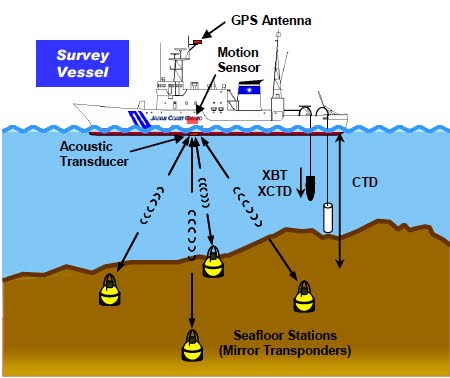
The figures from the paper about the M9.0 Tohoku-Oki megaquake are even worse, largely because the data is better. All of the sensors used in the Chilean earthquake were on land, and thus pretty far from the actual subduction trench where all the action occurred (it's the black line on that picture). The Japanese had GPS sensors on the ocean floor, right near the subduction zone.
(This last sentence shouldn't make sense--GPS systems require an unobstructed "view" of a satellite to work, so a sensor on the sea floor shouldn't be able to communicate with a GPS satellite. However, by putting a lot of acoustic sensors on the sea floor, a ship or buoy can triangulate to figure out its exact relationship to the sensors, and then communicate with a GPS satellite to figure out its precise location. Here's a figure from the Japanese paper to illustrate:
 So, here's the data they recorded, and if doesn't make your hair curl, something is dead in your soul:
 So, bits of Japan lurched eastward 24 meters and rose by three meters. I'm trying to picture the place where I'm sitting doing that, and I confess that I am utterly failing in my efforts--let's see, I think it would place me on the roof of my neighbor's neighbor's house.
This is plenty scary on its own--but here I am in Oregon, and the subduction zone off our coast is due for precisely this kind of megaquake. We're always cautioned the geographically separated earthquakes that occur close together in time are not connected. However, these megaquakes seem to be a different thing, and there's some opinion that they megaquakes around the Pacific rim may cluster--there was a bunch of them back in the early 1960's (Chile, Alaska, Kamchatka/Kuril islands) and now we may be seeing another bunch. I live well inland, but when I do go out to the Oregon coast, I take care to notice all the signs for tsunami evacuation routes. I appreciate geological drama, but its toll on human life overwhelms me. I prefer to view such drama with the remove of a scientific paper, or (as with the Sierras) at the distance of a hundred million years. It's scary enough for me.
There's still geological drama today, though, and lots of sentients to see it and measure it. While in camp, I finally got around to reading some of the scientific reports about what is now called the Tohoku-Oki Earthquake of March this year, and about the Maule Earthquake in Chile in 2010. Both of these megaquakes were extremely well measured, thanks to GPS sensors, and produced reams of data--data that could be distilled into a couple of pictures that can give you nightmares (as if the videos and photos of the quake and tsunami didn't do it). This one just made me gape:


You definitely need to click on that and blow it up. Ideally, you should blow it up so that it's about the size of a football field. See those black arrows on the picture of Japan? You should blow up this picture so that they are 24 meters long. Each arrow represents a report on the horizontal movement of a fixed GPS station during the recent megaquakes. It's a useful exercise to simply pace out 24 meters, just to see how big a distance it is. When you think in terms of a region moving that far, it's damn big.
That scary picture is from a review article; the primary sources have scary pictures of their own. Here's one from the report on the Chilean megaquake, measured at M8.8.
 This figure is, like many figures from the primary literature, so information-dense as to be difficult to grasp. It records many things (movement of the GPS stations, regions of slip from almost a dozen previous earthquakes, etc), but for me the trippiest is the squiggles off to the left. These record not just the final displacement of the GPS stations (the red arrows), but the route they took to get there over the course of three minutes (the trail of dots that connects the beginning and the end of the arrow). I don't know what would be worse--to be in Constitucion and go 15 meters in one direction, or to be in San Javier (SJAV) and three minutes wandering all over. Another figure from the same paper shows vertical displacements; the station at Concepcion (CONZ) actually rose almost two meters.
The figures from the paper about the M9.0 Tohoku-Oki megaquake are even worse, largely because the data is better. All of the sensors used in the Chilean earthquake were on land, and thus pretty far from the actual subduction trench where all the action occurred (it's the black line on that picture). The Japanese had GPS sensors on the ocean floor, right near the subduction zone.
(This last sentence shouldn't make sense--GPS systems require an unobstructed "view" of a satellite to work, so a sensor on the sea floor shouldn't be able to communicate with a GPS satellite. However, by putting a lot of acoustic sensors on the sea floor, a ship or buoy can triangulate to figure out its exact relationship to the sensors, and then communicate with a GPS satellite to figure out its precise location. Here's a figure from the Japanese paper to illustrate:
 So, here's the data they recorded, and if doesn't make your hair curl, something is dead in your soul:
 So, bits of Japan lurched eastward 24 meters and rose by three meters. I'm trying to picture the place where I'm sitting doing that, and I confess that I am utterly failing in my efforts--let's see, I think it would place me on the roof of my neighbor's neighbor's house.
 This is plenty scary on its own--but here I am in Oregon, and the subduction zone off our coast is due for precisely this kind of megaquake. We're always cautioned the geographically separated earthquakes that occur close together in time are not connected. However, these megaquakes seem to be a different thing, and there's some opinion that they megaquakes around the Pacific rim may cluster--there was a bunch of them back in the early 1960's (Chile, Alaska, Kamchatka/Kuril islands) and now we may be seeing another bunch. I live well inland, but when I do go out to the Oregon coast, I take care to notice all the signs for tsunami evacuation routes. I appreciate geological drama, but its toll on human life overwhelms me. I prefer to view such drama with the remove of a scientific paper, or (as with the Sierras) at the distance of a hundred million years. It's scary enough for me.
Heki, Kosuke (2011). A Tale of Two Earthquakes. Science 322: 1390-1391.
C. Vigny, A. Socquet, S. Peyrat, J.-C. Ruegg, M. Métois, R. Madariaga, S. Morvan, M. Lancieri, R. Lacassin, J. Campos, D. Carrizo, M. Bejar-Pizarro, S. Barrientos, R. Armijo, C. Aranda, M.-C. Valderas-Bermejo, I. Ortega, F. Bondoux, S. Baize, H. Lyon-Caen, A. Pavez, J. P. Vilotte, M. Bevis, B. Brooks, R. Smalley, H. Parra, J.-C. Baez, M. Blanco, S. Cimbaro, E. Kendrick (2011). The 2010 Mw 8.8 Maule Megathrust Earthquake of Central Chile, Monitored by GPS. Science 322: 1417-1421.
Sato, Mariko, and Tadashi Ishikawa, Naoto Ujihara, Shigeru Yoshida, Masayuki Fujita, Masashi Mochizuki,Akira Asada (2011). Displacement Above the Hypocenter of the 2011 Tohoku-Oki Earthquake. Science 332: 1395.
Sunday, June 19, 2011
First class, last class
First Class/Last Class
I typically have a rough time with last lectures. First lectures are easy—your head is clear, there is no personal history between you and the students to complicate communication, and you haven’t made any mistakes yet. Last lectures are tough. The stress of the end of the quarter fills your mind, and standing at the front of the chalkboard is like standing at the focus of a parabolic reflector of undergraduate anxiety. A class of undifferentiated freshmen has become a class of individuals: the ones that are smarter than you, the ones who planktonically drift towards failure, the angry whiners and grade-grubbers, the earnest strugglers who through might and main are dragging themselves from a C to an A-. Addressing a class is just public speaking; addressing these individuals who you know personally demands personal communication.
The hardest thing on the last lecture is the mistakes. I should say "mistake," because it's always the same one: I’ve somehow forgotten to tell them just how much they should love the subject for its poetry and emotion. So, I read Darwin’s tangled bank, or emphasize how a single mutation can change the history of life on earth, or how every atom in their bodies was formed in a star and recycled through thousands of lives…and I get choked up. Usually, I make it through, but it’s rough.
I was really worried that this time would worse—after all, not only the last lecture for this class, but my last lecture at Davis. I decided to try a slightly different tack. This was the first biology class for most of my students, and rather than make the envoi about me and my love, I made it a challenge for them: ten big problems that I thought could be solved during their science careers. This list is by no means comprehensive—in fact, it was designed as much to prompt review as anything else. I could add lots of other things, but it was fun to think about:
1. In the laboratory, make a self-replicating molecule or assemblage of molecules.
2. Make a simple cell from scratch (not Ventner’s reboot), or completely model one on a computer.
3. Effectively use biological systems to clean up the messes of the 20th century—from superfund sites to Hanford nuclear reservation. This will require an understanding of metabolism and genetics
4. Make a solar cell that simply comes close to the efficiency of rhodopsin or a chlorophyll-based photosystem.
5. Understand photosynthesis—from the initial excitement of an electron by light, to how to split water at room temperature, to consuming CO2 to make fuel.
6. Fix nitrogen efficiently. The Haber process, which produces ammonia from atmospheric nitrogen, and which modern agriculture depends upon, consumes somewhere between 2 and 5 percent of all natural gas production worldwide.
7. Understand the central dogma in Archaea. We just don’t understand how these cells work.
8. Understand how proteins fold, so that we can not only predict the structure that comes from a given sequence of amino acids, but design a sequence of amino acids that will give a specific structure.
9. Use viruses for therapy. This includes “gene therapy,” which has been the medicine of tomorrow for about three decades, as well as phage-based antibiotics.
10. Understand the role of Viruses, Archaea and microbial Eukaryotes in the environment. These have been called the “Dark Matter” of the biosphere, and we just don’t know what they do. It’s as if 70% of the economy was the black market.
(Bonus number 11—understand development. This is another thing we just don’t fully understand in biology, and it’s a neat problem.)
Well, I managed to get through it without choking, and to my surprise, I got a round of applause at the end. Kind of gratifying, but I’ll be happier, more like ecstatic, if one of my students goes on to actually solve one of those problems. I think they can.
Feel free to suggest further problems to be solved in the next 20 years.
Sunday, May 8, 2011
How to feel like a complete bastard
As part of the business of moving, we must sell our house. This means that we have to fix up a bunch of stuff to make it saleable--repair potential termite damage, replace a shingle on the roof, fix a leaky bathtub, paint, and fix up the front porch, which has these big cracks running through it.
This last issue means that we're going to have all kinds of conniptions on the front porch, which means that it's a totally unsuitable place for a hummingbird to build her nest.
 Fortunately, she had just started--the nest was about 1/4 built, and there were no eggs. But we could watch her fly up with a bit of fluff, tuck it in, then sit in it and wiggle her butt to get it in place.
 It had to go.
So, up the ladder I went, and down came the nest. It was mostly spiderwebs, and surprisingly solid in its attachment to the cable. But boy, did I feel like the lowest, meanest cur on this planet as I took it down.
This last issue means that we're going to have all kinds of conniptions on the front porch, which means that it's a totally unsuitable place for a hummingbird to build her nest.
 Fortunately, she had just started--the nest was about 1/4 built, and there were no eggs. But we could watch her fly up with a bit of fluff, tuck it in, then sit in it and wiggle her butt to get it in place.
 It had to go.
So, up the ladder I went, and down came the nest. It was mostly spiderwebs, and surprisingly solid in its attachment to the cable. But boy, did I feel like the lowest, meanest cur on this planet as I took it down.
Thursday, April 21, 2011
Busy insects
These structures popped up overnight in an outdoor hallway of the bio sciences building.
 They're chimneys of mud, made by soil termites. It's supposed to be a sign of rain, or of spring, or of bored termites (depending upon who you ask). Here's another view.
 They're not very tall, maybe six or seven centimeters, but I was still impressed. The nearest exposed soil is a long way away, and I would not have expected that a wee beastie would be able to find a space in the seam between a concrete path and a wall. But nature will find a way, and it seems that the smaller the beastie, the greater the patience. (what's that, Opal?--Oh, Pomeranians excluded!) A close-up shows the construction of these termite towers of Babel--not baked brick, but little pellets of mud, chewed and regurgitated and cemented in place by termites.
 I wasn't able to get a good picture of the builders. They would climb up only far enough to wave their antennae at me, then disappear before I could get a picture. I spent five minutes crouched awkwardly in a narrow hallway outside of a building full of scientists, and a half dozen people squeezed by me. Only one of these people (who I would hope are curious by profession) stopped even briefly to look at what I was doing. He got down to look at them too, and was delighted and impressed. I think that's the right response, and I dearly hope that my students would pass that test.
 They're chimneys of mud, made by soil termites. It's supposed to be a sign of rain, or of spring, or of bored termites (depending upon who you ask). Here's another view.
  They're not very tall, maybe six or seven centimeters, but I was still impressed. The nearest exposed soil is a long way away, and I would not have expected that a wee beastie would be able to find a space in the seam between a concrete path and a wall. But nature will find a way, and it seems that the smaller the beastie, the greater the patience. (what's that, Opal?--Oh, Pomeranians excluded!) A close-up shows the construction of these termite towers of Babel--not baked brick, but little pellets of mud, chewed and regurgitated and cemented in place by termites.
 I wasn't able to get a good picture of the builders. They would climb up only far enough to wave their antennae at me, then disappear before I could get a picture. I spent five minutes crouched awkwardly in a narrow hallway outside of a building full of scientists, and a half dozen people squeezed by me. Only one of these people (who I would hope are curious by profession) stopped even briefly to look at what I was doing. He got down to look at them too, and was delighted and impressed. I think that's the right response, and I dearly hope that my students would pass that test.
Saturday, July 17, 2010
"Hey mummy, what is fair? How come I have to share?"
As Ricky Lee Jones’ kid-inspired lyrics suggest, fairness is at least partly a learned quality. A young child doesn’t get fairness at all, and views of fairness change as children mature. I was amused to read a paper by a group of Norwegian economists who were trying to quantify this process.
A classic tool for looking at fairness in human interactions is “The Dictator Game.” The economist/sociologist/researcher gets two people, and gives one of them, the “dictator,” a sum of money. The dictator is then asked to divide up the money as he or she sees fit. Purely selfish people will keep it all, but (reassuringly) purely selfish people are rare. Most dictators give the other test subject some of the money. This is true across cultures and across ages.
But life is rarely as simple as the dictator game. Wealth is, alas, all too rarely bestowed by a rich uncle; it must be earned. But life is capricious—some have wealth due to luck, whether due to a rich uncle or a happy accident. And further complicating things, not everybody needs the same things, so a gift to some is worth far more than a gift to others—a factor the economists call “efficiency”. How does a person’s idea of fairness account for these factors of effort, luck, and efficiency? The Norwegians found that for most people, views of fairness change with age.
The Norwegians modified the dictator game so that the dictator divvied up wealth that was “earned,” in this case by the dictator and the partner sorting numbers on a computer screen for a while. Both dictator and partner were perfectly free to play video games, but most everybody “worked.” The researchers then modified the game—at random, one of the subjects of the game would be compensated for their “work” at a vastly higher rate. Since this was due to chance, the idea was that this would model “luck.” And finally, they modified the game by telling the dictator that every cent he or she kept would be worth one cent, but every cent he or she gave to the partner would be doubled, trebled, or quadrupled. It would be most “efficient,” and result in maximum benefit to society, for the dictator to give everything to the partner.
The Norwegians found that younger kids have, on average, a simple notion of fairness which they called “egalitarianism.” Regardless of effort, luck, or efficiency, the dictator divided things 50-50. As children aged, up to the end of high school, things changed. They steadily became more “meritocratic,” with dictators assigning wealth according to effort. Additionally, children paid more attention to efficiency, but this was a late development. Interestingly, boys (on average) discovered efficiency by age 13, while it took longer for it to be a factor for girls.
It’s not too surprising that most peoples’ views of fairness change as they grow up. A meritocratic view of fairness, accounting for efficiency, requires a certain level of cognitive development. But, as the authors note, this development must be in part driven by society. This study was not done in the United State, the world’s leading light of market-driven capitalism. This study was done in Norway, which is one of those awful European hell-holes that the champions of the invisible hand warn us about, and the toxin of Euro-socialism can’t help but warp impressionable young minds.
However, there is something here for the free-marketers. Besides the egalitarianism and the meritocracy, there is a third view of fairness manifested in this study. The authors call it “libertarianism, which justifies all inequalities in earnings.” Libertarian dictators give themselves all the wealth that is to be distributed. It appears, according to this study, that about a third of children are born libertarians, and since that number remains constant, it appears that the libertarians never grow up.
 data from Almas et al 2010
Having interacted with a few libertarians, this is also not surprising.
Ingvild Almas, Alexander W. Cappelen, Erik O. Sorensen, and Bertil Tungodden (2010). Fairness and the Development of Inequality Acceptance. Science 328, pp. 1176 - 1178.
Wednesday, May 12, 2010
Not microbiology, but still cool
I go on about the cool things that modern imaging can see at the micro scale, but there's been plenty of advances in imaging at the macro scale that reveal stuff that's almost as amazing. Like this:
 It's a landslide--on Mars. The blue arrow up at the top points to a probable meteorite that triggered it. For the full story, go here.
 It's a landslide--on Mars. The blue arrow up at the top points to a probable meteorite that triggered it. For the full story, go here.
Subscribe to:
Posts (Atom)