Showing posts with label weird Eukaryotes. Show all posts

Sunday, August 7, 2011

Predator, Prey, and Jabberwock

I noted that scientists can sometimes be unintelligible. Sometimes, this is a cultural thing, where the structure of language is just different. Other times, it’s just the words.


I’m reading through my backlog of Science magazines, and I found this interesting paper titled “7000 years of Emiliana huxleyi viruses in the Black Sea.” It’s really very neat: basically, if you look into the sediments at the bottom of the Black Sea, you can look back in time—the gunk on the top is stuff that floated down recently, while if you dig down a little bit you find gunk that was deposited thousands of years ago. Some of that gunk is minerals, washed into the Black Sea by its tributaries. However, a lot of that gunk is the shells of a type of plankton, Emiliana huxleyi.


What’s neat about this paper, by Marco Coolen from Woods Hole Oceanographic Institution, is that he isolated the DNA of E. huxleyi from that ancient ooze. So, he could look at how the genes in the population changed over the last seven thousand years. Even more interesting, he isolated DNA from the viruses specific to E. huxleyi, so he could look at how their population changed over time. This is nifty, because viruses are really predators. So by looking at the genetic changes in predator and prey over time, it’s possible to see how each changes in response to the other—and also how both respond to changes in the environment, as the Black Sea swung from brackish to fresh and back.


Viruses generally evolve quickly. What Coolen found was that, over 7000 years, the viral DNA he found in the Black Sea muck showed signs of continuous evolution and innovation. A certain combination of viral genes would be dominant for a couple of hundred years, then be replaced by a new combination. Every few hundred years, there would be a completely new dominant virus.


However, the prey—E. huxleyi—evolved more slowly, and revisited certain genetic combinations. While the population might be almost entirely of one sort for a while, it would evolve to be almost entirely of a different sort in a thousand years. It’s as if a population of humans were 99% brown-eyed and 1% blue-eyed, then over a thousand years the population evolved to be 99% blue-eyed. It’s likely that at least some of this change in E. huxleyi was driven by the viruses, as if (in our analogy) there were a virus effective at killing brown-eyed humans but not the blue-eyed. What’s neat is that as the viruses got good at killing the new majority type of prey, rather than evolving into something completely different, the E. huxleyi just reverted back to the original majority. Extending the analogy, it’s as if the viruses became good at killing blue-eyed humans—but rather than the population innovating and evolving to become 99% green-eyed, the population drew upon a small remnant of brown-eyed survivors. These became the parents of a new population that eventually evolved to be 99% brown-eyed.


This is all very neat: it tells us something about predator-prey relationships, the mechanisms of evolution in microbes, and how a very neat and ecologically important organism evolves in response to environmental changes. The paper is also really, really hard to read, freighted as it is with ten-dollar words. These are convenient—it is easier to simply say “coccolith” than “cute little calcite shield made by E. huxleyi,” but it makes for hard reading. After a while, it gets a bit much (and these are just some of the choice words and phrases in a two-page paper):


The song of Coccolithovirus to E. huxleyi, or

"You can't spell 'coevolution' without 'love'":


Let us stroll by euryhaline seas,
Wiggle our toes in recalcitrant alkenones,
Saunter the hypersaline chemocline
And bask in deglaciated photic zones.


I am pelagic, I come from the sapropel--
Of laminated coccolith ooze my home.
You are a haptophyte—of Holocene stock,

With many an amplicon in your genome.


Stratigraphic chemoclines mean nought
To us, who share in glycosphingolipid.
Come to me!--such palynological deposition
Is more than coccolithophorid!


Oh, let us co-occur in the deepest core
‘till hydrologic and nutrient regimes are no more.

Friday, March 25, 2011

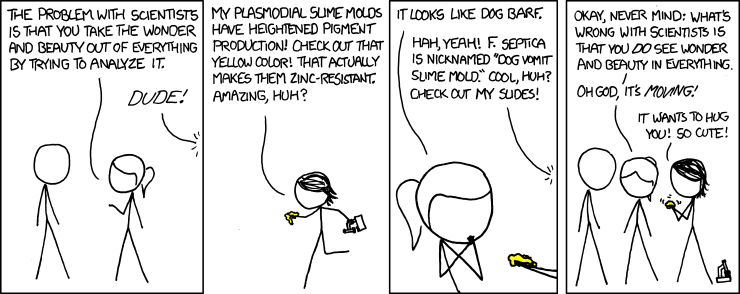
This about says it all...

And it even mentions one of my favorite eukaryotes, Fuligo!

From the ever-wonderful XKCD. (Click on it to make it legible.)

Tuesday, January 4, 2011

Infusoria!

The new class is going OK so far. I have very little formal training as a microbiologist, and I'm more of a molecular biologist who happens to work in Bacteria than an actual microbiologist. So, until today, I've never used a microscope for work. Today, though, I had to teach a lab class, using microscopes--phase contrast, Gram stain, and so on. Fortunately, it was all review for the students, and the TAs did most of the work. I spent most of the time looking at all the groovy things that grow when you make herbal tea using hay.

"Hay infusion" is close to the roots of microbiology--after Leeuwenhoek, who looked at rain water and water that had pepper in it, most of the early discoveries in microbiology were done looking at the things that grew after you soaked hay in boiled water--a hay infusion. In the early days of the field, when it was still unclear whether the critters seen in the microscope were alive, or plants, or fungi, or whatever, scientists dodged the issue by calling them "infusoria."

So, here's some video of a couple of ciliated eukaryotes found in hay infusion. This first one is happily waving his cilia (or "paws," as Leeuwenhoek called them).

This second video shows the organism's "contractile vacuole" at work. Look for it at seven o'clock on the cell, getting larger then suddenly contracting every four seconds.

This organelle solves the difficult problem of osmosis: water is constantly flowing into the cell, trying to dilute the contents of the cell so they are at the same concentration as the surrounding liquid. If the cell doesn't want to explode from the inrushing water, it has to get rid of it. So, it spends lots of energy sucking water out of its cytoplasm and concentrating pure water in the contractile vacuole--then discharging that pure water back out into its surroundings.

Technical notes: Zeiss optics, 10X60 or 10X100 with phase contrast and oil immersion, and the video was shot using a Canon PowerShot SD 880 held up to the eyepiece.

Saturday, May 29, 2010

Friday Fuligo, continued

The “dog barf” phase of Fuligo’s life is like the adult stage of a mayfly’s life. The mayfly larva lives for months as a predator in streams and lakes before spending a single day as a sexually reproducing result. The dog barf also lasts a single spectacular day devoted to reproduction, but it’s the last stage of a much longer predatory life.


Fuligo spends most of its life growing as a weird thing called a plasmodium. The plasmodium starts out as an ordinary eukaryotic cell, something like an amoeba. It’s mobile and predatory, and it engulfs any smaller cells it encounters as it creeps along its way. Unlike an amoeba, or any normal cell, it doesn’t divide as it grows. The cell just gets bigger, and BIGGER, and BIGGER. It copies its DNA, and its nucleus divides, so the result is a plasmodium: an enormous (well, a couple of centimeters) single cell membrane enclosing millions of nuclei. It has been reasonably compared to the title character in the B-movie classic “The Blob,” only instead of terrorizing Steve McQueen, it mows down bacteria and protozoa. If you’re lucky, you can sometimes see a plasmodium, a sort of film growing on moist humus.


When the time is right the Fuligo plasmodium gathers itself up and turns into the beautiful bumpy yellow blob we see. Its texture is like the fluffiest scrambled eggs, and I have read that it is cooked and eaten as such in Mexico—though I am not sufficiently adventurous to try it. If you see this in the morning, over the course of a single day it will turn tan and crusty, then brown and brittle. Break this, and you’ll get a cloud of black dust. The dust is spores, single cells that can spread on the wind and, in the right environment, repeat the cycle.


According to a recent hypothesis, the odd thing about Fuligo is that it not only eats protozoa as it oozes through the mulch, it actually incorporates some of their DNA into its own genome. This would be like me taking DNA from the asparagus that I ate last night and having the asparagus DNA woven into my own DNA—and that asparagus DNA would be found in the genomes of my descendants.


To briefly review, what makes Fuligo into Fuligo, and not asparagus or a human, is its genes. Fuligo DNA is transcribed to make RNA; that RNA either gets translated to make protein, or works as a catalytic RNA such as is found in the ribosomes. To a rough approximation, one gene encodes one protein or catalytic RNA. The sequence nucleotide bases in the DNA—A, T, G, and C—corresponds exactly to the sequence of nucleotide bases in the RNA transcript A, U (instead of T), G, and C. Likewise, the sequence of nucleotide bases in the RNA transcript corresponds in a precise way to the sequence of amino acids in the finished protein.

One hitch in this process is that the DNA often contains introns. Introns are sequences of DNA that occur in the middle of a gene, yet do not encode part of the finished catalytic RNA or protein. Eukaryotic organisms (like Fuligo, asparagus, and us) have lots of introns. As DNA is transcribed to make RNA, special enzymes snip the intron-encoded RNA out, and join together the remainder to make an RNA that can be much shorter than the DNA that it was transcribed from. The intron-encoded RNA is simply recycled.

Introns are a puzzle. They seem wasteful—the cell spends lots of energy replicating their DNA, making them into RNA, removing them from RNA transcripts, and recycling them. In fact, some people view them as “DNA parasites”: instead of an organism like a mosquito that reproduces at the expense of another organism, introns are DNA sequences that reproduce at the expense of another piece of DNA, the rest of the genome.


Most protozoa and a few fungi have particularly unusual introns. They are generally found in specific genes encoding the catalytic RNA of ribosomes. Class I introns are “self splicing”. They don’t need the help of any enzymes to do the cutting and pasting required to make a finished RNA. In fact, you can put RNA containing one of these introns by itself in a test-tube, and it will edit itself perfectly. The excised RNA will form itself into a stable little circle of RNA, and the rest of the RNA can go and do its job.


Different families of protozoa have different class I introns—the ones in different types of Tetrahymena look similar to each other, but different from the ones in different types of Acanthamoeba. Usually, the ribosomal RNA genes of these different protozoa contain one or two class I introns.


Fuligo is different. A group from Norway led by Steinar Johansen found that Fuligo’s ribosomal RNA genes have twelve class I introns. There’s a potentially easy explanation for this exuberance of introns. Duplication is a very common way for DNA sequences to evolve, so it’s possible that one class I intron could have been repeatedly duplicated. But the actual explanation is not so simple. Johansen found that most of the class I introns in Fuligo have no family resemblance to each other, so they’re not the result of duplications. In fact, one of the introns looks a lot like the ones from Tetrahymena. Another looks a lot like the ones from Naegleria. A third looks a lot like the ones from Acanthamoeba. These organisms, and a few others, are no more related to the Fuligo than you are—and yet, it looks like they contributed some DNA, specifically class I introns, to the dog-barf slime mold. A “family tree” of known class I introns shows this:

All the Fuligo introns are labeled Fse#### in bold; all the others are introns from other organisms. Generally, related organisms have related introns—for example, at the top of the figure, FseS1065 is a sibling of NmoL2563 and NmoL1949 and NaeL1926, which are all introns from related organisms in the genus Naegleria. Going down a little bit, you can see that the Fuligo introns FseS956, FseL1090, and FseL569 are closely related, and may have evolved by duplication from an ancestral intron. However, these are the only "sibling" introns in Fuligo.


Johansen proposes a wild hypothesis: The diverse protozoa eaten by the plasmodium stage of Fuligo have diverse class I introns. These are present (as the terrified protozoan is engulfed by the plasmodium) both in the protozoan genome, and as the little circles of RNA that are left over after the intron has been removed. It might be that the intron DNA gets mixed into the Fuligo DNA, or it might be that the intron RNA reverses its usual reaction—instead of snipping itself out, it pastes itself into a ribosomal RNA gene. Fuligo kills and eats the protozoan, but the protozoan reaches out of its grave and gives Fuligo a parting gift, a DNA parasite that it will never be rid of.


This is an unusual example of lateral gene transfer: the transfer of genetic material from one organism to another unrelated organism, uncoupled from reproduction. Typically, lateral gene transfer in Eukaryotes involves the transfer of a useful gene, one that enhances the fitness of the recipient, or something that is at least neutral. Here, we are shown the transfer not of a gene, but of a DNA parasite that may actually reduce the fitness of the recipient: a class I intron. Lateral gene transfer is rare in the Eukaryotic world (so I don’t worry about turning skinny and green when I eat asparagus), and this happened less than twelve times in the millions of years of Fuligo’s evolution. As Johansen says,

Perhaps the large number of introns accumulated in Fuligo [ribosomal RNA genes] reflects its natural behavior and promiscuous feeding habits and, thus, is a case in point of the phrase “you become what you eat.”

Eirik W. Lundblad, Christer Einvik, Sissel Rønning, Kari Haugli, and Steinar Johansen (2004). Twelve Group I Introns in the Same Pre-rRNA Transcript of the Myxomycete Fuligo septica: RNA Processing and Evolution. Molecular Biology and Evolution 21 (7), 1283-1293.