
The day before yesterday was one of the hinges of the year, where we turn from one segment of the farm calendar to another. In the morning, I went up to the barn. I gave the elderly sheep a scoop of senior equine feed. To the does, I gave a feeder-full of orchard grass hay. For the ewes, I only had to fluff up the orchard grass that was in their feeder, for they hadn't cleaned it up, and as soon as I opened the door they bolted out into the pasture. I walked over to the bucks, filled up their feeder with orchard grass, and fluffed up the rams' feeder. I then walked over to the junior bucks, topped off their feeder with orchard grass, walked over to the junior does and did the same for them, and I was done.
That was the morning feed. The junior does and bucks had been getting supplementary grain and a little alfalfa, but they had outgrown their need for it. The senior bucks are coming out of rut, and no longer need extra calories from grain. The sheep are working the pastures down to nubbins before I spread seed, and are less interested in hay than they are in fresh grass. Those animals had just finished tapering off their feed requirements. Today, some of the animals are starting their increase--the first does are expected to kid in a week or less, so now they are getting a generous serving of alfalfa. Things will get more complicated as we have kids to bottle feed, milking does to nourish, and possibly a ewe or two with lambs--and that's not to mention the routine of milking. But, for a couple of days there, feeding everybody, including the chooks, the cats, and the dog, took only twenty minutes.
Showing posts with label animals. Show all posts
Showing posts with label animals. Show all posts
Tuesday, March 6, 2018

Friday, January 29, 2016
Friday fauna: Where Eagles Dare to Eat Lunch
(Warning, kinda graphic image of dead animal further down the page, skip this one if you're squeamish.)
One of the noticeable steps in the transition from city slicker to farmer involves one's regard of the local fauna.
A couple of years ago, I would occasionally see a pair of bald eagles flying overhead, commuting back and forth between their nest somewhere and the river to our northwest. I'd stop whatever I was doing and gawk. Eagles! They are big, they are impressive, they are beautiful as adults, they are symbolic, and really, they are well worth stopping and admiring. The pair became a trio, and the juvenile spent a couple of weeks along our creek before it moved away to find new territory.
We are less than a month away from lambing and kidding here--a lot of the surrounding farms have lambs on the ground already--and I am mentally getting into the mode of worrying more about my animals. A bald eagle will happily eat anything that looks dead, and a golden will kill for its lunch. So my attitude towards the eagles has changed. When I see when flying overhead, especially if they're flying kind of low, my thoughts tend towards "Hey, @#$%, get the &^%$# out of here and don't even $%#^ing look at my $%@*ing animals!!! @#$%!!!"
Well, yesterday was a busy day here for the eagles, and they had me good and riled up. Adult and juvenile, bald and golden, they were flying over us all day, screaming and fussing. It didn't take too long to realize that they were not worked up about any of our beasts, but instead about something just across the creek from us.
Our neighbor J. runs cattle over there, and his cows have been calving recently. One little calf didn't make it--I couldn't tell whether it was killed by a predator or one of the myriad things that can off a young ruminant. Whatever the cause, a day's work by the eagles left it rather diminished:

I didn't have the long lens that I needed to capture what I saw through binoculars as I approached the carcass, and which really can push you away from the "majestic symbol of our country" view of eagles and towards a more farmer-ish view. It was a juvenile (but full-sized) golden eagle that had hit the calf buffet a bit too hard. It had tried flying, but was weighed down with excess giblets. So it just sat on the hillside above the carcass, basking in the afternoon sun, visibly engorged. Through the lens, it looked less the majestic eagle and more like a sumo wrestler regretting that last helping of pie. @$#%* better stay away from my animals.
Thursday, January 14, 2016
The Ballad of Butch the Chook
The life of the farm chicken is mostly good: a steady supply of food, acceptable housing, room to roam and scratch, nice spots for laying eggs, the occasional juicy snail...and then a rather sudden end. But not for Butch.
We got our first batch of chooks almost three years ago. At that time, there wasn't much to the farm at all--very few animals and almost no infrastructure. However, chickens don't need much, especially when they first arrive. (We get ours from Murray McMurray, and they arrive by mail as one-day-old peeps; you get a call from the P.O. at 5:30 in the morning, asking you to come by and pick up your package, which is about the size of a large shoe box and is chirping like a box full of chicks.) For a few weeks, they were fine in a big wooden box with a heat lamp.
The theme of our farm, for far too much of our term here, has been a race between animal acquisition and the construction of animal facilities, and animal facilities have consistently lagged. So our first batch of chooks was getting far too big for their temporary quarters before I got their coop built...a situation I'm really ashamed of.
I am also ashamed of the coop that eventually got built. There are a lot of paintings out there that have violins in them, and in many cases, you can tell that the artist has seen a violin before but when pressed, couldn't quite remember some features right. Well, I had seen some nice larger coops, and had some ideas about what I wanted, but I was constrained by cheapness and didn't get some details right. I was also hampered by my own inexperience: I had seen some construction work, but I clearly didn't get the construction right. The result was just bad. The floor gave out, the doors didn't stay together, the roof was horrible, there were severe design flaws...just bad.
Once we got them into the coop, we had a mixed relationship with our chooks. I never did get the coop painted, so it stayed ugly. As always, facilities for animals lagged behind need, so I didn't get the perches installed for a while. I never got a satisfactory waterer, so the birds got all their water from the animals' water buckets. I was so busy with the other animals that I didn't really get to domesticate the birds, and only two of them ever got named.
Things even managed to get worse. I didn't get egg boxes made until after the birds had started laying, so I taught them some inexcusably bad habits. Of the dozen or so birds, a couple laid eggs where they were supposed to; the rest would find secluded nooks and hidden niches to make nests. I'd periodically find a clutch of a dozen or two dozen eggs of unknown age behind the fencing wire or in the burn pile or with the plumbing supplies or behind the paint cans or in some other private place. If I found a nest, I could sometimes clean the eggs out and the culprits would continue to lay there; more often than not, as soon as they realized they'd been found, the culprits would stop laying there and find a new hiding place.
There were a few birds who did lay in the boxes we provided. However, there were also a couple of birds who developed a taste for eggs. Worse, the oviphages knew that the egg boxes were an easy mark. I never did see a smoking gun--or yolky beak--to know who did it, but I had some suspicions.
By last spring, we were feeding over a dozen birds, and getting eggs from maybe two. The remainder had some utility, eating snails and such, but still, we were paying to feed them. We decided to get a new batch of chooks. The chirping box arrived in the mail in July, and they've been settling in nicely since. I took longer than I'd like to admit, but I did finally get their coop built, and it's pretty good: better design, and vastly better construction. I took unreasonable delight in dismantling the old coop, obliterating that stain from our yard.
A neighbor of ours offered to take our old birds and give them a home in some canning jars, which was fine by us. So one night, S. came by, reached into the coop and grabbed the snoozing chooks by their feet and stuffed them, complaining and groggy, into a box. "Big day tomorrow," said S., "been hunting, so we're doing chickens and grouse and a turkey!"
Such was the end for our first batch of chooks--except Butch. Butch was always a special bird. We were very suspicious about Butch from an early age; though the bird never developed spurs, it did develop a bit more comb and wattles than a hen of the breed was supposed to. Butch would try--and still tries--to crow sometimes in the morning, though it comes out like a teenage boy trying to do James Earl Jones. But, Butch was one of the few birds that, at least for a while, went into nest boxes, and with my own eyes I saw Butch enter an empty nest box and leave an egg behind. Thus the name (and the lack of a gendered pronoun), and Butch avoided an early trip to the cook pot.
Butch differed from the other birds in one essential way: instead of heading back to the crummy, shoddy coop to sleep, Butch would perch high in the rafters of the woodshed. So when S. came by that fateful night, Butch escaped.
But Butch had to develop a new modus vivendi. The new chickens have grown up in their new coop, and I have them fenced in with an eight-foot-high wall of chicken wire under a tree. (They can fly around, but remain naive about the possibility of flying out of their enclosure, and they will learn that they should always lay eggs in the nest boxes.) Butch was wandering around forlornly (and hungrily) so I put captured the bird and threw it in with the young 'uns. They collectively decided that this newcomer should be at the bottom of the pecking order and went on the attack. From nesting in rafters, Butch knew that vertical flight meant safety, and so escaped--back to hunger and solitude.
However, Butch has it figured out now. Every morning I find Butch in the enclosure, under the coop, breakfasting on scratch that has fallen through the floor. When I release the new birds from the coop, Butch quickly runs in as they fly out, and grabs a bit more chow before flying up to the roof and over the fencing. Periodically, during the day, Butch will fly in for a nibble and fly out. Every night finds Butch safely and smugly roosting, high up in the woodshed, resting up for another day. And so Butch lives and will, unlike the rest of the first cohort, continue to live, happily ever after.
Provided I never find yolk on Butch's beak.
 |
| Butch, getting ready to fly the coop. |
Wednesday, January 13, 2016
The year in review...
Well, that was a busy year. It's good to look back on it--partly because it allows me to actually se that we have accomplished something in this our third year on the farm, and partly because it's nice to have such a year in the rear view mirror.
 There it is: most of what I worry, work, fuss, and tire myself out on, a place that I don't leave most days. I can walk less than a mile, and most of my world gets small enough that you can't really tell much about it.
 Here's a few lines that clarify things--the green line is our property line, and the purple line is what we actually payed attention to in the last year--just over half of our acreage.
 Here's the same bit of land, viewed from space; my world is again in purple.
As with the previous years, the big effort was to get our infrastructure built to meet the needs of the animals, those already here, those born on site, and those acquired--an effort comparable to building an airplane as it's flying and full of passengers. We started the year with facilities that could accurately be described as "not immediately fatal." We are beginning the new year with facilities that are, for some animals, adequate, and for others, promising to be much better than adequate.
Our barn has become quite functional. Of course, it was designed to be functional, but between design and implementation there are always contingencies. That said, it is now safely and effectively housing more than 35 Shetland ewes of all ages and more than 20 Nigerian Dwarf does and kids. Banks of LED lights make the barn bright as day, using the power of a single 120 Watt bulb. Building enclosed spaces under the eaves has doubled our housing area and allowed different age groups to be segregated.
The construction of new feeders has made feeding quite easy. I'll need to tweak their design in the coming year to further reduce waste and improve fleece quality, but the improvement over the last year is huge.
The male animals are still in "not immediately fatal" housing, but that is changing; after two years of delay (getting engineering done on the works, negotiating with a federal granting agency, waiting for weather, waiting for the end of hunting season, etc) we are finally building housing for our bucks and rams.
It won't be done until early 2016, but at least it's under way--which means that our rams will have shelter that protects them from the elements and that they can't destroy.
As growers of sheep and goats, we are primarily growers of pasture, which we use animals to harvest. This year saw big improvements in our pastures, improvements visible from space. Thanks to the federal government (and you, the taxpayer!), we received financial assistance in building fencing in our pastures to facilitate rotational grazing and good grazing techniques. You can actually see this part of our labors in the satellite picture:
The south (left) pasture is divided in two by permanent fence, then subdivided by electric mesh for rotational grazing. The rams and bucks are in smaller pastures (top and lower right). Internal fencing, combined with improved housing, has made management of the farm immeasurably easier. 2015 was a very difficult year for grazing--a severe drought made the fields dry up two months earlier than usual. We could have done worse: we've done some seeding, to try to improve our pasture, and some targeted grazing and manual weed control to eradicate some of the more troublesome weeds. Also, we did a soil analysis, and started lime applications to help bring our soil's pH back to a more hospitable range. We could do better: this year will see additional seeding, lime, and perhaps fertilizing. So far, we are having a nice wet winter.
We still need to buy hay, and this year we did a better job. In previous years, I'd become something of a fixture at the co-op, coming in every week to buy six bales of hay, because that was all that fit in the truck and all that we had space for; an expensive and inefficient way to do things. This last year, we've started buying hay by the three-ton, then by the eight-ton load, and we've connected with an organic supplier--although not soon enough to get the really good stuff. This coming year, we'll hopefully be able to buy (and store) a year's worth of the good, second-cut hay.
A lot of that food eventually becomes poop, and this year saw no improvement in our ability to deal with it. We are still using deep bedding, a system of straw bedding that is changed quarterly. It's effective, but creates problems with fleece quality and can damage the barn structure. We don't have good compost management, either. The coming year we will hopefully see the construction of a proper compost facility and installation of a raised flooring system in the barn. I also hope to purchase a manure spreader, to recapture valuable nutrients that are otherwise lost.
Of course, it is necessary for the farm to not only manage resources, but also be financially sound. Our products this year have been primarily quality breeding stock (both goat and sheep), dairy products, and meat (and a few eggs).
A breeding program is a decades-long endeavor, and we are at the very beginning. This year, we bought a few more animals that will make good breeding stock: we took advantage of a herd dispersal, and got a couple of good sires by being persistent and in the right place at the right time. We are just seeing the very first results of our first round of breedings, some of which are good. A goat of our own breeding placed tenth in a huge class at the ADGA national show, and other animals of our breeding got good reviews from judges at other shows.
While show ribbons are nice, stock is supposed to be sold. We sold all of the goat kids that we didn't want for ourselves (we keep the ones that are better than their parents). We didn't do as well with the sheep, having twice as many rams as ewes in our lamb crop. Most of the boys went to the butcher, though one found a home as a sire in Colorado. We are not able to command as high a price for our animals as more established farms, but we hope that will change over the coming years.
Dairy production was limited this last year, with only eight does in milk and most of them low-producing first-fresheners. However, this allowed me to work on cheesemaking techniques. Happily, I have learned to make a variety of fresh cheeses that people are willing to pay for. We also improved our aging facilities, making hard cheese possible. I am now sampling some of the cheeses that I made this summer, and they are genuinely pleasing. This coming year, with more does in milk, I'll be making and hopefully selling much more cheese; indeed, the challenges will lie not in the reliability, but in time management (both in milking and cheesemaking) and marketing.
Wool production is still rather below what we'd like. Our game is not yet up to producing a good, clean fleece. The improvements in pasture management and housing over the last year are a start, but more work is required. We have yet to find a shearer we are completely happy with, and our experience with a wool processor this year was nearly farcical. We have got some wool that is being made into combed top and yarn, so hopefully we will have some product to sell, but we probably won't break even on wool this year or next.
We had some turnover in our chickens this year. The original gang got forcibly retired, as most of them had stopped laying with any regularity, and all of them refused to use their egg boxes, choosing instead to lay in obscure hiding places. We also retired the original chicken coop, which caused me shame whenever I looked at its construction. The new chicks arrived in July, and have been kept separate from the original gang so they won't learn bad habits. I built their egg boxes in late December, and the first egg showed up January 2nd.
Wedge and Spot, the cats, are both now permanently outdoor cats, having had too many incidents indoors. They do fine with it, and follow us around whenever we go for walks in the area, complaining the whole way. Eleanor likes her goats, and will let you know when she thinks you're getting to close to them. Sophie, having been subjected to a rigorous program of forced marches, is losing weight and resembles more a bullet and less a cannonball.
We didn't get to have a vegetable garden this year; the garden plot has been continuously used for animal housing (see "not immediately fatal" conditions), but we hope to plant something this spring after the rams are moved into their new manse. However, this summer saw the Real Doctor's brother and his family totally reconstruct the gardens along our front path, so we now have a lovely herb garden that has been making life much tastier. Now we just need to grow some tomatoes!
So there's the year on the farm. When I look at what I do, day to day, I feel both exhausted and like I haven't accomplished anything. However, taking the long view, I suppose a lot of progress has been made, and much of that progress will allow us to be both more relaxed and more productive next year. But for right now, I am very tired.


As with the previous years, the big effort was to get our infrastructure built to meet the needs of the animals, those already here, those born on site, and those acquired--an effort comparable to building an airplane as it's flying and full of passengers. We started the year with facilities that could accurately be described as "not immediately fatal." We are beginning the new year with facilities that are, for some animals, adequate, and for others, promising to be much better than adequate.
Our barn has become quite functional. Of course, it was designed to be functional, but between design and implementation there are always contingencies. That said, it is now safely and effectively housing more than 35 Shetland ewes of all ages and more than 20 Nigerian Dwarf does and kids. Banks of LED lights make the barn bright as day, using the power of a single 120 Watt bulb. Building enclosed spaces under the eaves has doubled our housing area and allowed different age groups to be segregated.
 |
| Sheep expansion--November 2015 (Goats earlier in the year) |
 |
| New center-aisle feeders: Feb 2015 |
 |
| Ram housing--started Dec 2015 |
As growers of sheep and goats, we are primarily growers of pasture, which we use animals to harvest. This year saw big improvements in our pastures, improvements visible from space. Thanks to the federal government (and you, the taxpayer!), we received financial assistance in building fencing in our pastures to facilitate rotational grazing and good grazing techniques. You can actually see this part of our labors in the satellite picture:
 |
| New pasture fencing: January 2015 |
We still need to buy hay, and this year we did a better job. In previous years, I'd become something of a fixture at the co-op, coming in every week to buy six bales of hay, because that was all that fit in the truck and all that we had space for; an expensive and inefficient way to do things. This last year, we've started buying hay by the three-ton, then by the eight-ton load, and we've connected with an organic supplier--although not soon enough to get the really good stuff. This coming year, we'll hopefully be able to buy (and store) a year's worth of the good, second-cut hay.
A lot of that food eventually becomes poop, and this year saw no improvement in our ability to deal with it. We are still using deep bedding, a system of straw bedding that is changed quarterly. It's effective, but creates problems with fleece quality and can damage the barn structure. We don't have good compost management, either. The coming year we will hopefully see the construction of a proper compost facility and installation of a raised flooring system in the barn. I also hope to purchase a manure spreader, to recapture valuable nutrients that are otherwise lost.
Of course, it is necessary for the farm to not only manage resources, but also be financially sound. Our products this year have been primarily quality breeding stock (both goat and sheep), dairy products, and meat (and a few eggs).
A breeding program is a decades-long endeavor, and we are at the very beginning. This year, we bought a few more animals that will make good breeding stock: we took advantage of a herd dispersal, and got a couple of good sires by being persistent and in the right place at the right time. We are just seeing the very first results of our first round of breedings, some of which are good. A goat of our own breeding placed tenth in a huge class at the ADGA national show, and other animals of our breeding got good reviews from judges at other shows.
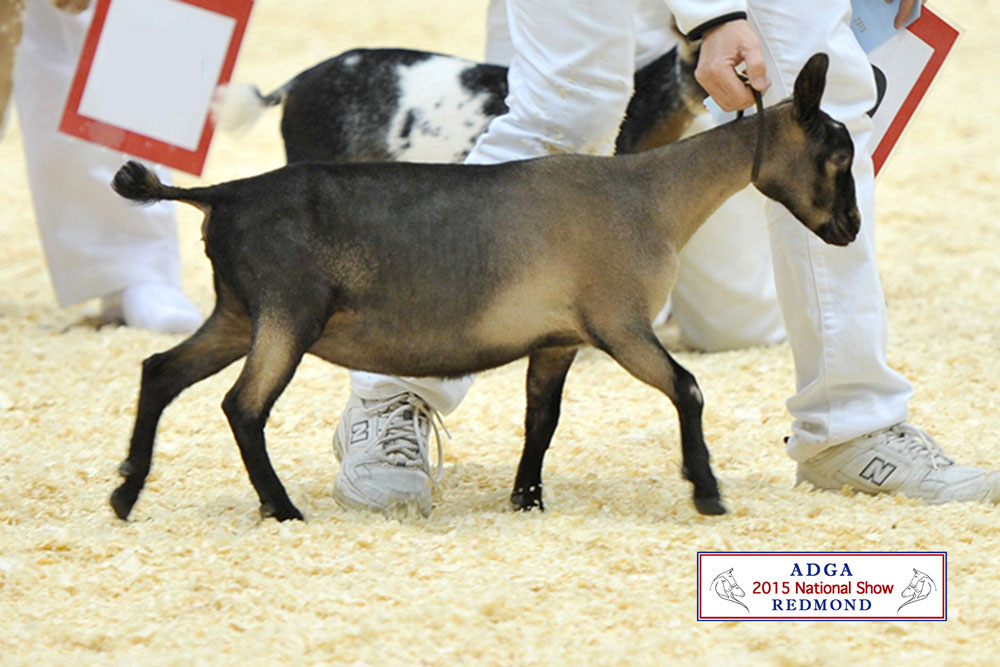 |
| Boadicea, daughter of Lady and Cernunnos, at ADGA Nationals |
While show ribbons are nice, stock is supposed to be sold. We sold all of the goat kids that we didn't want for ourselves (we keep the ones that are better than their parents). We didn't do as well with the sheep, having twice as many rams as ewes in our lamb crop. Most of the boys went to the butcher, though one found a home as a sire in Colorado. We are not able to command as high a price for our animals as more established farms, but we hope that will change over the coming years.
Dairy production was limited this last year, with only eight does in milk and most of them low-producing first-fresheners. However, this allowed me to work on cheesemaking techniques. Happily, I have learned to make a variety of fresh cheeses that people are willing to pay for. We also improved our aging facilities, making hard cheese possible. I am now sampling some of the cheeses that I made this summer, and they are genuinely pleasing. This coming year, with more does in milk, I'll be making and hopefully selling much more cheese; indeed, the challenges will lie not in the reliability, but in time management (both in milking and cheesemaking) and marketing.
 |
| Mmmmmmmmmmmmmmm.... |
Wool production is still rather below what we'd like. Our game is not yet up to producing a good, clean fleece. The improvements in pasture management and housing over the last year are a start, but more work is required. We have yet to find a shearer we are completely happy with, and our experience with a wool processor this year was nearly farcical. We have got some wool that is being made into combed top and yarn, so hopefully we will have some product to sell, but we probably won't break even on wool this year or next.
 |
| Oak Apple Bing--currently siring lambs in Co. |
We had some turnover in our chickens this year. The original gang got forcibly retired, as most of them had stopped laying with any regularity, and all of them refused to use their egg boxes, choosing instead to lay in obscure hiding places. We also retired the original chicken coop, which caused me shame whenever I looked at its construction. The new chicks arrived in July, and have been kept separate from the original gang so they won't learn bad habits. I built their egg boxes in late December, and the first egg showed up January 2nd.
 |
| New chooks: Jul 2015; New coop: Nov 2015 |
Wedge and Spot, the cats, are both now permanently outdoor cats, having had too many incidents indoors. They do fine with it, and follow us around whenever we go for walks in the area, complaining the whole way. Eleanor likes her goats, and will let you know when she thinks you're getting to close to them. Sophie, having been subjected to a rigorous program of forced marches, is losing weight and resembles more a bullet and less a cannonball.
We didn't get to have a vegetable garden this year; the garden plot has been continuously used for animal housing (see "not immediately fatal" conditions), but we hope to plant something this spring after the rams are moved into their new manse. However, this summer saw the Real Doctor's brother and his family totally reconstruct the gardens along our front path, so we now have a lovely herb garden that has been making life much tastier. Now we just need to grow some tomatoes!
So there's the year on the farm. When I look at what I do, day to day, I feel both exhausted and like I haven't accomplished anything. However, taking the long view, I suppose a lot of progress has been made, and much of that progress will allow us to be both more relaxed and more productive next year. But for right now, I am very tired.
Tuesday, December 8, 2015
Tuesday Tool: The Needle and the damage done, and the damage repaired.
Today's tool is the needle.
Every so often, we need to draw blood from our animals. There's a couple of reasons for this. One is biosecurity. There are a number of infectious diseases that can be devastating to an operation that is trying to sell breeding stock, as we are. The pathogens responsible for these diseases have in their bag of tricks ways of bamboozling the immune system; they can infect an animal for years, and yet the animal's immune system will not register their presence. (One of the pathogens is a lentivirus, like AIDS; another is a relative of the tuberculosis bacillus--both of which are similarly hard for human immune systems to process.) So, a critter could be infected at birth, and give rise to a couple of years' worth of offspring, and infect them, before you could be sure that they were infected. So, it behooves us to periodically do blood tests on everybody.
Another reason for blood draws is to test for pregnancy. We want to know whether our animals have been successfully bred, or whether they need to go and visit the boys again. A blood test can tell you this within a month of breeding, well before the mom-to-be's start bulging.
At any rate, a blood draw is no big deal, mostly. The tool of the day is a 20ga, 1" needle on a 12cc syringe. My job in the process is to straddle the goat to immobilize her, and firmly but gently hold her head pointing slightly up and to the side. The Real Doctor is getting quite good at feeling for the jugular vein, slipping the needle in, finding the lumen of the vein, and pulling out five or six cc's of blood. The vein seals itself up nicely when she pulls out, and, just as I always got a lollipop for getting a shot, the goat goes away with a couple of peanuts.
All is mostly routine, and for a dozen of our goats all was routine. However, there was one doe, Mizuki, who went all drama queen on us. First she was totally squirmy, and would not agree to be held. As soon as I could hold her somewhat still, and the Real Doctor started palpating her throat, she would scream, and scream loudly. If we ignored the screaming and the Real Doctor could actually locate the vein, she would give a tremendous wrenching twist, or rear up on her hind legs, or somersault, or lash out with a hoof, or otherwise upset things--and we'd have to start all over again.
Three times, Mizuki reared up just as the Real Doctor was about to poke her. Even though she's a Nigerian Dwarf doe, she's on the large end of the spectrum for her breed, and way overweight. So, when she reared, it was with some power; it was enough to throw me over (and because of a wrist injury, I was choosing to roll onto my back rather than catch myself). Three times she did this, interspersed with bouts of kicking and flailing. I was getting kind of sore, the Real Doctor was getting kind of frustrated, and eventually, Mizuki was getting kind of tired.
After almost half an hour of this, Mizuki gave one mighty effort and reared up, and I was able to hold on to her as I was launched onto my backside. There I was, on my back in the mucky straw, clamping a wheezing, upside-down seventy-pound goat to my chest. The Real Doctor was able to slip in, find the right blood vessel, and slip out before Mizuki recovered herself enough to struggle. I let her get up, gave her a peanut, and picked myself up.
Surveying the damage, I had a lot of scratches and stiffness. There was evidence of one close call: a sharp hoof had punched a four-inch-long gash into my jeans, from the crotch seam to the inseam. I had a nasty welt, but given the location of the tear, I was glad that was all that it was.
Which means that the tool of the day makes another appearance: the needle, but this time it's one used with thread. I just got the jeans back from the seamstress, nicely patched and (I guess) more fashionable than new. A few dollars of repairs have saved me $40 of jeans, so I'm happy.
And Mizuki? Not reactive for any diseases, and pregnant.
Tuesday, March 24, 2015
Tuesday Tool Torturous Treatment Edition
Today's tool is the Portasol disbudding iron.

It works a treat--gets up to temperature faster than electric dehorners, and stays hot. The only downside, compared to the more common electric dehorners, is that it's a little smaller (not a problem for our Nigerian Dwarves), and you'll need to refill it every six to ten goats.
Most of the time, as the owner of a herd of goats, I'm as nice as can be. I am generous with the treats, and try to give the goats all of what they need. There are occasions where they think I'm a little mean, like jabbing them with the occasional needle or trimming their hooves, but really, those insults are no big deal, easily compensated for by a couple of peanuts.
Then there's disbudding.
Most goats have horns, or would, were they not disbudded. For a goat to be shown in an American Dairy Goat Association sanctioned event, it can't have horns. For the safety and sanity of the goat's owner, it can't have horns. And really, for the safety of the goat's herdmates, it can't have horns, and for it's own safety so it doesn't get caught in fences, it can't have horns.
The horn starts as a growth from the skull, and if you were to dissect a mature goat horn, you'd see that it had at its core a projection from the cranial bone, covered with some tissue and then a heavy layer of keratin. It's a living part of the animal, not like an antler, so removing an adult horn is really amputation. Thus, it's best to take care of it before it starts growing.
When the kid is born, you can barely feel a little bump where the horn is going to be. If you wait a week, the bump will be a little button; you want to wait until you can easily feel it, but before the bud breaks the skin. Your object is to kill that horn bud--all the cells in the skull that will be growing into the horn--without killing the animal. There are paste dehorners, caustic goops that eat into the skin and bone. These are OK for cattle, but not so good for goats--they tend to rub them all over, causing random and occasionally severe damage. Better to use a disbudding iron.
The disbudding iron is a tube-shaped element, usually a little over a cm in diameter. Sometimes it's heated like a soldering iron, while our disbudder uses lighter fluid. Once it's up to temperature, you get your goat kid, wrap it in a towel or other restraint, drape it over your leg, hold its head down, and press the hot disbudding iron onto the horn bud for
one
two
three
four
five
six
seven
eight
nine
ten seconds.
It is agonizing. The kid doesn't like it, and struggles and cries for all its little body is worth. You can trim their hair away, but there's still going to be the awful burning flesh smell, not to mention the lovely sizzling sound and sight of burning flesh. If you don't hold the iron in place for long enough, you'll have to do it again--you need to burn down into the bone a little way, to kill it completely. If it's a buck kid, you need to do a second burn, because their horn buds are not little dots--they're elongated, like paisleys. Then, having burned a ring around the bud, you use the side of the iron to char the surface of it off, bubbling and burning down to the bone.
Then, you have to do the kid's other horn.
It's horrible. I hate doing it. But, the next step after this for me was to do fourteen more kids. Then, being neighborly, I did eight kids for a neighbor. It made for a long and horrible-feeling day; I was jittery and jangly and irritable. It didn't help that I had to get a lamb unstuck from our fence, and just as I was pulling him out and had a hand on each hind leg, he jumped up and pressed himself into the electric wire. He was fine but it made me dance around.
I'm always worried that I'm going to kill the kids or leave them traumatized or something. We give them a dose of banamine, a painkiller/anti-inflammatory before, and a cooling spray afterwards, and an hour later they're bouncing around like nothing has happened. They're all out there now, romping and playing and being goat kids, with these two horrible burn scars on their heads.
Come to think of it, I had an anaesthesia-free operation on a sensitive part of my body when I was a few days old, and I have no memory or lingering horrible feelings from it. So, hopefully the kids will be alright.
Sunday, January 4, 2015
Cold snap
We had a bit of a cold snap this last week--cold by local standards, getting into the teens at night and not getting above freezing during the day. The cold makes for some lovely sights.
One of the more charming sights is seen after a night that is humid and just below freezing--the frozen snores of sleeping voles, snug in their burrows:
 The best part is being there as the sun comes up. When they melt, you can hear this barely-perceptible "zzzzzzz....zzzzzzzz"
One of the more charming sights is seen after a night that is humid and just below freezing--the frozen snores of sleeping voles, snug in their burrows:
Wednesday, November 12, 2014
Wednesday words, avoiding embarassment with the neighbors edition
I will not use the word "herd" to describe a group of sheep.
I will not use the word "herd" to describe a group of sheep.
I will not use the word "herd" to describe a group of sheep.
I will not use the word "herd" to describe a group of sheep.
I will not use the word "herd" to describe a group of sheep.
I will not use the word "herd" to describe a group of sheep.
I will not use the word "herd" to describe a group of sheep.
I will not use the word "herd" to describe a group of sheep.
I will not use the word "herd" to describe a group of sheep.
I will not use the word "herd" to describe a group of sheep.
I will not use the word "herd" to describe a group of sheep.
I will not use the word "herd" to describe a group of sheep.
I will not use the word "herd" to describe a group of sheep.
I will not use the word "herd" to describe a group of sheep.
I will not use the word "herd" to describe a group of sheep.
I will not use the word "herd" to describe a group of sheep.
I will not use the word "herd" to describe a group of sheep.
I will not use the word "herd" to describe a group of sheep.
I will not use the word "herd" to describe a group of sheep.
I will not use the word "herd" to describe a group of sheep.
I will not use the word "herd" to describe a group of sheep.
I will not use the word "herd" to describe a group of sheep.
I will not use the word "herd" to describe a group of sheep.
I will not use the word "herd" to describe a group of sheep.
I will not use the word "herd" to describe a group of sheep.
I will not use the word "herd" to describe a group of sheep.
I will not use the word "herd" to describe a group of sheep.
I will not use the word "herd" to describe a group of sheep.
I will not use the word "herd" to describe a group of sheep.
I will not use the word "herd" to describe a group of sheep.
I will not use the word "herd" to describe a group of sheep.
I will not use the word "herd" to describe a group of sheep.
I will not use the word "herd" to describe a group of sheep.
Wednesday, October 8, 2014
Wednesday Wordage appropriate nickname edition.
Today is Wednesday, nicknamed "hump day."
It is also the day we are doing all of our goat and sheep matings. Pure coincidence.
It is also the day we are doing all of our goat and sheep matings. Pure coincidence.
Tuesday, September 30, 2014
Tuesday Tool wise use edition
The tool of the week--of the last several weeks, on a twice-daily basis--is Oxypol veterinary ophthalmic antibiotic ointment. It is a mixture of oxytetracycline and polymixin, in a vaseline carrier.
There is a lot of well-placed concern about the overuse and abuse of antibiotics in agriculture. Our culture's excessive dependence on these drugs is likely to bite us in the butt in the near future. We--that is, anybody who eats a burger at Mickey D's or buys meat at the grocery, or is not particularly fastidious about antibiotic free meat and eggs--all are participants in a system that uses tons of antibiotics every year. These drugs are used as an entirely routine part of the diet of almost all livestock and poultry, partly prophylactically to prevent the spread of disease in crowded settings, and partly because, for reasons not well understood, they promote rapid weight gain. Recently, the FDA came out with a set of (easily ignored) guidelines to get the food industry to reduce its dependence on antibiotics. I don't think much will happen to change the status quo. In our society, the contest between short term profit and long-term public health goods is not a fair fight.
That said, on our farm, we use antibiotics. Our medicine cart and freezer contains a variety of antibiotics, injectable, oral, and topical, and all are hardly ever used. They only come out when there is some specific, treatable disorder.
(Squeam alert--if you're turned off by graphic descriptions of eyes, injuries, or the opening of Un Chien Andalou, probably time to close the page)
Bucks are good at cleaning up blackberry brambles. They are, however, not especially bright, or sensitive to pain (as befits an animal whose primary means of delivering a message is to whack his head as hard as possible against the message's recipient). I have seen a buck, quite contented and happy, with a thorny blackberry stem jammed an inch up his nostril.
Cherubino is one of our many bucks, and one of the dumber ones. Over a month ago, while enthusiastically eating brambles, he jammed a thorn in his right eye, smack in the pupil. The result was a wound which, when I saw him at the end of the day, had punctured the cornea, damaged the iris, and caused massive vascularization of the eye. There looked to be a hole or pit in the surface of his eye, about a millimeter across. It looked like hell, all red and inflamed and swollen.
The Real Doctor, with her expertise in this field (at least with human eyes), prescribed antibiotics right away, and her prognosis was grim: messing with the iris was, for her, the first step to a dead eye. However, as our vet told us, goat eyes are a bit tougher. He agreed with the use of antibiotics, and suggested that the eye would look worse for a couple of weeks, but heal to have a lump of white scar tissue in the pupil, and a deformed but functional iris.
Our vet's prediction is bearing out. The wound initially got black and mounded up, with inflammation and scar tissue creating a bump over a millimeter high, focused on a crater a millimeter across. This blackened ocular landscape was surrounded by intense red vascularization and inflammation of the iris and sclera, so the whole eye looked like an angry volcano that had just erupted. It was the nastiest looking thing on the farm (and there are some nasty things on a farm), and made our eight-year-old niece, who normally has an unconditional and all-encompassing love of goats, scream and run away. Cherubino looked like the hell-goat, at least from the right; from the left, he was totally unconcerned and hungry for more brambles.
Most of Cherubino's eye looks OK now, except for a lump of white scar tissue right in the center. A lot of this healing has been helped by twice-daily applications of Oxypol. Of course, Cherubino does not agree with this regime, and vigorously contests with my applications of the drug. So, twice a day, I have to catch him, lift his forelegs off the ground and tightly grip his neck with my thighs, wrap my left arm all the way around his head and force his right eye open, and oh-so-carefully squeeze a 1-cm-long ribbon of goo into his eye.
I should mention that it is the rut--so Cherubino, like all our bucks, is extra stinky. Like, paralyzingly stinky, a stinky that makes the air gelatinous, a stinky so thick that it is almost audible, a stinky like a lump of Bulgarian feta that has been sent by ship to Borneo and back, a stinky that is repulsive from a hundred feet away. His glands are going full blast, and like all our bucks, he spends a lot of time peeing on his head and beard. So, this is what I have to squeeze between my thighs and wrap my arm around--and about half the time, I notice that he's wet, and it hasn't been raining. So, I have a special pair of "buck pants" and a "buck jacket" that I wear, twice a day, to deal with this. I have about two more weeks left of this treatment.
If I were smarter, there might be a different tool of the week; I have a friend who has a tyvek bunny-suit, just for dealing with bucks.
There is a lot of well-placed concern about the overuse and abuse of antibiotics in agriculture. Our culture's excessive dependence on these drugs is likely to bite us in the butt in the near future. We--that is, anybody who eats a burger at Mickey D's or buys meat at the grocery, or is not particularly fastidious about antibiotic free meat and eggs--all are participants in a system that uses tons of antibiotics every year. These drugs are used as an entirely routine part of the diet of almost all livestock and poultry, partly prophylactically to prevent the spread of disease in crowded settings, and partly because, for reasons not well understood, they promote rapid weight gain. Recently, the FDA came out with a set of (easily ignored) guidelines to get the food industry to reduce its dependence on antibiotics. I don't think much will happen to change the status quo. In our society, the contest between short term profit and long-term public health goods is not a fair fight.
That said, on our farm, we use antibiotics. Our medicine cart and freezer contains a variety of antibiotics, injectable, oral, and topical, and all are hardly ever used. They only come out when there is some specific, treatable disorder.
...........................................................................................
(Squeam alert--if you're turned off by graphic descriptions of eyes, injuries, or the opening of Un Chien Andalou, probably time to close the page)
...................................................................................
Bucks are good at cleaning up blackberry brambles. They are, however, not especially bright, or sensitive to pain (as befits an animal whose primary means of delivering a message is to whack his head as hard as possible against the message's recipient). I have seen a buck, quite contented and happy, with a thorny blackberry stem jammed an inch up his nostril.
Cherubino is one of our many bucks, and one of the dumber ones. Over a month ago, while enthusiastically eating brambles, he jammed a thorn in his right eye, smack in the pupil. The result was a wound which, when I saw him at the end of the day, had punctured the cornea, damaged the iris, and caused massive vascularization of the eye. There looked to be a hole or pit in the surface of his eye, about a millimeter across. It looked like hell, all red and inflamed and swollen.
The Real Doctor, with her expertise in this field (at least with human eyes), prescribed antibiotics right away, and her prognosis was grim: messing with the iris was, for her, the first step to a dead eye. However, as our vet told us, goat eyes are a bit tougher. He agreed with the use of antibiotics, and suggested that the eye would look worse for a couple of weeks, but heal to have a lump of white scar tissue in the pupil, and a deformed but functional iris.
Our vet's prediction is bearing out. The wound initially got black and mounded up, with inflammation and scar tissue creating a bump over a millimeter high, focused on a crater a millimeter across. This blackened ocular landscape was surrounded by intense red vascularization and inflammation of the iris and sclera, so the whole eye looked like an angry volcano that had just erupted. It was the nastiest looking thing on the farm (and there are some nasty things on a farm), and made our eight-year-old niece, who normally has an unconditional and all-encompassing love of goats, scream and run away. Cherubino looked like the hell-goat, at least from the right; from the left, he was totally unconcerned and hungry for more brambles.
Most of Cherubino's eye looks OK now, except for a lump of white scar tissue right in the center. A lot of this healing has been helped by twice-daily applications of Oxypol. Of course, Cherubino does not agree with this regime, and vigorously contests with my applications of the drug. So, twice a day, I have to catch him, lift his forelegs off the ground and tightly grip his neck with my thighs, wrap my left arm all the way around his head and force his right eye open, and oh-so-carefully squeeze a 1-cm-long ribbon of goo into his eye.
I should mention that it is the rut--so Cherubino, like all our bucks, is extra stinky. Like, paralyzingly stinky, a stinky that makes the air gelatinous, a stinky so thick that it is almost audible, a stinky like a lump of Bulgarian feta that has been sent by ship to Borneo and back, a stinky that is repulsive from a hundred feet away. His glands are going full blast, and like all our bucks, he spends a lot of time peeing on his head and beard. So, this is what I have to squeeze between my thighs and wrap my arm around--and about half the time, I notice that he's wet, and it hasn't been raining. So, I have a special pair of "buck pants" and a "buck jacket" that I wear, twice a day, to deal with this. I have about two more weeks left of this treatment.
If I were smarter, there might be a different tool of the week; I have a friend who has a tyvek bunny-suit, just for dealing with bucks.
Thursday, September 25, 2014
Time
L'shana Tova to all those who keep time thusly; happy equinox to those who mark it. (It doesn't quite rise to the level of Wednesday Word, but I recently heard the fall equinox described as the time when the Earth is three quarters of the way around the sun.)
Either way you mark it, fall is here. It arrived with a good solid rainstorm, bringing about an inch of rain. As I made the rounds yesterday morning, I would open the gate to each herd's enclosure. A few noses would poke out, and then retreat back into the shelter. Rams, bucks, ewes, does, all spent the day under cover, dryly watching me trudge around. The fields are still brown and will be for a long time, but I could sort of hear the underlayer of moss that fills our fields sighing with relief. It's been a long, exceedingly hot summer. It's time for fall.
I mentioned earlier this week how, in the short term, time gets vague for me. I got reminded again how short term planning is futile here. I had planned, yesterday, to do a bunch of drywall work on the addition to the house. However, while I was in town, I received a call from brother H. that the roof had blown off of the rams' shelter ("It just flew off, like a kite!"). Also, I noticed that the roof on the bucks' shelter (a rather old tarp) was on the verge of failure, and that action needed to be taken. Plans? Hah.
Tuesday, September 23, 2014
Tuesday Tool, looking back and looking forwards edition
It's been a busy few weeks here at the farm. There has been a lot of tool use going on...which has precluded sitting down to blog about tool use. I have an hour of breathing room, now, so here we go:
Two weeks ago, the Tuesday Tool was the Makita 18V cordless 6 1/2" Circular Saw.

This tool saw extensive use making a new shelter for our goat does. Their old shelter was falling apart, difficult to clean, and way too crowded. They now have plenty of room and protection from the coming rain, not to mention access to a pasture full of brambles yum yum.
Last week it was the drywall lift.

The addition to the house is finally getting some work done--it was left more or less as a shell, with the siding and trim and windows all done and some insulation in the walls, but no drywall or ceiling or floor. Thus it stood for over a year, with the only changes being that some of the insulation was removed by our cats, who found it enjoyable to claw at. Now, with much help, insulation has been topped up, a vapor barrier installed, and the walls and ceiling drywalled. And, if you want to put twelve-foot panels of 5/8" drywall up on a ceiling, you will need a lift. Roseburg Rentals has them, along with scaffolding.
Which brings us to today's tool, the CIDR and its applicator.
 The CIDR (pronounced like the tree) is a little widget of plastic impregnated (pun intended) with progestin. The applicator is used to insert it into a doe that you wish to breed, and the hormones diffuse out of the plastic and into the doe, swamping out all other hormonal signals and effectively resetting the doe's cycle. After a dozen or so days, it is removed, the doe gets a shot of another hormone, and comes into heat like a ton of bricks.
The farm imposes on us an odd relationship to scheduling. Day to day, there is very little in the way of a schedule. It does not matter if it's Tuesday or Saturday, the chores need doing, and there is always the miscellaneous backlog of work to be done as soon as possible. Most of the time I am unaware of the day of the week. I become aware of weekends only because the Real Doctor is home, and if she's home on a weekday or away on a weekend, I'm utterly lost in time.
The flip side of this is that we do make some plans, set in stone, about a year in advance. There are some events--fairs, shows, the violin workshop, and conventions for the Real Doctor--that occur on specified dates known years into the future. These events dictate our schedule--we want our lambs to be of a certain age by the Black Sheep Gathering; it would be nice to have some does in milk by the RDGA nationals; it would be nice not to have to milk during the violin workshop; it would be nice to have some kids weaned by county fair; and so on. So, sometime in the summer each year, we sit down with a calendar, decide what we want to do and attend, figure out the gestation period for our animals, work backwards, and say that we want them conceived right then. The CIDRs allow us to make it so that the does and ewes are very willing and able to be bred on that date--and so, in a couple of weeks, there will be a frenzy of mating going on, and five and a half months from now, we will have a long, sleepless week of lambing and kidding.
Two weeks ago, the Tuesday Tool was the Makita 18V cordless 6 1/2" Circular Saw.
This tool saw extensive use making a new shelter for our goat does. Their old shelter was falling apart, difficult to clean, and way too crowded. They now have plenty of room and protection from the coming rain, not to mention access to a pasture full of brambles yum yum.
Last week it was the drywall lift.
The addition to the house is finally getting some work done--it was left more or less as a shell, with the siding and trim and windows all done and some insulation in the walls, but no drywall or ceiling or floor. Thus it stood for over a year, with the only changes being that some of the insulation was removed by our cats, who found it enjoyable to claw at. Now, with much help, insulation has been topped up, a vapor barrier installed, and the walls and ceiling drywalled. And, if you want to put twelve-foot panels of 5/8" drywall up on a ceiling, you will need a lift. Roseburg Rentals has them, along with scaffolding.
Which brings us to today's tool, the CIDR and its applicator.
The farm imposes on us an odd relationship to scheduling. Day to day, there is very little in the way of a schedule. It does not matter if it's Tuesday or Saturday, the chores need doing, and there is always the miscellaneous backlog of work to be done as soon as possible. Most of the time I am unaware of the day of the week. I become aware of weekends only because the Real Doctor is home, and if she's home on a weekday or away on a weekend, I'm utterly lost in time.
The flip side of this is that we do make some plans, set in stone, about a year in advance. There are some events--fairs, shows, the violin workshop, and conventions for the Real Doctor--that occur on specified dates known years into the future. These events dictate our schedule--we want our lambs to be of a certain age by the Black Sheep Gathering; it would be nice to have some does in milk by the RDGA nationals; it would be nice not to have to milk during the violin workshop; it would be nice to have some kids weaned by county fair; and so on. So, sometime in the summer each year, we sit down with a calendar, decide what we want to do and attend, figure out the gestation period for our animals, work backwards, and say that we want them conceived right then. The CIDRs allow us to make it so that the does and ewes are very willing and able to be bred on that date--and so, in a couple of weeks, there will be a frenzy of mating going on, and five and a half months from now, we will have a long, sleepless week of lambing and kidding.
Thursday, August 21, 2014
That was the fair that was
-->
Tuesday morning, I noted a certain spring in my step that
had been lacking the last couple of weeks.
As I made the rounds, I did not feel sore of joint, tired of limb, or
generally exhausted. I attributed this
renewed pep to taking Monday “off”, or as off as I can while still keeping
animals fed and watered and milk from going sour and laundry from piling too
high. What had me so tired, enough to
need a day off, was the Douglas County Fair.
The fair presents an interesting view of life here in
Douglas County. It’s taken me, a city
boy, a long time to get used to life here, but I’m learning to appreciate
it. It’s no longer a surprise when
somebody talks about their newborn lamb that’s been rejected by its mother, and
how they had to take it to work for bottle feeding for a week, and it wasn’t a
problem. It seems that most people
either did 4H or FFA as kids, or have children raising a lamb or hog for one of
those programs. The loudest noise I
heard at the fair (outside of the rock concerts every night) was the excited
cheer from a hundreds of teenagers at the selection of the winner of the hog
showmanship competition. The local
newspaper ran pictures of the champion steer and hog and the kids who raised
them, above the fold, on the front page.
Other facets of Douglas County show themselves at the fair,
besides the 4H and FFA livestock. The
timber industry has its own big tent, and the local firms all have displays
celebrating their stewardship and their ability to employ locals. The exhibit hall had booths for the NRA, a
concealed carry class, a couple of booths that were raffling off guns, various
branches of the military, Oregon Right to Life (really, there is no
contradiction, is there?), a handful of churches with quizzes to determine
whether you were heading to heaven or hell, and vendors of bumper stickers and
t-shirts urging us to remember Benghazi and impeach the dictator. The county Democratic Party had a booth too,
though they admitted that they did feel a bit like a minority. The lady working the Douglas County
Republicans booth lives a couple miles down the road from me; the fellow at the
Democrats booth just over the hill. A
certain politeness is useful in small communities, when everybody is your
neighbor.
There were the usual fairground rides, run by the gypsies
that travel from fair to fair, ensuring a certain uniformity in all these
events. The rides—the whirl-a-meal, the
rising gorge, the hurling dervish—were all there, working to separate riders
from their lunch and any loose items in their pockets. The food stalls were similarly free of
regional context—giant mounds of curly fries and deep-fried anything—with one
exception. I grew up going to the fair
and eating fry bread, or the less-politically-correct “Indian fry bread”; here,
the booths sold “scones,” which are the same thing, but served with honey and
cinnamon sugar. I had two, over the four
days of the fair, and that will hold me till next year.
All these sights and sounds and gastric experiences were
ancillary to my experience of the fair. We
were at the fair for the open-class (that is, not 4H or FFA) livestock
competition, with our fine goats and sheep.
For us, the fair is an opportunity to have our animals seen by prospective
buyers; for us to advertise our farm; for our animals to be professionally
evaluated and ranked with those from other farms; and to interact with other
breeders and growers and trade insights with them. It’s a big deal. So, in the week before fair, we spent a lot
of time grooming our animals, picking burrs from fleece, trimming nails,
clipping hair, and so on. The
fairgrounds provided pens, but these needed to be filled with sawdust and straw
and set up with feeders and buckets and salters, and we also needed hay and
grain and all the other requirements for a healthy and happy animal. Some folks bring in whole outdoor living-room
suites, with tables and chairs and cupboards and rugs, but we just made do with
folding chairs and a folding table; and, though it wasn’t as elaborate as many
of our neighbor’s displays, we did manage to get a laminated banner with our
farm name and logo on it.
We brought the animals in on Tuesday, before the official
start of the fair, and after a cursory check by the vet, they were led to their
pens. Wednesday was spent on getting
things a little better set up, and picking fleeces clean. We brought seven of our Shetland sheep: two
ram lambs, three ewe lambs, and two yearling ewes. That’s a lot of fleece to pick, especially
after they’ve had free run of a pasture full of queen anne’s lace. One of our goals over the next five years is
to have fewer weeds in our pastures, but for now—owing to years of neglect—we
have lots of weeds, and lots of burrs in our fleece. At least we have better feeders than last
year, when the simple act of eating would fill our sheeps’ fleeces with bits of
hay. We envied our neighbors at the
fair, who had a troupe of grandchildren with their nimble fingers picking
fleeces.
The sheep competition was on Thursday, and the Shetlands
were the largest class (there were also Dorsets, St. Croix, East Down, and
Liecester sheep in the competition). The
judge was more familiar with the meat breeds, and even then didn’t have a lot
of experience with the comparatively rare St. Croix and Blue-Faced Liecester. As breeder of Shetlands, one gets used to
having this sort of judging—the fleeces got a cursory look, and there was a
bias towards larger, more “built” animals.
However, our sheep did well. Our
ram lambs finished first and second in their group; the yearlings were second
and third; and our ewe lambs took top spots, with one winning reserve champion
Shetland. We also scored a brace of the
group titles, such as best young herd.
Friday was supposed to be a rest day, but most of the day
was spent helping other sheep folks and goat breeders with their animals. One of the things I’ve come to like about the
fair is the fact that, despite our all being in competition with each other,
everybody helps everyone else. For
example, after the show, all the Shetland breeders spent a long evening critiquing
and admiring each other’s animals. This cooperative
attitude extends to working as night watch—the sheep barn is right next to the
amphitheater where, every evening of the fair, there is an extremely loud rock
concert, and there are extremely hammered people staggering through the barn,
picking fights with the rams and doing other similar acts of stupidity.
Saturday was the goat show.
As a show sanctioned by the American Dairy Goat Association, exhibitors
were encouraged to dress in white. So after
doing the morning chores, I changed into my milkman outfit and headed to the
ring with Java, Zarzuela, and Snegurochka, our three junior does. It might be
because they’re small, so it’s easy to get a lot of them; or it might be that
they’re cute and trendy, but there were a lot of Nigerian Dwarf Goats in the
competition. Despite being in a large
class, our does did great, with each being the top of her age class, and Java
winning best junior doe. Of course, once
our goats were done, there were the adult Nigerian Dwarves, the Nubians, the La
Manchas, and all the other breeds, and so I spent most of the day helping to
wrangle much larger goats than I’m used to.
It was interesting to see the variety, and having been dragged around
the ring by an upset Nubian, it reinforced my desire not to deal with the larger
breeds.
The fair officially was over on Sunday. Some folks were there a soon as the gates
opened at 6 AM, spiriting their animals back to the farm and taking down their
displays. Others hadn’t really done any
deconstruction by noon, by which time we had made two round trips to the
fairgrounds and back. There was one bit
of fair business left, before we quit the fairgrounds for good—there are cash
awards for placing in the livestock show, and we collected enough to pay for a
few days’ hay for our herd. Then, home,
unpacking, and R&R. As I mentioned,
it’s exhausting to prep for fair, then take care of animals at home and at two
locations in the fairgrounds, show animals, and then pack everything up. There was a lot of laundry and housecleaning
to do, not to mention sleep to catch up on.
An exchange with a cashier at the co-op sums it up:
Cashier: How’d the
fair go for you?
Me: Great—all our
animals did really well, best junior doe, champion ewe.
C: You look tired.
Glad it’s over?
Me: Oh, yeah.
C: Everybody’s seems
so glad when it’s done. Looking forward
to next year?
Me: Oh, yeah.
Wednesday, August 20, 2014
Tuesday Tool
(A bit late, but it was a busy day)
The tool of the day is definitely the Double K Model 401 Belt Mounted Variable Speed Clipper with 6 foot flex-shaft drive.
 My project for the last few days has been to trim all of our goats, peeling off a year's worth of shaggy hair and leaving a nice, sleek-looking, cooler animal. The does are not too bad--their hair isn't terribly long, despite having not had a haircut in over a year. The bucks, on the other hand...well, they're awful. They are furry like bears, hair three inches long all over, and a layer of cashmere underneath. And, they smell like bucks.
So, one by one, each goes up on the stand, into the stanchion, and starts complaining and fidgeting as I get the clippers going. I've tried doing it with a hand-held clipper, but the extra power of the Mod. 401 is wonderful. Mow up the back, then along the sides, up the legs, up the neck and around the head; wrestle and fuss and struggle while clipping the face and noggin; kick and complain while doing the legs and escutcheon and tail. Trim, trim, trim, trim--and while I'm at it, trim their hooves, give the a copper bolus, and dose them with anti-louse. The whole process, for one goat, takes just under an hour, leaving the goat upset and spick and span, and leaving me covered in itchy goat trimmings--the hair is stiff enough that it can penetrate my skin and act like a fiberglass splinter. I can do three goats before running inside to change my shirt or take a shower. (If I were more Orthodox about my Judaism, part of my morning ritual would be to thank the divine that I am not a woman; as it is, I am thankful that I don't wear a bra.)
Clipping is nobody's favorite chore. The goats don't recognize each other right away, so they are busy re-establishing their hierarchies. There is much complaining, still, but at least they are cooler and easier to look at, and they won't be bothered until next summer.
The tool of the day is definitely the Double K Model 401 Belt Mounted Variable Speed Clipper with 6 foot flex-shaft drive.
So, one by one, each goes up on the stand, into the stanchion, and starts complaining and fidgeting as I get the clippers going. I've tried doing it with a hand-held clipper, but the extra power of the Mod. 401 is wonderful. Mow up the back, then along the sides, up the legs, up the neck and around the head; wrestle and fuss and struggle while clipping the face and noggin; kick and complain while doing the legs and escutcheon and tail. Trim, trim, trim, trim--and while I'm at it, trim their hooves, give the a copper bolus, and dose them with anti-louse. The whole process, for one goat, takes just under an hour, leaving the goat upset and spick and span, and leaving me covered in itchy goat trimmings--the hair is stiff enough that it can penetrate my skin and act like a fiberglass splinter. I can do three goats before running inside to change my shirt or take a shower. (If I were more Orthodox about my Judaism, part of my morning ritual would be to thank the divine that I am not a woman; as it is, I am thankful that I don't wear a bra.)
Clipping is nobody's favorite chore. The goats don't recognize each other right away, so they are busy re-establishing their hierarchies. There is much complaining, still, but at least they are cooler and easier to look at, and they won't be bothered until next summer.
Wednesday, June 18, 2014
Wednesday Words--Somebody's Cover Has Been Blown Edition
Marquee in front of a bar on the road into Roseburg:
It turns out that that suspicious new fellow is alright, and the bar is not warning him that its patrons are onto his game. Instead, the bar is trying to drum up business from the National Amateur Retriever Championship, which also explains the dozens of trucks rigged up with dog kennels.
WELCOME TO
ROSEBURG
NARC
It turns out that that suspicious new fellow is alright, and the bar is not warning him that its patrons are onto his game. Instead, the bar is trying to drum up business from the National Amateur Retriever Championship, which also explains the dozens of trucks rigged up with dog kennels.
Monday, October 14, 2013
Monday Musical Offering...crank up the bass!
For truly brain-case-wasting bass, there is only one way to go:

So, just like last year, we had a feral momcat produce a litter of kittens in our field. We captured the kittens and the mom; we had hopes that the mom would be domesticable, since she was a potent rodenticide and didn't run away like last year's momcat. (Until we captured her, we only ever saw the hind end of last year's momcat; this year's, I almost stepped on several times during my daily walks.) However, it was not to be; domesticity did not suit her, or at least being trapped did not, and she almost killed herself trying to get away. She has, most likely, met the same fate as last year's momcat at the local animal shelter.
However, her three sons were the purringest kittens we'd ever met. We've kept two, hopefully as combination rodenticide/ housecats. Stereo Left is Wedge (Brother E. wanted to discourage us from keeping any of the kittens; this kitten was the first one we captured, and E. warned us that he was the thin end of the wedge.) Stereo Right is Spot (Because...well, we'll let you figure it out). If you put your head between these two, the low-frequency vibrations will loosen your fillings and blur your vision--in the most satisfied, contented way. In the photo, I am listening to a loop of the opening pedal-point of Strauss' "Also Sprach Zarathustra."
Tuesday, September 17, 2013
Tuesday Tool Tyin' 'em off edition
The tool today is the elastrator, and the associated rubber band.

I am a terrible blogger. I should keep up to date, but I have not--witness the six goat kids bouncing around outside the window, heretofore unmentioned. I should post cute photos--and there is precious little as cute as a precious little goat kid--and I have not. As for the first failing, well, that cat is out of the bag. As for the second, here, have this:
 Those little kids are both bucklings. The association between male goats and randy behavior is cliched, but until you actually see a two-day-old buckling making the moves on his brother, you don't really appreciate quite how strong the drive is in these guys. These little lads are now about two months old, and it won't be too long before they are not just play-acting. We don't really want that--we want to control who breeds with whom, not to mention avoiding incest. So, out comes the elastrator.
Pretty quick work, actually. Slip the little orange cheerio(TM) over those four prongs, squeeze the handles, and it opens up about two inches--wide enough to fit over the necessary bits. Roll the rubber band off of the prongs, and you're done. The kids appeared to be slightly uncomfortable for about an hour, but it seems (based on some conversations I've had) far less painful than a vasectomy. Another week or so, the whole package will fall off, and we will no longer have bucklings--we'll have wethers.
Brother E. is in New Zealand at the moment, revisiting the city we lived in for a year when I was five. I don't remember much of the place, but I do remember wonderful beaches. A feature of all the beaches in New Zealand, as I recall it, was that the tideline was marked by those little orange cheerios. New Zealand has a lot of sheep, which means a lot of lambs. All of those lambs get their tails docked, and a lot of them get castrated, so a lot of those little orange cheerios get washed downstream. Brother E. has visited the beaches, and says that he hasn't seen too many of them--I'm not sure if it's because of changes in practices, or because lambing season has just started there.
Did I mention lambs? We have lambs too. See? Bad blogger. Baad!

I am a terrible blogger. I should keep up to date, but I have not--witness the six goat kids bouncing around outside the window, heretofore unmentioned. I should post cute photos--and there is precious little as cute as a precious little goat kid--and I have not. As for the first failing, well, that cat is out of the bag. As for the second, here, have this:

Pretty quick work, actually. Slip the little orange cheerio(TM) over those four prongs, squeeze the handles, and it opens up about two inches--wide enough to fit over the necessary bits. Roll the rubber band off of the prongs, and you're done. The kids appeared to be slightly uncomfortable for about an hour, but it seems (based on some conversations I've had) far less painful than a vasectomy. Another week or so, the whole package will fall off, and we will no longer have bucklings--we'll have wethers.
Brother E. is in New Zealand at the moment, revisiting the city we lived in for a year when I was five. I don't remember much of the place, but I do remember wonderful beaches. A feature of all the beaches in New Zealand, as I recall it, was that the tideline was marked by those little orange cheerios. New Zealand has a lot of sheep, which means a lot of lambs. All of those lambs get their tails docked, and a lot of them get castrated, so a lot of those little orange cheerios get washed downstream. Brother E. has visited the beaches, and says that he hasn't seen too many of them--I'm not sure if it's because of changes in practices, or because lambing season has just started there.
Did I mention lambs? We have lambs too. See? Bad blogger. Baad!
Wednesday, August 21, 2013
Wednesday Wordage Parasitic edition
I think my goal for the next couple of years will be to master the skills of robotics, electronics, programming, and engineering. I will then use those skills to make small aerial drones, equipped with compact chromatographs and spectrometers that will be able to analyze the air they fly through. They will be able to detect trace amounts of a staggeringly wide variety of airborne chemicals, ranging from gases to aerosols to particulates, identify them all and trace them to their point of origin. These autonomous robots would act like a swarm of noses, and would be tremendously useful in a number of applications. I would call them "nose bots."
And, all the effort would be worth it if I could obliterate from my mind what "nose bots" really are--we may have them in our flock of sheep, so I had to do some reading about them. Eeeeew.
And, all the effort would be worth it if I could obliterate from my mind what "nose bots" really are--we may have them in our flock of sheep, so I had to do some reading about them. Eeeeew.
Monday, August 12, 2013
Breakfast with Boocoo and Sneggy
Dramatis Personae:
Human . . . . . . . A human
Boocoo . . . . . . . A goat kid

Sneggy . . . . . . . . A goat kid

Scene: barn, exterior. After noises of struggle, enter two goat kids, on leads, pulling human. The goat kids surge towards two bowls of grain mix, while the human ties their leads to a hitching post--making sure that there is no way that one goat can get to the other's grain.
Boocoo: Food! FoodfoodfoodfoodfoooooodFOOD! (very loud munching noises)
Sneggy: Food! FoodfoodfoodfoodfoooooodFOOD! Hey! This is food, mostly. (Looks at human, then nibbles at food)
Boocoo: (very loud munching noises)
Sneggy: (nibbling noises) Hey, was that a sheep I heard? (looks around; stares, at length, into the distance)
Boocoo: (very loud munching noises)
Sneggy: (Still staring) Pretty sure that was a sheep...
Human: Sneggy! Focus! Eat! (jiggles bowl of grain)
Sneggy: Hey! There's food here. (Looks at human, then nibbles at food)
Boocoo: (very loud munching noises)
Sneggy: (nibbling noises) Wait--I think I heard a log truck...yes, yes...definitely a log truck. You know that they have log trucks going by on the road there? (stares, at length, at the road)
Boocoo: (very loud munching noises)
Human: Sneggy! Focus! Eat! (jiggles bowl of grain)
Sneggy: Hey! There's food here. Did you know there's food here? (Looks at human, then nibbles at food)
Boocoo: (very loud munching noises)
Sneggy: (nibbling noises) Hey! Did you you know that there are dried peas in this grain mix? And alfalfa pellets? did you know that I don't really like them? (stares at human, aggrieved; starts to wander around, tangling leash on hitching post.)
Boocoo: (very loud munching noises; these stop, as there is no more grain. loud whuffling noises, as goat tries to vacuum up bits of grain dust)
Human: (jiggling Sneggy's grain bowl) Sneggy! Focus! Eat! Look--lots of barley, corn, oilseed, calf manna--lots of good stuff!
Sneggy: Wow! There's food here! Where did that come from?! (Looks at human, then nibbles at food)
Boocoo: (straining at lead, trying to reach Sneggy's bowl)
Sneggy: (nibbling noises; pauses) You know, there's a really nice view of those hills from here. I could just stand here and stare, and stare, and stare, and stare, and...are those cows over there? Cows are kind of neat. They're like giant goats, really. Cows eat grass, you know. There's grass here. I wonder how grass looks to a cow. I wonder how grass looks to a crow. I heard a crow once. I heard a raven, too. Crows are different from ravens. Ravens and crows and cows. It's weird that crows and cows are so different, but only differ in spelling by one letter. If things made sense, I think ravens should be called cows. But then ravens would have to eat grass...(verbal wandering is paralleled by wandering around on lead; at this point, walks through food bowl, catches side, flinging contents over entire porch.)
Sneggy: Ooooo! That was food! Where did that come from?! Somebody should clean it up.
Boocoo: Ooooo! Food! FoodfoodfoodfoodfoooooodFOOD! (very loud munching noises)
Human: ******!!!!!
Monday, April 29, 2013
Going to the vet to get tutored!

Subscribe to:
Posts (Atom)