I marvel at deciduous trees. So much carbon wasted every year.

It’s quite a roll-out: first, NASA’s astrobiology program announces a very important press conference coming in one week. There is all kinds of speculation, some of it quite fervid. Finally, the news. No Martians, no radio signals from Tau Centauri. Instead, a more mundane headline in the NY Times says “Microbe Finds Arsenic Tasty; Redefines Life.”
The actual science is interesting, though it doesn’t quite live up to the hype (surprise!). While the the hype is about “redefining life” and “stretching the possibilities for extra-terrestrial life,” the real interest lies in a demonstration of the power of selection and what down-to-earth microbes can do.
Here on earth, microbes (and humans, and every other living thing) have to grow—they take in atoms from their environment and convert that “dead” matter into a part of a cell. Every living thing uses pretty much the same ingredients: Carbon, Hydrogen, Nitrogen, Oxygen, and Phosphorus, with a sprinkle of other elements Why only those particular elements? Carbon is neat, but could it be substituted with an element from the same column on the periodic table, such as Silicon? No. Even though it shares some characteristics with carbon, it just doesn’t have the same wonderful reactive repertoire.
This has not stopped speculation about the other ingredients found in a cell; Felisa Wolfe-Simon at the NASA Astrobiology Institute and her coworkers wondered if the phosphorus found in the cell could be replaced with a similar atom on the periodic table. However, the element most similar to phosphorus on the periodic table is Arsenic.
As the headline suggests, Wolfe-Simon found—or more correctly, evolved—a microbe that can almost completely replace its phosphorus with arsenic. In this cell, arsenic behaves similarly enough to phosphorus that it grows reasonably well. However, despite the headlines, very little adjustment need be made to the definition of life. Some definitions of life hold that “life is mainly made of the elements Carbon, Hydrogen, Nitrogen, Oxygen, and Phosphorus.” So, that can be revised to read “…and Phosphorus (or Arsenic).” Ho hum.
The most interesting thing about this report was its application of selection. Natural selection is one of the driving forces behind evolution—from a varied initial population, the environment selects those individuals who are best able to survive and reproduce, and allows them to do so. The rest don’t make it. It’s very simple, but amazingly powerful. You can do this in the laboratory: start with a varied initial population, select only those individuals who have a certain trait (say, the ability to survive exposure to Arsenic), and allow only them to reproduce; the rest die.
As my mentors taught me, “you get what you select for.” If you start with a very large and very varied population, and slowly ratchet up the selection pressure, you can select for, and evolve, almost anything. In fact, something very similar to this recent study was accomplished over a decade ago, using slightly cleverer techniques.
A biology textbook might refine the above definition of life by mentioning proteins, and how they are all made of the same 20 amino acids, just in different arrangements. There is a genetic code, in which each of the 20 amino acids is specified by three nucleotides strung together in DNA. There are four different nucleotides (called A, G, C, and T), so there are 64 possible three-nucleotide combinations. 61 of these specify the 20 amino acids (there is obviously some redundancy), and three specify the end of a protein. You probably saw this table back in high school:

Starting in the 1980s, researchers (most notably Peter Schultz) tried to redefine life: they wanted to make proteins that had different, new, non-biological amino acids in them. To do this, they had to somehow persuade the cells to change the way they decoded their genetic information. Essentially, they had to convince a cell that “UAG” no longer should be decoded as “stop”, but rather as the bizarre new amino acid Propargyloxyphenylalanine. The cell, you might imagine, required some strong persuasion—and this is where selection came in.
Schultz’s group cleverly placed a gene in the cell for chloramphenicol resistance—if this gene were properly expressed, the cell could survive exposure to the antibiotic chloramphenicol. However, this gene was modified: it could only be properly expressed if “UAG” were translated as Propargyloxyphenylalanine. If UAG were used normally, as “stop”, the cell would stop making the protein, and die. That’s selection for you—and it allowed Schultz to find the very rare cell that had mutated so that it could pull of this trick. All he had to do was look for cells that survived chloramphenicol exposure.
Schultz used selection again to make sure hat he had succeeded; there was, after all, the possibility that the cell sometimes translated UAG as Propargyloxyphenylalanine, and sometimes translated UAG as some other amino acid. So, he cleverly placed another gene in the cell that encoded a weird protein called “barnase.” If the cell makes even a little bit of barnase, the barnase will kill the cell. The gene that Schultz used also had a UAG in it, but in this case, functional barnase would only be produced if UAG were translated as anything but Propargyloxyphenylalanine. Again, selection allowed Schultz to find the very rare cell that only translated UAG as Propargyloxyphenylalanine—selection killed every other cell. Again, all he had to do was look for the surviving cells.
So, you get what you select for—no matter how rare or absurd. Using the power of selection, Schultz and others have evolved cells that use more than 70 different, completely non-biological amino acids in their proteins—a pretty thorough redefinition of this aspect of life. How does this relate to the Arsenic story? Selection. Wolfe-Simon selected for the ability to use Arsenic in place of phosphorus, and you get what you select for.
She started with microbes that were already pretty tolerant of arsenic. They are not from a very unusual family—they are proteobacteria, a family name as bland among bacteria as “Smith” among Americans. However, these had been recovered from Mono Lake in California, an environment with unusually high concentrations of arsenic. In the lab, the cells were grown with increasing amounts of arsenic and decreasing amounts of phosphorus. These conditions selected for the ability to replace phosphorus with arsenic, so cells that could do this would grow and reproduce. Those cells that could not (and these were the vast majority) simply died. The selection was made harsher and harsher, so that eventually cells were growing in as close to phosphorus-free conditions as could be managed. Selection found the rare cells that learned to use arsenic, and all Wolf-Simon had to do was look for the survivors. Over the course of just a few generations, Wolfe-Simon forced the evolution of an Arsenic-using bacterium (figure C).

This is a rather extraordinary claim, and as Carl Sagan noted, extraordinary claims require extraordinary evidence. So, the bulk of Wolf-Simon’s report consists of proofs that these cells are chock-full of arsenic and very low in phosphorus. It’s bizarre—virtually everything that is usually has phosphorus has arsenic. So DNA and RNA have a sugar-arsenate backbone; ATP is now Adenosine tri-Arsenate; NADH has Arsenate rather than phosphate; the membrane phospholipids are now arseno-lipids, and so on. There’s a hint of phosphorus left. (One thing that needs to be cleared up is just how much phosphorus there is left, and where it is.) These cells (figure C) are strikingly different in aspect from their immediate “wild” ancestors (figure D). The Arsenic-incorporating cells are larger and somewhat irregularly shaped.  A cross-section electron micrograph shows that much of their volume is made up of storage vacuoles absent in their ancestors (figure E; note that the magnification is five times greater). These may be for storing excess arsenic, or protecting some cellular machinery from arsenic.
  These are not exceptionally happy cells, though: it takes them almost two days to grow and divide. One can almost hear them sighing with relief when the arsenic is taken away and replaced with phosphorus; their growth rate almost doubles.
Like any good study, this one raises lots of new (and previously undreamt-of) questions. The ancestors of these cells were isolated from an arsenic-rich environment—so, how much arsenic (if any) is there incorporated into these cells in the wild? How much actual genetic difference is there between the laboratory-grown cells and wild cells? Could one evolve arsenic-using cells from other cells in the same environment, or even cells from other environments? The cells grown on arsenic are clearly sick—could they evolve to actually prefer arsenic to phosphorus? These are all questions that would really help us understand life on earth.
I don’t think this has the hyped impact on astrobiology. For one thing, NASA’s own definition of life scrupulously avoids mentioning specific elements as being necessary for life. Furthermore, arsenic is a much less common element in the universe than phosphorus. However, this is a really neat finding, the result of clever work, and it gives us fresh opportunity to marvel at what life can do.
Liu, Chang. C, and Peter G. Schultz. (2010). Adding New Chemistry to the Genetic Code. Annual Review of Biochemistry 79: 413-44.
Felisa Wolfe-Simon, Felisa, Jodi Switzer Blum, Thomas R. Kulp, Gwyneth W. Gordon, Shelley E. Hoeft, Jennifer Pett-Ridge, John F. Stolz, Samuel M. Webb, Peter K. Weber, Paul C. W. Davies, Ariel D. Anbar, and Ronald S. Oremland (2010). A Bacterium that can Grow by Using Arsenic Instead of Phosphorus. Published on-line ahead of print: Science DOI: 10.1126/science.1197258.
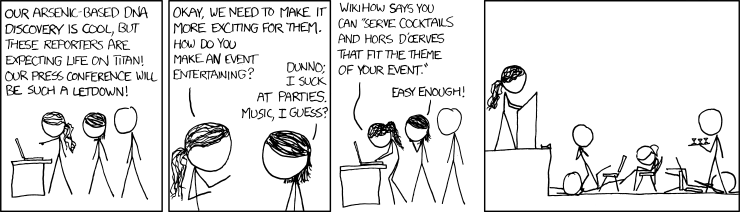
We’ll leave the last word to XKCD: (click to get the punch-line.)