Sunday, March 31, 2024

 Parental artifact #18–a 12-place set of Heath Ware


My parents acquired this service partially as a wedding present, partially as a purchase, in 1958. My mom noted in her handwritten catalog of possessions that it was “considered quite classy.” As a young couple my parents were keen on “mid century modern” design, with its spare elegance, and a number of their furnishings—lamps, tables and chairs, ceramics, chests of drawers—fit that aesthetic. However, as they got older, as kids multiplied, and as they inherited things from relatives who were less simpatico with their vision, stylistic coherence waned. Mid century modern bumped into mission and Victorian and ranch and more. Despite this, I think they kept a fondness of the clean aesthetic of that style.
This service was always the “good” china, rarely used. Two other sets of china lived through complete lives, from purchase to piecemeal destruction, as my two brothers and I went from babies to adults, and as my parents went from adults into the fog of Alzheimer’s. But the Heath ware remained inviolate. Even though (or perhaps because) it was only used rarely, it acquired a thick patina of emotional significance and memory for all of us over the years.
When it came time to apportion my parents’ chattels, most of the job was relatively easy. However, we brothers have a shared spreadsheet labeled “grand bargains/horse trading” that was our effort at dealing with those really significant items that we all felt strongly about. The Heath Ware was on that list, along with The Microscope, the cactus painting, the Ceropegia painting, the silk dragons, and a handful of other items. These are objects that I think were so internalized as part of our personal identity as individuals, but individuals within a family, that relinquishing them felt like relinquishing a piece of one’s own anatomy.
So there was some bargaining, some horse trading, and some strong emotions; and while I do not have the microscope or the cactus painting, I do have the Heath ware. Its emotional and aesthetic desirability is combined with practical appeal: the china we had been using, a treasured wedding present from Duva’s sister, was starting to decay, its glaze failing under the assaults of the microwave and the dishwasher. The Heath Ware has become our daily service. We have a set of plain Corelle plates for Pesach, but no “good” china as such. If you dine with us, you will eat off of what was my parents’ good china.
Shortly after bringing the Heath Ware into our kitchen, I was loading the evening’s dishes into the dishwasher and I had a most unusual sensation: I was carefully placing a plate into the rack, and superimposed on top of that mundane experience, a much older version of myself, with pale, aged, and slightly shaky hands, was accidentally dropping that same plate and watching it break.
I was just starting to register that this was odd when I also experienced:
—carefully getting the Heath Ware plates out for our weekly dinner with Grandaddy when I was five, an event which was routine, but kind of special.
—serving our parents a cake for their 50th anniversary in 2008, and using the Heath Ware because it was a special event. Even if my dad was already starting to fade in dementia’s fog, he understood the significance.
—having my favorite cake served on the large plate for my eighth birthday, and feeling important for that.
—noticing that the posh restaurant at which Duva and I were celebrating our anniversary used the same plates, but in a different color.
—pointedly not getting the Heath Ware plates out for our weekly dinner with Grandaddy, well before his death, but at some point in time when the dinners became less special and more routine.
—watching, in my PJ’s, after I was supposed to be in bed, as my parents entertain some important guests with a fancy dinner off the good plates and at the special table—with a tablecloth, even!
I can’t say that I experienced all these things simultaneously, because that word implies that they took place at the same point in time, in an ordered sequence of events. Rather, while I was holding that plate in my hand, I got a view of time from the outside, from a position where events were not sequential; they just existed, stacked on top of each other in no order. It was instantaneous, a flashbulb illuminating a different reality.
Can baked earth give a transcendent vision of reality? I suppose if you were amongst Abraham’s ancestors, before he scorned idols, it might provide some connection with the divine, but that notion has been rejected since.
At any rate, without any interruption, I finished the motion of loading that plate into the dishwasher. I didn’t drop it, it didn’t break. That particular event is, I guess, in some version of my future.
Nothing is permanent, that’s an obvious lesson, but I had a lot more to think about. Maybe it was a piece of ceramics trying to explain the world to me; maybe it was my parents, reaching out to reassure me from wherever they may be; maybe it was a momentary slosh of neurotransmitters between different regions of my brain, triggered by strong but suppressed emotion. No matter. An alternative view of time can be useful in coping with the turmoil of history’s march of “one damn thing after another.”
I went for a hike along the North Umpqua Trail a few days back, from Steamboat Creek, downstream a couple of miles. This area was devastated by the Archie Creek Fire two years ago. The walk was profoundly, deeply disturbing. There were very very few live trees, and what I remembered as a hike through a mature forest of towering cedars and three-hundred-year-old firs was now a dismal tour through a morgue of disfigured, tortured corpses. I won’t live to see this be a mature forest again. No one alive today will see it as a mature forest either.
It is proper for me to be sad for what has been destroyed. If I stay within linear time, I’ll stay sad about it. Linear time bestows upon you a sense of loss—before, there was a forest, or one’s parents, healthy and vital. Now, and for all the rest of my march through linear time, they are gone. There’s not much comfort there; at best, I can say that there is a spur to action. If I want to do the work of repairing a broken world, planting trees, restoring trails, taking action against climate change—“better” is something that I can only see in linear time. But there will always be that sense of loss. As it is written, “it is not for you to see the work finished; nor are you free to cease the labor.”
My parents’ Heath Ware, though, seems to have offered me an alternative view, a refuge from this sense of loss. If I can be in this destroyed forest, and see it from outside time, I may not exactly be comforted, but I can at least not take it personally. The forest, my parents, both in their bloom, are as real as the “present,” always right there for me.

 Parental Artifact #17–a batik shirt.


Here I am, all gussied up and “out on the town”—farmer-speak for at the co-op getting a load of feed. The next stop was the grocery store, where a random stranger approached me and said “I don’t know if there is a shirt of the week competition going on, but if there is, you totally win!” I now own a few shirts like this, all beautiful if not aesthetically restrained. As is the style, they are not to be tucked in, and they have a pair of pockets just above the waist, which are quite handy.
On the one hand, there is nothing mysterious about this shirt. It loudly states what it is, and again more quietly, on the label, that it is batik made by BuKarli in Jogjakarta, Indonesia. On the other hand, this shirt and its companions are a little mysterious to me. They are practically new, unworn, and fit me perfectly. When my parents purchased them, they fit nobody in my family at all.
The batik shirts were bought where they were made, when my family visited Java in 1981. We were traveling from Canberra, where we had lived while my father was on sabbatical at the Australian National University, back home to Los Angeles. We stopped for a week or so each in Indonesia, Malaysia (and Singapore), and Japan. Our stays in Malaysia and Japan could be justified by visits to my dad’s former colleagues and students. I am not positive why we visited Java, but I’m pretty sure it was my mom’s suggestion.
There are many reasons to want to visit Java. If I were in charge, I would go there to experience a gamelan orchestra and “wayang” shadow puppet plays, along with some of the other cultural sights, as I am motivated by such things. My mom, on the other hand, was always strongly motivated by botany. If one is in Southeast Asia, then the place to go for botanists is Bogor, Java, home of the world’s premier tropical botanical garden. I am pretty sure this flower of the botanical world attracted my mom the way the way Rafflesia (the plant with the world’s largest single flower, which smells like carrion; native to Java, and grown in Bogor) attracts flies.
(As an aside, I can’t recall how many expeditions we made as a family to see a particular plant that grows only in a particular place: Kennedy’s mariposa lily, fire poppy, elephant tree, antarctic beech, the southernmost mangrove, coco de mer, ironwood, Panamint daisy, various Banksias, a hybrid cholla cactus…the list is very long. In considering my parents’ long marriage, it is worth noting that my dad, though not at all botanically motivated, pretty much always put in the work to make these jaunts happen. I suspect that the reasons we were in Australia in the first place were as much biochemical as they were botanical, although I will never know for sure.)
Visiting Bogor had historical precedent in my mom’s family. In the 1920’s her grandfather made a world tour. He was a botanist, professionally, and while traveling from South Africa and Japan, he stopped at Bogor (then, under Dutch rule, known as Buitenzorg). The gardens were world famous even then, having been on the forefront of tropical botany for a hundred years. His visit was professional, not touristic. We have some postcards from that trip, and though I don’t recall my mom mentioning it, I’m pretty sure that retracing her grandfather’s footsteps was an attraction.
I wish I remembered more of Bogor. I do remember Victoria amazonica (the Victoria Water Lily from the Amazon, with leaves over a meter across), Rafflesia (it wasn’t blooming, so it wasn’t much to look at) and a few other plants. I remember more vividly other things from Indonesia—the Buddhist temple complex at Borobudur made a big impression on me, as did the hour-long near death experience of a taxi ride through Jakarta, and the batik workshops of Jogjakarta.
While Bogor was probably the main reason for my mom’s interest in Java, it’s possible that batik was a secondary reason. My mom had a lifelong interest in fabric arts, and batik was part of that. She had tried it herself, and on earlier trips had acquired some pretty examples of batik from other areas, and a Javanese batik her grandfather had bought decorated a wall in her parents’ house. However, these paled in comparison with what we saw in Jogjakarta. My parents went on a shopping spree. My brothers and I now have a large number of framed and un-framed batik artworks from Java. One of us has a tjanting, the tool for drawing with wax for batik, and another has an intricate copper form for printing a wayang figure in wax upon cotton. And, since they fit me well, I have these nice shirts, which are art as much as anything in a frame.
I’m 6’1”, the tallest in my family; in 1981, I was maybe 5 feet something, and nobody in the family was anywhere near six feet. My dad, maybe 5’6”, was also rather chunky, and while his arms weren’t long enough for the sleeves of one of these shirts, his trunk wouldn’t have fit inside any of them. As near as I can tell, the shirts were bought “on spec” for us. How did my parents know that they’d fit me? A mystery, and a happy one. At any rate, once we returned to Los Angeles, the shirts went into a trunk, where they slept, folded up, for nigh on forty years, until my brothers and I allocated them.
These beauties have been sleeping in my closet until recently, nestled among my oxfords and neckties from my teaching days. Too fancy to wear, I thought. However, I looked at them recently, and thought again.
These shirts are art, and art is meant to be seen. There’s no penalty for wearing them to town: unlike the many nice neckties I own, they are comfortable, and the extra pockets are useful. But mainly, they are beautiful! There is absolutely nothing wrong with inflicting a little beauty onto the world. And so I do. Mayhap I will win the shirt of the week contest. Or maybe, I will just brighten somebody’s day; and, as a bonus, I’ll wear them, and rub shoulders with 13-year-old me in a crowded and sweaty market in Java, and with my mom’s adventurous spirit, my dad haggling in pidgin with a craftsman, and with my great-grandfather traveling around the world a hundred years ago.

 Parental Artifact #16 A toy cap gun, perhaps meant as a pendant or charm for a bracelet.


My parents were pretty much pacifists, and this was germane in my upbringing. I say “pretty much,” because they were not dogmatic or consistent. There was a definite tendency against the toy guns and army stuff that was very common among boys when I was growing up, and it was dinned into me that when roughhousing, the only acceptable place to hit somebody was on the shoulder—to the point that to this day I don’t think I could hit anybody anywhere else. On the other hand, I definitely remember my dad making a toy six-shooter out of wood and my mom making a holster for it out of vinyl “leather” when I went through a cowboy phase as a very kid—but that was a phase, and I didn’t really mourn when the barrel of the gun fell off.
My parents’ lives were necessarily more complicated than mine at that time; my dad had served a stint in the Army, and while never in combat, he thoroughly hated it. My mom’s brother is an Army lifer, retiring as a Lieutenant Colonel. I never really heard that much about what he did, and he didn’t talk about it, but he was a helicopter pilot in the Vietnam war era. So I can understand why my parents might have less-than-positive feelings about militaristic toys.
Well, for a kid, that which is forbidden is of course most desirable. I sort of remember seeing this little gun in one of my mom’s little boxes of pendants and such at a young age, and being fascinated by it. I also remember her telling me that it was under no circumstances to be touched, it was dangerous, and made an unbelievably loud bang. It disappeared from view, and pretty much from my memory, for a long time. And now, after partitioning most of my parents’ estate, I have it. I really don’t know anything of its provenance, though I suspect it’s a good deal older than I am.
I found this again recently, while sorting through a box of stuff from my parents, and I thought I would have my own little celebration of the 4th of July today—and a seánce, of sorts, with my mom. It took a little bit of figuring to get it to go: how to get the cap into the gun, and then learning that it matters which direction the cap goes in. Then it was time to try it out, and see if the half-century-old powder and primer still worked.
Well by golly it did; and as my mom had told me, it is VERY loud, louder than a .22 rifle. It also made more smoke than the .22. Satisfied, I went back inside and put it away, to fire it off again next year on the 4th, or when there is something to celebrate with a bang.
Then I found out that my country has celebrated the 4th of July in a predictable way: with fireworks, parades, bands, and a mass shooting that left six dead, dozens wounded, aged from eight to eighty five. Our country is 244 years old, and I can’t tell if it is angrily adolescent, or agitatedly senile. Either way, I feel more and more that it should not be trusted with anything more than a cap pistol and some sixty year old caps, and it should be told that it can’t hit anyone anywhere except in the shoulder.

 Parental artifact #15–a book, and a complicated relationship with religion


Religion was as formative in my upbringing as the weather on Neptune. I went to a preschool run by the local Presbyterian Church, but that’s because it was the preschool within walking distance. My parents were married in a church, but I don’t know why or whose decision it was. When we visited my mom’s parents or brother, no graces were said, no bibles were read, and if Jesus Christ was mentioned, he was on a crutch. If you go back far enough, you’d find WASPs and maybe a Lutheran or two on that side of the family, but you would have to dig for evidence of piety. On my dad’s side, his mom’s family was Irish Catholic, but there’s no evidence that it was at all important in her life. My dad’s dad, on the other hand, had a more interesting story. While he was not in any way observant or overtly religious during my life, religion was an inescapable part of his biography.
My grandfather was a refugee from a Jewish community in the Pale of Settlement in modern-day Belarus. He was also a refugee from Judaism, as practiced where he grew up. He described his education in the old country without fondness. Rote learning and memorization of texts was dull, and hunching over books in dim conditions contributed to health issues later in life. It was not useless; on arrival in the new world and the prairies of Canada, he was able to use this education, teaching Quakers who wanted to read the Torah in Hebrew. However, within a few years, he was in college and soaking up a vast amount of secular philosophy.
I am speculating about the psychology behind the events of a hundred years ago and a person I only knew as an old man, but I feel that he delighted seeing other approaches to the big questions, and his philosophical world expanded along with his geographical world. His personal life further separated him from his religious upbringing when he fell in love with my grandmother. From a very few letters I’ve seen, this was an event of oceanic proportions in his life, and it led him further into Western philosophy to find beliefs that better explained his world. It also strained his familial relations. There was a wall growing between him and his religious past; he was building it up from one side, his family from the other.
But any refugee will have some warm memories of the land they fled, however urgent their departure. Matzoh show this well (It’s Pesach as I write this, perhaps the most education-centered holiday in any religion, in which every component of the observation seems to have instructional purpose. So, it is appropriate that matzoh are the prompt for this). I remember my grandaddy telling little me about matzoh. He told me about sourdough, and the work of maintaining it, and how people would always save a little for the future. He told me about how the Jews of Egypt had to flee before their bread could rise, symbolically giving up a certain future to become refugees. Then, getting wistful, he spoke warmly of the communal effort of the Jews of his town to prepare the bakery and make Passover matzoh. He reminisced further, clearly relishing the memory of the taste of pure, essential wheat. As he munched on some store-bought egg matzoh, he told me how nothing since has compared to that.
He also noted, gesturing with an egg matzoh, that he was going to hell for this. It was Passover when he told me this, and he noted that he was in good health and should get no dispensation to eat anything other than plain matzoh for Passover. The people he grew up with thought that amounted to a grave wrong; he thought they were silly, even insulting. He wasn’t angry, so much as he was dismissive.
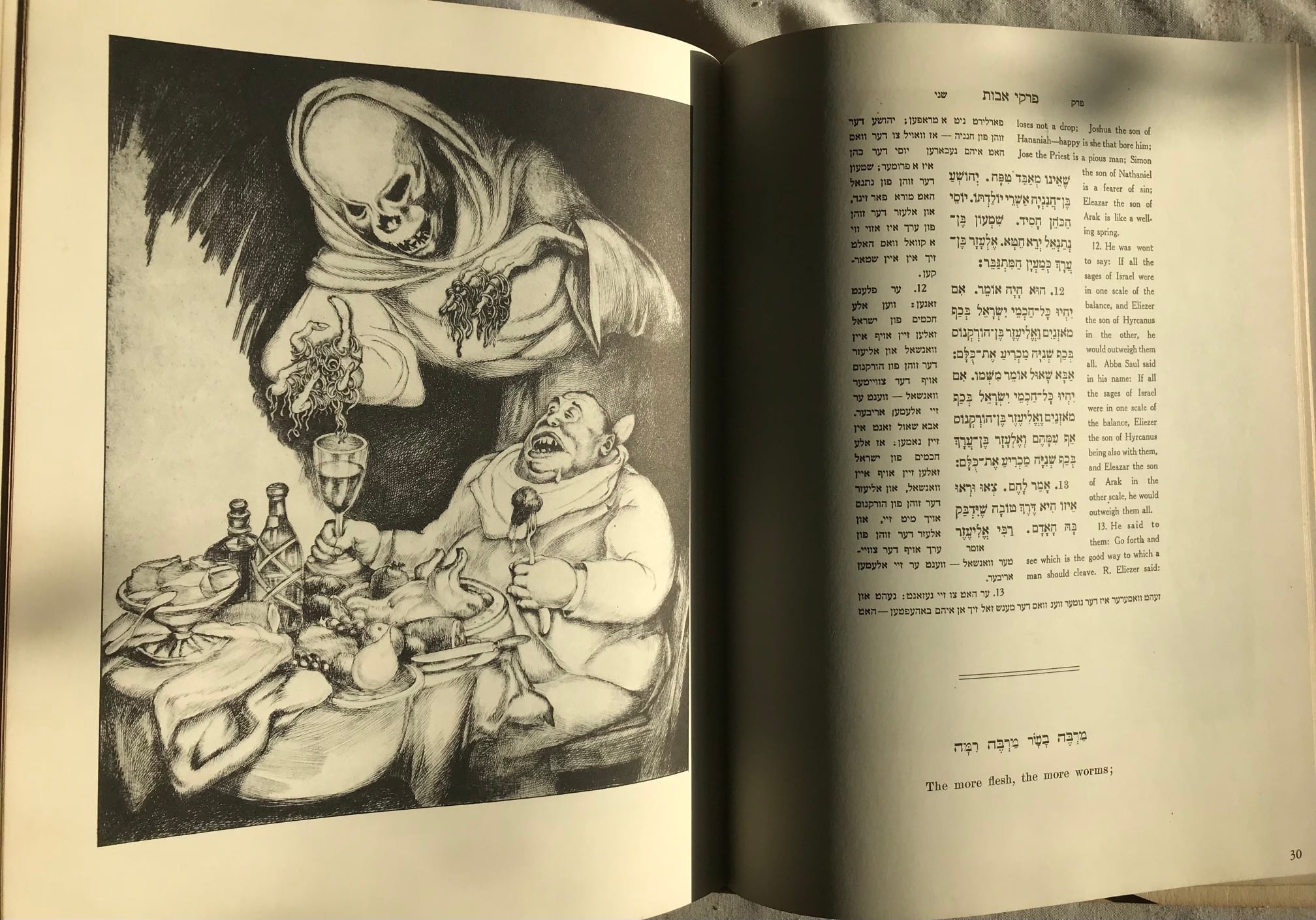
Like matzoh, this book is another fragment of his past life that he held dear in spite of the troubled history. Beyond the stories behind matzoh and hamantaschen, he hardly ever talked to me about the religion of his youth—except this book. He would sometimes mention it, or quote from it, and this particular volume was the only book from the Jewish tradition that he ever pointed me towards. The Pirke Avot, or “Wisdom of the Fathers,” is basically a book of sayings or proverbs that is tucked into the Mishneh (an encyclopedia of Jewish case law that elucidates the application of the Torah’s commandments). While a share of the wisdom in this book emphasizes study of Torah, most of it is straightforward humanist truth, presented in plain but eloquent language. On avoiding excess: “The more flesh—the more worms.” On the need to do right: “It is not your lot to complete the work; nor is it yours to desist from it.” A seventy-five year old man could find many opportunities to drop these nuggets of truth on an eight year old grandkid, even if he were trying to free himself from the chains of his past religion.
Today, here am I, _hineni_, a Jew. The religion I adopted (and that adopted me) in the late 20th century, is different from the religion my granddad fled, as practiced in the late 19th century. G_d has seen much since then: industrial war, the triumph of science, the Shoah, the overwhelming interconnectedness of the entire world, the threat of humanity’s suicide from nuclear weapons and climate change. It seems that all religions have some statement that they are eternal and unchanging, but this is advertising copy. Having studied biology all my days, I am used to seeing the evolution, succession, and extinction of organisms, while genes persist—and even genes evolve and change. The organism of Judaism has evolved. This book, the Pirke Avot, is one of its genes that I inherited, along with my Y chromosome, from my granddad.
My practice is different from that of my grandfather’s youth, and the way I read this book is different. It is definitely shallower and less all-encompassing: language is a hurdle I have not overcome, and there are references that do not resonate for me. But it is like music: one can find deep meaning in a Mahler symphony without understanding German poetry or harmonic theory. I read the Pirke and I am still moved, but differently from my grandfather, and in a different world. Our Passover seder still features matzoh ball soup and haroset, but it’s Tom Kha Matzoh Ball and a chunky guacamole.
I don’t think it’s possible to go back to the faith of my grandfather’s youth. My experience of the Divine is far less literal. The Divine’s expectations of me are perhaps different, and what I seek from prayer to It is far less of a physical nature. Manifestations and miracles do not feature significantly in my religion.
And yet…
There is a discordant and disturbing moment towards the end of the Passover seder. After hours of festivity, welcoming strangers, remembering our peoples’ suffering and celebrating deliverance, we rise, open the front door, and look for the prophet Elijah, whose appearance would be a harbinger of the world’s redemption in this age. With this hope-filled gesture, we ask of the Divine,
“Pour out Your wrath upon the nations that do not recognize You,
And upon the kingdoms that do not call upon Your name…
Pour out Your wrath upon them, and let Your burning wrath overtake them.
Pursue them with anger and destroy them beneath the heavens of the Lord.”
This is a difficult piece of the ritual, and its violence always disturbed me. These lines refer to Amalek, whose sin wasn’t apostasy, but that he preyed upon the weak and defenseless, the ones struggling to keep up with the caravan—in modern terms, those whom society is leaving behind. Perhaps we’re admitting that redemption cannot be universal, that there are those so dedicated to evil that the liberation of the world demands their destruction.
Lately the world seems to have turned into a darker and crueler place. Governments have been seized by aspiring autocrats who lust for power and relish cruelty. Demagogues have whipped up fears and violence against people who simply want equality. Oligarchs grow obscenely rich, pulling on the levers of power to accumulate megayachts and spaceships while greasing the skids for others to fall into poverty. Religious zealots work with all of them to enforce an unjust, rigid, and bigoted culture. So much of society seems to be racing to become Amalek, plundering and killing the already weak and defenseless.
These last few years, we have reached this part of the seder, something really uncomfortable happens to me—something that my grandfather rejected, and that I strongly dislike in myself. It comes from a place of exhaustion and diminishing hope. I find myself on the first night of Pesach, standing at my door in a midnight darkness that is as metaphorical as it is literal, actually searching, earnestly and honestly, for Elijah. I am looking hard for the old man, and staring into the dark for that sign that the Divine, with a certain amount of wrath, will reach into the world and make it whole and we will know Shalom.
Next year in Peace!

 Parental artifact #14–a letter of resignation by my grandfather to the American-Russian Institute.


For those who would rather not not squint at Grandaddy’s cursive, here is the text of the letter:

611 9th Street
Santa Monica, Calif
Dec 17 1948
Riva Mucha
Executive Sec., A.R.I.
Dear Miss Mucha
Please present this statement at the meeting of the Board of Directors tomorrow.
I have been a member of the A.R.I of Southern California since its beginning. During this time, I have done what I could to help the Institute in its efforts to maintain and improve cultural relations between the people of the USA and the USSR. This I looked upon as the main function of the ARI. Of late, it appears to me that the institute, through no fault of its own, was placed in the position of an apologist. It is either ignoring or apologizing for acts of barbarism that are committed officially against culture in the USSR.
My own position is that such acts are a threat to society and must be condemned whenever and wherever they occur. It is evident that I can no longer remain a member of this organization. I am therefore resigning from the board of directors and from membership in the ARI as of this day.
Because of the high regard I have for the original ideals of the ARI and for all those who have worked sincerely to carry them out, it is painful for me to take this step. However, in view of the present circumstances, I cannot act otherwise.
Yours sincerely,
(Signed) David Appleman
Grandaddy Appleman was not one to shy away from exposing himself to career risk or losing friendship in order to stand up for his expansively humanist ideals. The turbulence of the twentieth century, and his long migration from shtetl to California academia, gave him plenty of opportunities to test his resolve. He was left-leaning all his life, beginning with socialist Zionism as a kid, and went on to associate with pacifist Quakers, unions, socialists, communists, the Israeli Labor Party and kibbutz movement, and so on. He got into trouble in the ‘50’s and ‘60’s for some of these associations, but thankfully that was still a time when courts protected unpopular speech.
It’s therefore no surprise that he was on the board of the American-Russian Institute of Southern California. I’d never heard of it, but a little reading showed that it was a Soviet-funded organization that worked to bring a positive representation of the USSR to America. It produced a quarterly journal with articles about life on collective farms, the role of women, and socialist-realist artists, as well as books and lectures on similar matters. The presence of many academics, such as my grandfather, gave an air of respectability to the organization, and it did quite well from its founding in the ‘20’s up until the late ‘40’s. It’s worth remembering that the 1930’s were a time when many felt that the future lay either with fascism (which had not yet been completely discredited) or Soviet communism (ditto).
I don’t know when or why my grandfather joined the ARI. I think he was in favor of democracy, but wished it would be more inclusive and socialist. He also must have had some mixed feelings about Russia and the USSR—there were extremely good reasons that his family left the old country, but there must have still been some warm feelings for his birthplace, and wishes for peace.
I also do not know what was the last straw for his association with the ARI. 1948 was a wretched time to be a human being in the USSR. His letter refers to acts of barbarism against culture. Like many Russians, culture was extremely important to Grandaddy, and it’s easy to think of Soviet or Stalinist policies that were barbaric against culture. 1948 saw the “Anti-cosmopolitan campaign,” in which “rootless cosmopolitans”—that is, Jews—were persecuted. Attention was first directed at Jewish artists and intelligentsia, and Jewish contributions to Russian culture were vigorously suppressed.
Even if one ignores antisemitism, and ignores culture, 1948 saw plenty of acts of barbarism by the Soviets. It became increasingly difficult for anyone with clear eyes and a conscience to support the Soviets, and as my grandfather noted, the ARI became primarily an apologist for atrocities. Support for the ARI withered (at the same time that Hoover’s FBI and anti-communists were ascendant), and the national organization mostly ceased to function. The California ARI persisted, thanks to wealthy and dedicated true believers until at least the 1960’s.
Now, three-quarters of a century later, the ARI is unnecessary. Russia has fully committed itself to fascism, but no longer needs to pay apologists to excuse its crimes in an obscuring blizzard of whataboutism. No academics need to be subsidized to lend an air of respectability to ugly suppression. An entire American news organization has happily and voluntarily partnered with Russian fascism, because their values align. An entire American political party has willingly enabled Russian fascism, praising Putin, because its own leader and many of its rank-and-file prefer fascism to the threat of a democracy shared with different people. And, in addition to all these willing apologists, Russia still pumps money and effort into shifting public opinion through propaganda and lobbying organizations like Facebook and the NRA.
There was something, some intolerable action, that forced my grandfather to distance himself from the Soviets. After Grozny, Aleppo, Mariupol, and Bucha, I don’t know if there is anything that will force the American right to distance itself from Putin’s fascist Russia. Just this week, CPAC announced that it would be holding its meeting in Viktor Orbán’s Hungary—Orbán being the lone European leader who has not denounced Putin, instead denouncing the Ukrainian president and all but blaming rootless cosmopolitans for the world’s ills.
My grandfather quit the Soviets, but he never gave up on the people of Russia. He was an admirer of dissidents such as Andrei Sakharov, and did what he could—which was, admittedly, not much. Today, I am myself tied up in knots, trying to distinguish between Russia and Russians. Russia, the state, has published on RIA Novosti an article calling for the elimination of the Ukrainian state and liquidation and exile of its entire governing class and intelligentsia. I strongly urge you to read this (link in comments), and bear in mind Maya Angelou’s admonition that “when people show you who they are, believe them the first time.”
On the other hand, the Russians I’ve known (including many coworkers when I was an academic) were good people, very proud of their history and culture. They were also, largely, ex-pats, who like my grandfather, left Russia for very good reasons. In truth, it seems that Russia has experienced a severe loss of human intellectual capital in the last few weeks. Of those who have stayed, many or most are as thoroughly soaked in nationalist propaganda as any citizen of Berlin or Moscow in 1939. Polls of Russians in Russia show strong support for this action, and for expanding into Poland and the Baltic States. Reading about and seeing pictures of Bucha, it becomes hard to not feel something like hatred for these Russians. As the Ukrainian president Zelinskii said, this is now the face of not just Russia, but the Russian people.
I do not want to hate. I want to hope, as did my grandfather. So, I will note that in Russia, in January, the ten most downloaded apps were picture filters for makeup and some business tools; in March, the top ten are all VPN apps and Telegram. Maybe the truth will get through.
References in comments.

 Parental Artifact #13–a 1901 Atlas that belonged to a great-grandparent (1)


Honestly, I did not know this even existed before we got to the stage of divvying up my parents’ material possessions. Neither of my brothers wanted it. Flipping through it, I observed a note in red pencil on the map of Mexico, pointing at central Michoacán, identifying “Lime production centers.” I figured the book had to have belonged to my great-grandfather. A glance at the inside cover confirmed his ownership.
H. J. Webber was a horticulturalist whose career was largely dedicated to subtropical fruits and who literally wrote the book on citrus (2). Dr. Webber had a full and rich life, doing much for the citrus and avocado industries in California, and rising to such a level of prominence in his field that there is a building named after him on the campus of the University of California, Riverside. Interestingly, he is the person responsible for bringing the word “clone” into the English language in 1903. He needed a word to accurately describe a population that was genetically identical, like a grove of trees that were all grafts from a single parent, so he borrowed the Greek word for “twig,” and published a note in the journal Science (3). He died well before his word found new life in the era of DNA technology.
I don’t know where Dr. Webber lived when he bought this book, but I am pretty sure that he was busy with his career in horticulture. For most of his professional life, he was focused on the importance of germ plasm, collecting, breeding, and improving new cultivars from places near and remote. It amuses me to look through the pages of this atlas, from three generations and a hundred twenty years’ remove, and see where my germ plasm was at that time. Perhaps I have inherited from Dr. Webber a tendency to think too much about population genetics: when I see V’s of geese migrating up and down the western flyway, I see strings of chromosomes, the ebb and flow of the genes that make up a population. I see much the same thing when genetic material from our farm ends up in Australia or Canada or Britain. When I thumb through these pages, I think of the genes that have made me, migrating all over the globe, and weirdly getting together in Southern California.
Biologist me sees the migration of genes; humanist me sees the history of individuals, of interesting people who filled the branches of my family tree (an apt term, given the number of horticulturalists in my ancestry on both sides!). Looking at these pages, it is fascinating to see some of the conditions my people came from—how large or small the towns, under what crown or polity they lived—and how towns have matured to cities and regimes have changed and changed again in that time. So, here are a few pages from this atlas.
San Diego, where my X chromosome comes from, was a lot smaller, and already focused seaward—a great-grandparent worked there for the port. Coming from SoCal, I’m kind of amused by how un-sprawling this view of San Diego is, and can’t help but think about real estate.
Saint Louis is where the original owner of this tome may have resided at the time of its purchase. 1901 saw him finish a doctorate at Washington University, and rejoin the USDA, for which he worked before and after getting his degree. In the surrounding five years he also could be found at research stations in Florida, Washington DC, New York, and Nebraska.
In 1901 some of my genes were in the rough and ready town of Dawson, Yukon Territory, barely a dot on this map, near the Alaska border. A few years before the printing of this atlas, the town boasted over 15,000 residents; the gold that attracted them all had mostly been extracted by 1901 and the town’s population had plummeted, but one of my grandparents stayed long enough to to be half of the first graduating class of Dawson High School.
My Y chromosome comes from an atlas page too much in the news of late, and acquiring yet another layer in a thick sedimentary record of tragedy. The mad dictator that has caused the most recent suffering is, by his own account, inspired by this map, which obliterates almost a dozen sovereign nations and subsumes them all in the Russian Empire. The source town is not shown, but is in the Mohilev [currently Mogilev] Oblast in “West Russia” [currently Belarus].
There are a lot of stories about how those genes migrated and recombined on their way to Southern California, driven by careers, marriages, jobs, itchy feet, and a legitimate fear of death. But there they ended up, and now they are distributed between Los Angeles and Roseburg. For better or worse, it’s likely the end of the line for these particular combinations.
Recently, I was in a vast antique store in Eau Claire, Wisconsin. It had a huge collection of old prints, lithos, engravings, and other papers suitable for framing. Amid the stacks of “Birds” and “Portraits” and “Posters” were drawers of maps, by region. I was amused to see many pages from another edition of this very atlas there, for sale as individual prints. I suppose they are suitable for framing, which would no doubt give Mr. Cram a deal of pride.
If you’d like to see what an American cartographer made of where your germ plasm was in 1901, please: let me know—I’ll try to get a picture of the map and post it here or send it to you. You may find it amusing.
References
(1) Cram, G.F (1901). Cram’s Superior Atlas of the World. George F. Cram, New York.
(2) Webber, H.J. [ed] et al, (1943) The Citrus Industry. University of California Press, Berkeley.
(3) Webber, H.J. (1903). New Horticultural and Agricultural Terms. Science 18 (459), 501-3.

 Parental Artifact #12: a 2004 Toyota Prius.


It amazes me how much our cars can both mirror and shape our stories about our selves. A family’s story can be told in automobiles, in chapters of make, model, and mileage. The procession of vehicles can symbolize vigorous youth, the joys and burdens of family, the midlife crisis, and the compromises of older age. The cars can also illustrate family dynamics, for good or ill—and this is entirely a phenomenon of the last few generations: my grandfather saw the first automobile to roll through his hamlet in the Russian Empire, and the Orthodox Priest tried to exorcise it as it was clearly the Devil’s work.
Sixty years after that, but before I was born, my family lived in Argentina for two years, where my dad was a postdoctoral fellow with Luis Leloir. At that time, every male Argentine who sat in the driver’s seat of any car saw himself as the dashing Formula One champion Juan Manuel Fangio. My parents told us lots of stories about the “assertiveness” of Argentine drivers, treating every street as Monaco or Monza. I think some of this rubbed off on my dad, and only slowly faded away.
My parents returned to the United States with one more child than when they left, and settled down in Los Angeles, city of cars. Before I was born the next year, they purchased a VW camper van. This underpowered shoebox definitely tempered my dad’s internal Fangio. It was a good vehicle for who we were at the time. Over thirteen years and three engines, it took us all over the West on camping trips, hauled garden and home supplies, and ferried me and my brothers around, all while driving back and forth to USC every day. My dad personalized it: he installed a doorbell under the bumper that would make a cheerful “brrrrrrrrrrrring”, which is sometimes a more appropriate means of communication than the klaxon’s bray.
The “bus” was followed by a VW Vanagon, which mostly (if less reliably) filled the same role as its predecessor for almost a decade. When there were no longer three sons to be ferried around and taken on camping trips, it was replaced by a Ford Bronco. This would allow my parents to go camping, by themselves, in slightly more adventurous places, and I think may have helped my dad express his Fangio as he negotiated midlife. It was also, unfortunately, a horrible vehicle for commuting. As my parents aged and interest in “roughing it” waned while the need to get back and forth to work persisted, the Bronco was sold to the woman who was my grandfather’s caregiver at the end of his life, and my parents got a practical Honda Civic Wagon.
If my parents’ story were told in cars, there’s a significant chapter that exists only in fragments, like an ancient text, but is nonetheless illustrative of my parents’ life: a yellow VW Rabbit.
It seemed normal to me as a kid that my mom didn’t drive. I know my mom was in some ways quite old-fashioned. She came of age before “women’s lib,” and was accustomed to limits on life that seem absurd today. For instance, she didn’t have a credit card for a very long time, and generally preferred my dad charging things. When I was young, she mostly stayed home with my brothers and me, and because most things in our town were within walking distance, a car wasn’t necessary.
Apparently, when I was very young, she had made a bid for a driver’s license. What I remember hearing was that my dad, and his dad (the same one who saw a terrified priest attempt to exorcise an early automobile), offered to teach her—which is a circumstance absolutely fraught with peril for a relationship. I do not know if they went through with this scheme or not, but I do remember that even the discussion left lasting damage, one of the very few patches of rough water in the outwardly calm stream of their marriage.
Last year I was emptying a four-drawer filing cabinet of their financial records dating back to the late 1960’s, and to my surprise found a couple of credit card slips (from my dad, of course) and a booklet from a driver training class for Irma Appleman. It was not the whole course, and I know nothing of the circumstances surrounding it. I just know that it didn’t go to completion, and my mom never got a license.
Years later, having three sons in elementary school, junior high school, and high school, my parents again considered the notion of my mom learning to drive and getting a second car. By this time, it was also much more normal for a wife to have her own wheels and the liberty to drive (if it is liberty to be constantly schlepping children to this or that appointment!). I remember my mom going far enough along in this idea to posit that she’d want a cute, yellow VW Rabbit.
I think the trauma of driving lessons from my dad (still somewhat possessed by the spirit of Fangio), and a bit of timidity about asserting herself in a domain that she still viewed as masculine, ultimately prevented this from happening. And so, until the last time she rode in a car, my mom sat in the passenger seat—in the bus, in the Vanagon, in the Bronco, in the Civic.
The last car my parents had was this Prius. The days of adventurous camping were fewer, although the car did make a few trips along the rutted dirt roads of Anza Borrego State Park and to UC Hiking Club reunions. Mostly, it went back and forth to USC, shopping, doctor’s offices, nurseries, and the like. After a couple of embarrassing mishaps as the fog of Alzheimer’s Disease thickened, my dad laid to rest the spirit of Juan Manuel Fangio and didn’t drive any more. I don’t think he was upset about it; I honestly don’t think he remembered driving, other than a sense that he had to be somewhere else but couldn’t figure out how to get there. Duva and I bought the car in 2011—my dad’s writing and signature on the transfer is feeble—years after my dad’s drivers license had expired.
The Prius has served us well, and marks a chapter in our life. Duva has used it as a commuter. It has been a trouper on long drives to Los Angeles and back. When we lived in Sacramento, it took us skiing and biking all over. It has carried dozens of goats for us, new arrivals to the farm and those we have sold. A couple of weeks ago, as Duva was driving to work, she swerved to avoid a deer that leapt into the highway. As she did so, a second deer walked into the road. Duva was unhurt. The deer died. So, too, did the Prius. After a minute the electrical systems shut down and the car was inert. The insurance company says it is a total loss, and so we have accepted an inadequate-seeming check and are using it to buy about a tenth of a new car.
Those possessions of my parents that have become mine evoke a wide range of emotional responses: mild appreciation, nostalgia, wonder, historical reflection, aesthetic awe, gratitude and more. I don’t like cars. I tolerate them for their utility. However, I find myself more than a little surprised that the loss of this car is causing me sadness. There’s the loss of a familiar object, but there’s also the abrupt severing of a direct tie to an object that carried some of my parents’ identity. The cars in our life are like chapters in our story, and this chapter in our life is over and we move on to the next one. But, in my parents’ story of their life, as told in cars, this is the end of the book.